APR vs Interest Rate: What the Difference Means for Your Loan
A lower interest rate does not always mean a cheaper loan. See how APR folds fees into one comparable number, how it is calculated, and why the loan term changes what a fee really costs.

A lender offers you 20,000 at 9%. Another offers the same amount at 10%. The first looks cheaper, but if it comes with a 600 origination fee, it is not. The interest rate tells you what the lender charges on the balance; the APR (annual percentage rate) also counts the fees, so you can compare offers on one number. This guide explains how APR is worked out, when it helps and where it can mislead you.
Interest rate and APR in one sentence each
- The interest rate is the price of borrowing the balance. It sets your monthly payment.
- The APR is the yearly rate that links what you actually receive with what you actually pay back, once one-time fees are counted.
With no fees, the two are the same. Every fee you pay to get the loan pushes the APR above the interest rate.
How APR is calculated
APR is not the interest rate plus the fee as a percentage. It is found in three steps.
- Work out the payment from the loan amount, the interest rate and the term, with the standard formula M = P × r ÷ (1 − (1 + r)^−n), where r is the monthly rate and n the number of months.
- Work out what you really get. If a 600 fee is taken from a 20,000 loan, 19,400 lands in your account, but you still repay the payment on 20,000.
- Find the rate that links the two. Look for the monthly rate at which 19,400 would be paid off by exactly those payments over the same number of months. Multiply it by 12 and you have the APR.
Step 3 has no neat formula, so calculators solve it by trial: try a rate, see whether the payment comes out too high or too low, and narrow the range until it fits.
A worked example
Take a 3-year personal loan of 20,000 at 9% with a 3% origination fee (600) paid upfront:
- Monthly payment: 635.99 for 36 months, a total of 22,895.81.
- Total interest: 2,895.81.
- Money you receive: 19,400.
- APR: about 11.09%.
- Interest and fees together: 3,495.81.
The 600 fee adds just over two percentage points to the rate. That is the honest price of this loan compared with one that has no fee.
What if the fee is financed?
Some lenders add the fee to the balance instead. You then borrow 20,600, receive the full 20,000 and pay 655.07 a month. The APR is slightly lower at about 11.03%, but the fee now costs 686.87 rather than 600, because you pay interest on it for three years. Interest and fees together rise to 3,582.68. Paying the fee in cash is cheaper overall if you can; financing it only spreads the cost out.
Comparing three offers by APR
Here are three offers for the same 20,000 over 3 years:
- Offer A: 10%, no fee. Payment 645.34, APR 10.00%, interest and fees 3,232.37.
- Offer B: 9%, 600 fee. Payment 635.99, APR 11.09%, interest and fees 3,495.81.
- Offer C: 8.5%, 900 fee. Payment 631.35, APR 11.67%, interest and fees 3,628.63.
Offer C has the lowest rate and the lowest payment, yet it is the most expensive by almost 400. The APR ranks the three in the right order; the interest rate and the payment rank them backwards.
Why the term changes the APR
A fee is a one-time cost, and the APR spreads it over the life of the loan. The shorter the loan, the fewer years share the fee and the higher the APR. Here is the same 20,000 at 9% with a 600 fee over different terms:
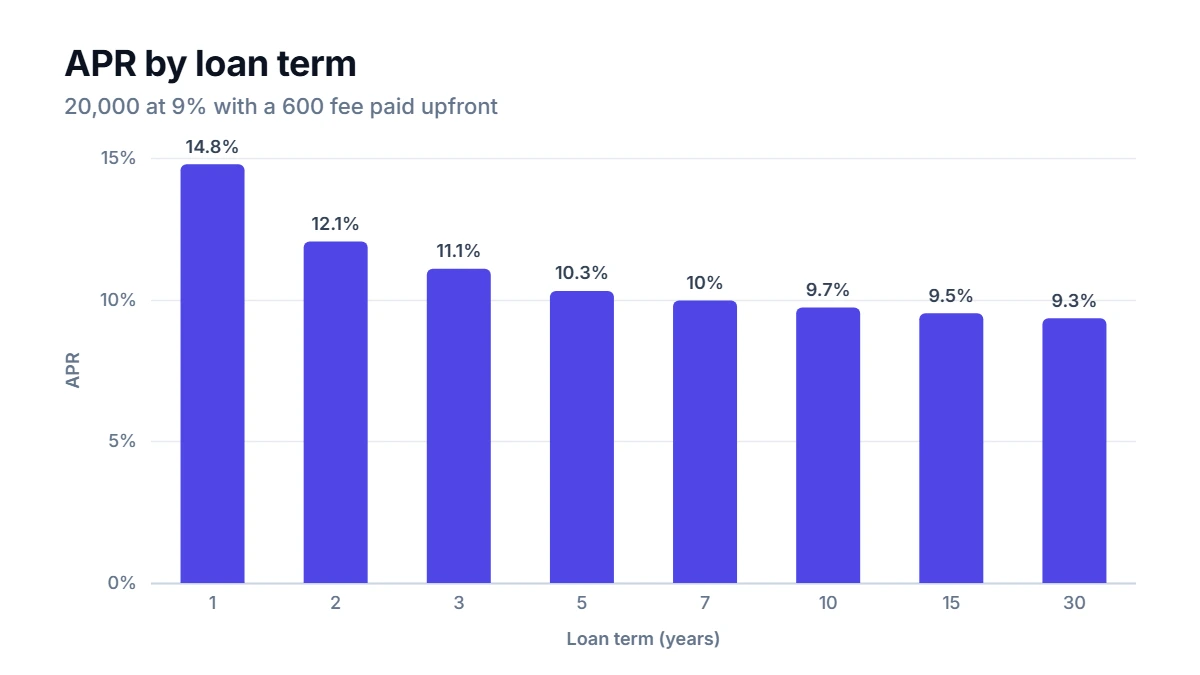
- 1 year: 14.78%
- 3 years: 11.09%
- 5 years: 10.31%
- 10 years: 9.72%
- 30 years: 9.34%
This cuts both ways. The APR assumes you keep the loan for the full term. If you pay off a 5-year loan after two years, the fee was spread over only two years and your real cost was closer to the 2-year figure of 12.05%. If you expect to repay early or refinance soon, a no-fee loan at a slightly higher rate often wins.
How to use the APR Calculator
Enter the loan amount, the interest rate the lender quotes and the term in years, months or both. Add the one-time fees and choose whether they are paid upfront or financed into the loan. The APR Calculator then shows the monthly payment, the APR, the amount you receive, the total interest, what the fees really cost and the combined cost of borrowing. Run it once for each offer and compare the APR and the "interest and fees" line side by side.
Common mistakes
- Adding the fee percentage to the rate. A 3% fee on a 3-year loan added about 2.1 points here, not 3. On a 10-year loan it adds much less.
- Comparing a rate with an APR. Ads often show the lowest headline rate. Compare APR with APR.
- Assuming every cost is in the APR. Which fees must be included in an official APR depends on the country and the loan type, so check current rules and ask the lender what is included. Late fees and optional insurance are usually left out.
- Mixing up APR and the effective annual rate. The APR here is the monthly rate times 12. The effective annual rate also counts compounding within the year and is higher: about 11.68% for the example loan.
These figures are estimates for comparing offers, not financial advice. The lender's official disclosure is the final word.
FAQ
Can the APR be lower than the interest rate?
Not on a normal loan with fees. Fees can only shrink what you receive, so the APR is equal to or higher than the rate. If an offer shows an APR below its rate, a lender credit or rebate is probably involved, and it is worth asking how the figure was worked out.
Does APR matter on a credit card?
Most credit cards have no upfront fee to spread, so the card's APR is simply its yearly interest rate on the balance. The comparison trick in this guide matters most for installment loans with origination or processing fees, such as personal loans, car loans and mortgages.
What is a discount point?
On a mortgage, a point is an optional upfront fee, usually 1% of the loan, paid to get a lower interest rate. It works like the larger fee in Offer C: it lowers the payment but only pays off if you keep the loan long enough. The APR shows the trade-off over the full term.
Why do two lenders quote different APRs for the same rate?
Because their fees differ. Two 3-year loans at 9% with fees of 0 and 600 have APRs of 9% and about 11.09%. The rate alone would never tell you that.

