How CDs Work: Interest, Penalties and CD Ladders
A certificate of deposit trades access to your money for a fixed rate. See how CD interest is calculated, what an early withdrawal really costs month by month, and how a CD ladder keeps part of your savings within reach.

A certificate of deposit (CD) is one of the simplest deals in banking: you lend the bank a fixed sum for a fixed time, and the bank promises a fixed rate in return. The catch is that your money is tied up until the term ends. Knowing how the interest is calculated, how much an early exit really costs, and how to stagger several CDs helps you decide whether that trade is worth it.
What you agree to when you open a CD
A CD has four terms that matter:
- Deposit: the amount you put in on day one. Most CDs do not accept additions later.
- Term: how long the money stays in, commonly from 3 months to 5 years.
- Rate: usually advertised as an APY (annual percentage yield), fixed for the whole term.
- Early withdrawal penalty: what the bank keeps if you take the money out before the maturity date, often expressed as a number of months of interest.
In return for locking your money away, a CD often pays more than a regular savings account and, unlike a savings rate, the CD rate cannot drop during the term. If rates rise after you open it, though, you are stuck with the old rate until it matures.
APY, APR and compounding
Banks add interest to a CD daily, monthly or quarterly, and each addition then earns interest of its own. The APR (or plain interest rate) is the yearly rate before that compounding. The APY is what you actually earn over a year once compounding is included:
APY = (1 + APR / n)^n − 1, where n is the number of compounding periods per year.
Because the APY already includes compounding, it is the right number to compare CDs with. A 4.5% APY compounded daily corresponds to an APR of about 4.4020%; compounded monthly, about 4.4098%. Different APRs, same yield.
The balance after t months is then:
Balance = deposit × (1 + APY)^(t / 12)
Worked example: 10,000 for different terms
Assume a 4.5% APY. That rate is only for illustration; check what banks offer today, because CD rates change often. Holding the rate fixed across terms shows the effect of time alone:
- 6 months: balance 10,222.52, interest 222.52
- 12 months: balance 10,450.00, interest 450.00
- 24 months: balance 10,920.25, interest 920.25
- 36 months: balance 11,411.66, interest 1,411.66
- 60 months: balance 12,461.82, interest 2,461.82
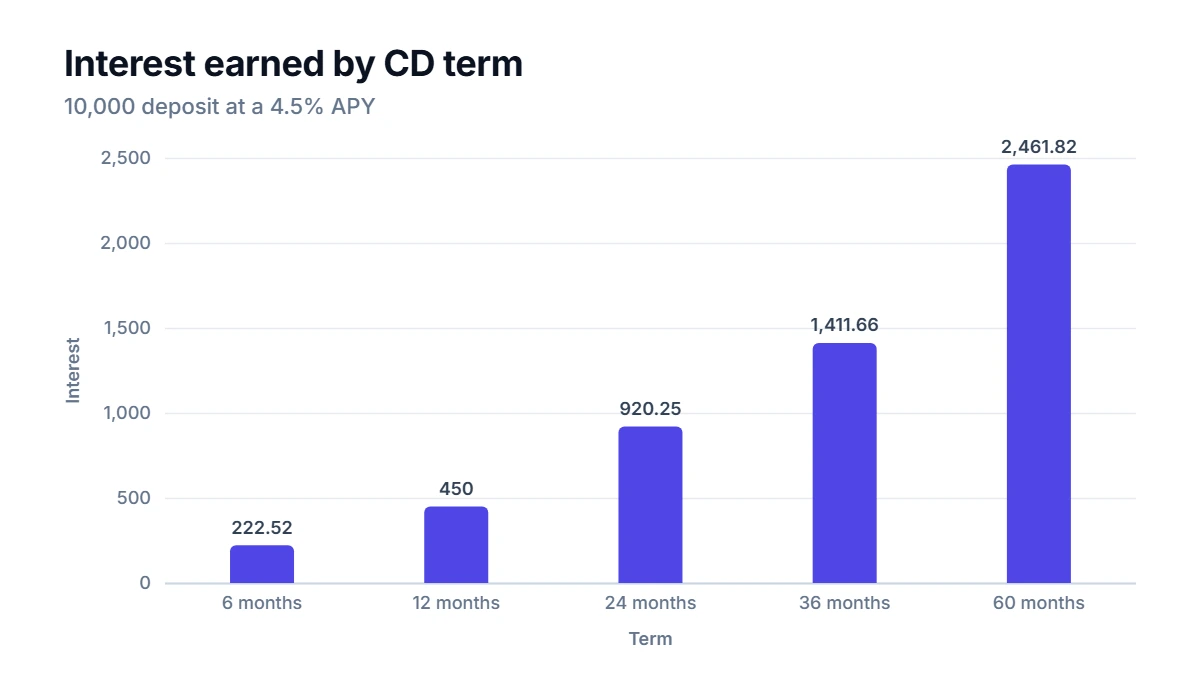
The five-year CD earns more than five times the one-year interest, because interest in later years is earned on a bigger balance. In real life longer CDs may pay a higher or a lower rate than shorter ones, depending on what markets expect interest rates to do.
What tax does to the result
CD interest is usually taxable. If your tax rate on interest were 22%, the 450 earned over 12 months would cost 99 in tax and leave 351. Tax rules and rates vary by country and change over time, so check current rules for your situation.
The real cost of breaking a CD early
Penalties are often described as "three months of interest" or "six months of interest." A common way to estimate them is simple interest on the deposit at the APR:
Penalty = deposit × APR × penalty months / 12
For our 12-month CD with a six-month penalty, that is 10,000 × 0.044020 × 6 / 12 ≈ 220.10.
The key point is timing. Early in the term you have earned less interest than the penalty, so the difference comes out of your deposit. With the six-month penalty:
- After 1 month you would get back about 9,816.65, a loss of 183.35.
- After 5 months, about 9,965.00, still below your deposit.
- After 6 months, about 10,002.42, just above it.
- At maturity there is no penalty and you receive the full 10,450.00.
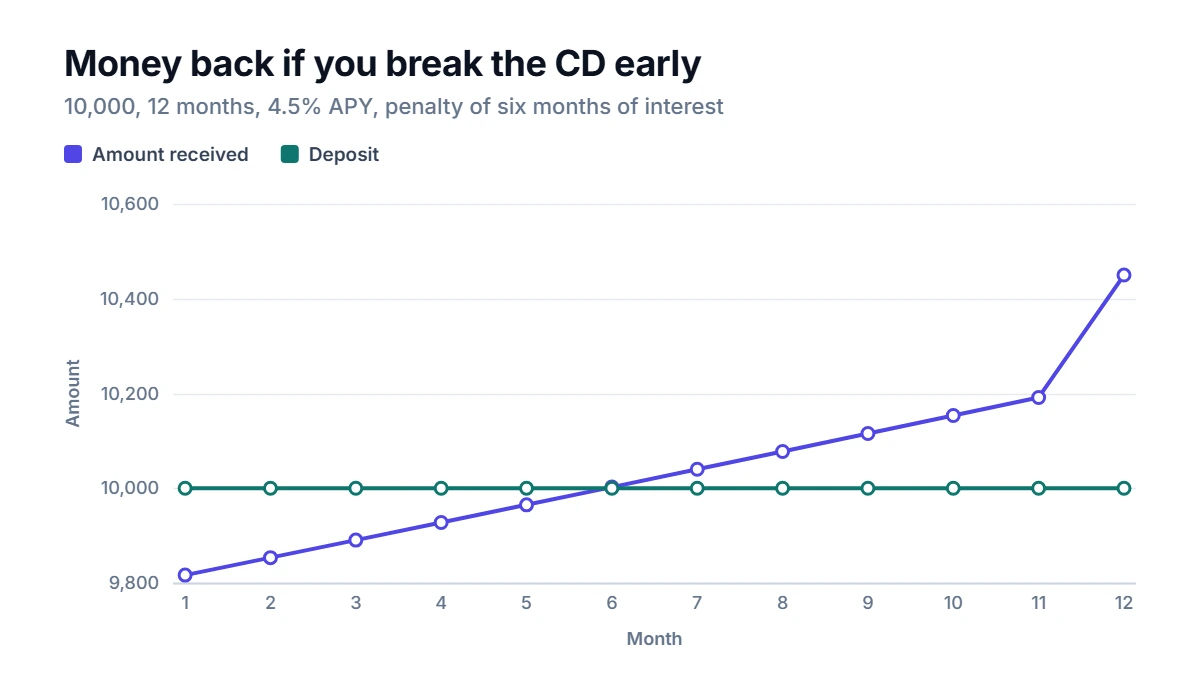
With a three-month penalty the break-even comes sooner: about 10,000.60 after month 3. Banks calculate penalties in different ways, so read the account terms before you sign.
CD ladders: earning more without locking everything up
A ladder splits your money across several CDs that mature at different times. Instead of one 10,000 five-year CD, you open five CDs of 2,500 with terms of 1, 2, 3, 4 and 5 years. At the same 4.5% APY they would mature at:
- Year 1: 2,612.50
- Year 2: 2,730.06
- Year 3: 2,852.92
- Year 4: 2,981.30
- Year 5: 3,115.45
Each time a rung matures, you can spend the money or roll it into a new five-year CD at the end of the ladder. After the first few years, you have a CD maturing every year, most of your money earns longer-term rates, and you never wait more than a year for access to part of it. It also smooths out rate changes: you are never betting your entire balance on one moment's rate.
How to use the calculator
The CD Calculator takes the deposit, term in months, the rate, and whether that rate is an APY or an APR, plus the compounding frequency. Two optional fields cover the penalty in months of interest and your expected tax rate on interest. It returns the balance at maturity, the interest, both forms of the rate, and a month-by-month table that includes what you would get back if you withdrew early. To plan a ladder, run it once per rung and add the results.
These results are estimates, not financial advice. They assume the rate stays fixed and the interest stays in the CD.
FAQ
What happens when a CD matures?
Most banks give you a short grace period, often around a week or two, to withdraw the money or change terms. If you do nothing, many CDs renew automatically for the same term at whatever rate the bank offers then, which may be lower. Put the maturity date in your calendar.
Is a CD better than a high-yield savings account?
It depends on whether you need access. A savings account lets you withdraw any time, but its rate can change at any time. A CD locks in a rate for the term in exchange for that flexibility. Many people keep their emergency fund in savings and put money they will not need for a while in CDs.
Can I lose money in a CD?
The deposit itself does not go up and down with markets. You can end up with less than you put in if you withdraw early enough that the penalty exceeds the interest earned. Inflation can also reduce what the money buys. Deposit insurance limits vary by country and bank, so check the current rules for yours.
Should I choose monthly or daily compounding?
If you are comparing offers by APY, the compounding frequency is already accounted for. Two CDs with the same APY pay the same amount over a year, whatever their compounding schedule.

