How Compound Interest Works (With Real Numbers)
Compound interest turns small, steady savings into large sums over time. See exactly how it works, why starting early matters so much, and how much compounding frequency really adds.

Compound interest is interest that earns interest. Each time interest is added to your balance, the next round of interest is calculated on that bigger balance, so growth speeds up the longer you leave the money alone. It is the reason a modest monthly saving habit can turn into a six-figure sum over a working life, and the same mechanism makes unpaid debt grow faster than most people expect.
Simple interest vs compound interest
With simple interest you only ever earn interest on the money you deposited. Put 10,000 in an account paying 7% simple interest and you earn 700 every year, no matter how long you wait. After 30 years you would have 10,000 + 30 × 700 = 31,000.
With compound interest, the 700 earned in year one is added to the balance, so year two pays 7% on 10,700, which is 749. Year three pays 7% on 11,449, and so on. The yearly amount keeps rising. Left for 30 years with interest added once a year, the same 10,000 grows to 76,122.55, about two and a half times the simple-interest result.
The pieces that drive growth
Four inputs decide how much compounding does for you:
- The starting amount. More money at the start means more money earning interest from day one.
- Regular contributions. Every deposit starts its own small compounding snowball.
- The interest rate. A higher rate makes each round of interest larger.
- Time. This is the input most people underestimate. Interest from early years keeps earning in every later year, so the last decade often adds more than the first two combined.
How often interest is added (the compounding frequency) also matters, but much less than you might think. More on that below.
A worked example: 10,000 plus 200 a month
Say you open an account with 10,000, add 200 at the end of every month, and earn 7% a year compounded monthly for 30 years. Here is what the Compound Interest Calculator shows:
- Final balance: 325,159.17
- Total you put in: 82,000.00 (the 10,000 start plus 360 deposits of 200)
- Total interest earned: 243,159.17
Interest makes up roughly three quarters of the final balance. The year-by-year table tells the story of how that happens:
- Year 1: you deposit 2,400 and earn 801.42 in interest. The interest is small next to your own deposits.
- Year 7: for the first time, the interest earned in a single year is larger than the 2,400 you add that year.
- Year 10: the balance is 54,713.58 and the year's interest is 3,600.02.
- Year 16: the total interest earned so far passes the total amount you have deposited.
- Year 20: the balance is 144,572.72 and that year alone earns 9,658.02 in interest.
- Year 30: the final year earns 21,832.53 in interest, more than nine times your yearly deposits.
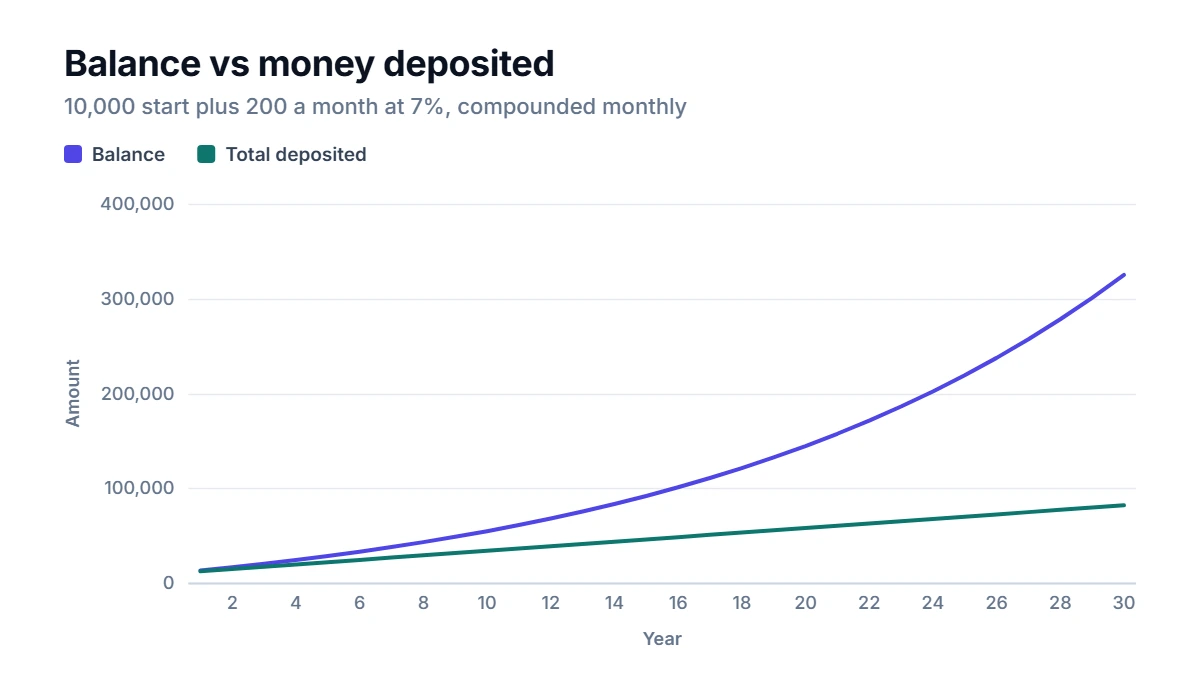
The gap between the two lines in the chart is the interest. It is thin for the first decade and then widens fast. That shape, flat at first and steep later, is what compounding always looks like.
Why starting early beats saving more
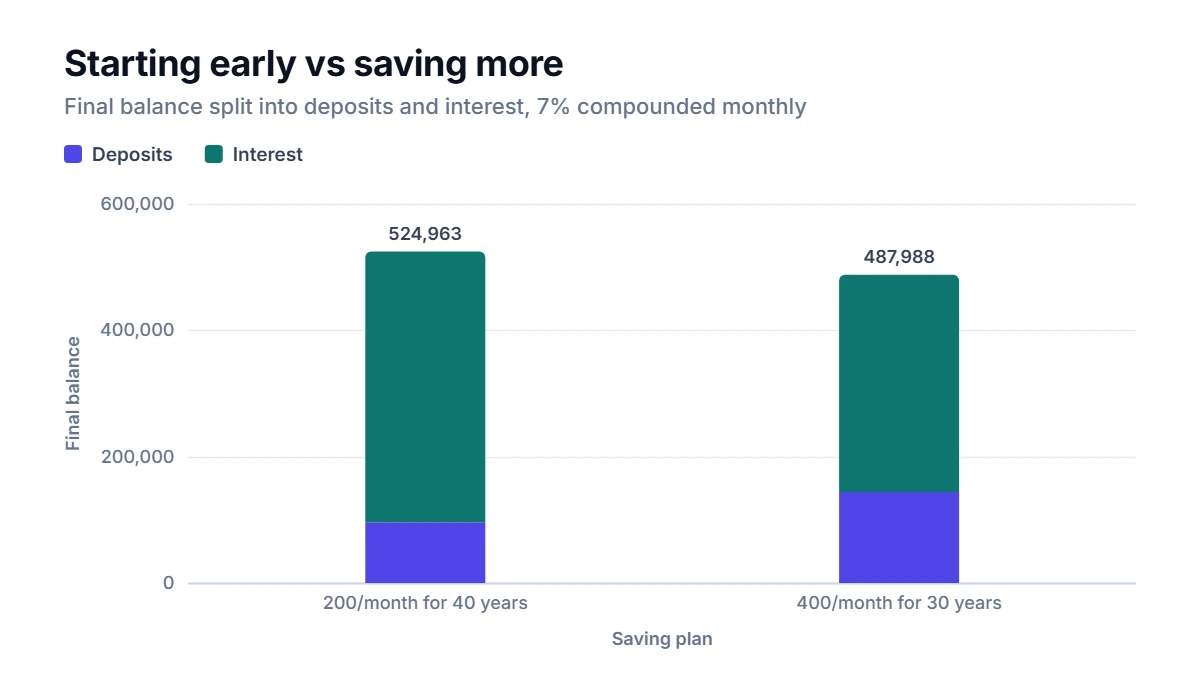
Compare two savers who both earn 7% compounded monthly:
- Saver A puts away 200 a month for 40 years. Total deposited: 96,000. Final balance: 524,962.68.
- Saver B waits ten years, then saves twice as much, 400 a month for 30 years. Total deposited: 144,000. Final balance: 487,988.40.
Saver B deposits 48,000 more and still ends up with less. The extra ten years give Saver A's early deposits time to compound, and that time is worth more than doubling the monthly amount later.
How much compounding frequency matters
Banks may add interest yearly, quarterly, monthly or daily. Here is a single deposit of 10,000 at 7% for 30 years with no further contributions:
- Annually: 76,122.55
- Quarterly: 80,191.83
- Monthly: 81,164.97
- Daily: 81,645.26
Moving from yearly to monthly compounding adds about 5,000 over 30 years, but going from monthly to daily adds less than 500. Once compounding is monthly or more frequent, the rate itself and the number of years matter far more. When you compare accounts, look at the annual percentage yield (APY), which already includes the effect of compounding, so two offers can be compared directly.
The rule of 72
To estimate how long money takes to double, divide 72 by the annual rate. At 7% that is 72 / 7 ≈ 10.3 years. The exact answer for yearly compounding is about 10.2 years, so the shortcut is close enough for planning. At 3% doubling takes about 24 years, and at 10% about 7.
Common mistakes and things to keep in mind
- Ignoring inflation. A balance of 325,159 in 30 years will not buy what 325,159 buys today. If prices rose 3% a year, it would have the buying power of roughly 134,000 today. Use a rate after inflation if you want results in today's money.
- Assuming a steady rate. Savings rates change and investment returns go up and down. A fixed rate is a useful planning assumption, not a promise.
- Forgetting taxes and fees. Tax on interest and account or fund fees reduce the effective rate. Even a 1% yearly fee makes a large difference over decades. Check current rules for how your account is taxed.
- Stopping contributions early. Pausing deposits in the early years costs more than it seems, because those deposits would have had the longest time to grow.
All results are estimates based on the numbers you enter. They are not financial advice.
FAQ
Is compound interest the same as APY?
Not quite. The interest rate (often called the nominal or APR rate) is the yearly rate before compounding. APY is the rate you actually earn in a year once compounding is included. A 7% rate compounded monthly gives an APY of about 7.23%.
Can compound interest work against me?
Yes. Credit cards and many loans charge compound interest, so unpaid interest is added to the balance and starts accruing interest itself. The same math that grows savings makes a debt balance grow if you only make small payments.
Does a higher rate or a longer time matter more?
Both matter, but time is the one you can control most easily. In the example above, adding ten years at 200 a month did more than doubling the monthly amount. A higher rate usually comes with more risk, while time costs nothing but patience.
What happens if I deposit at the start of each month instead of the end?
Each deposit earns one extra month of interest, so the final balance is slightly higher. The calculator assumes end-of-month deposits, which gives a slightly conservative estimate.

