How Exponents Work: Rules, Examples and Exponential Growth
What the small raised number really means, the seven exponent rules and where they come from, and why doubling grows faster than anyone expects.

An exponent is a short way of writing repeated multiplication. Instead of 2 × 2 × 2 × 2 × 2, you write 2⁵, or 2^5 on a keyboard. The small raised number says how many times the base appears in the product. That sounds like a small convenience, but exponents are behind compound interest, computer memory sizes, scientific notation, the Richter scale and every "doubles every year" headline you have ever read.
Base, exponent and power
In 3⁴ = 81:
- 3 is the base, the number being multiplied.
- 4 is the exponent (or index, or power), how many times the base is used.
- 81 is the result, also called "the fourth power of 3".
Two powers have their own names: x² is "x squared", because it gives the area of a square with side x, and x³ is "x cubed", the volume of a cube.
The rules that make exponents useful
Exponents follow a small set of rules. Each one comes straight from counting how many copies of the base are being multiplied, so you never need to memorize them blindly.
- Product rule: x^a × x^b = x^(a+b). Writing 2³ × 2⁴ out gives seven 2s multiplied together, so it is 2⁷ = 128.
- Quotient rule: x^a ÷ x^b = x^(a−b). In 2⁷ ÷ 2³, three of the 2s cancel and four are left: 2⁴ = 16.
- Power rule: (x^a)^b = x^(a×b). (2³)² is 2³ × 2³ = 2⁶ = 64.
- Product to a power: (xy)^n = x^n × y^n. (2 × 5)³ = 2³ × 5³ = 8 × 125 = 1,000.
- Zero exponent: x⁰ = 1 for any nonzero x. Apply the quotient rule to x^5 ÷ x^5: it equals x^0, and anything divided by itself is 1.
- Negative exponent: x^(−n) = 1 / x^n. The quotient rule again: 2³ ÷ 2⁵ = 2^(−2), which is 8 ÷ 32 = 1/4.
- Fractional exponent: x^(1/n) is the n-th root, and x^(p/q) is the q-th root raised to the power p.
The last rule follows from the power rule. If (x^(1/2))² must equal x^1 = x, then x^(1/2) has to be the number whose square is x, which is the square root.
Worked examples
A fractional power. What is 16^(3/4)?
- The denominator 4 means take the fourth root: the fourth root of 16 is 2, because 2 × 2 × 2 × 2 = 16.
- The numerator 3 means cube the result: 2³ = 8.
So 16^(3/4) = 8. Typing 16^0.75 gives the same answer, since 0.75 = 3/4.
A negative base. Signs depend on whether the exponent is even or odd. (−2)⁴ = 16, because four negative factors pair up into positives, while (−2)⁵ = −32. A negative base with a fractional exponent only has a real answer when the denominator is odd: (−8)^(1/3) = −2, but (−4)^(1/2) has no real value, since no real number squared is negative.
Watch the brackets. −2⁴ and (−2)⁴ are different. The usual order of operations applies the exponent first, so −2⁴ = −(2⁴) = −16.
Why exponential growth surprises people
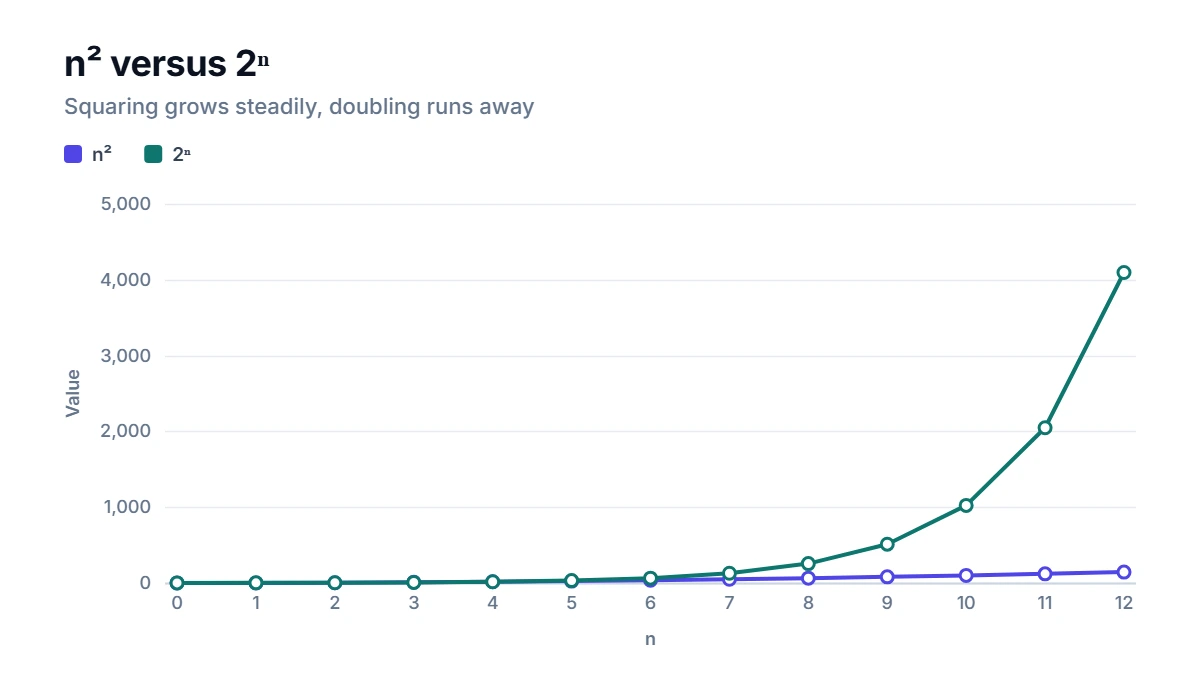
Repeated multiplication grows far faster than our intuition expects. Compare n² with 2ⁿ. At n = 4 they are equal at 16. By n = 10, n² is 100, but 2ⁿ is already 1,024. By n = 12 it is 4,096 against 144.
A classic illustration is folding paper. A typical sheet is about 0.1 mm thick. Each fold doubles the thickness, so after n folds it is 0.1 mm × 2ⁿ. After 10 folds that is about 10 cm. After 42 folds it would be 0.1 mm × 4,398,046,511,104, roughly 440,000 km, farther than the distance to the Moon. You cannot really fold paper that many times, but the arithmetic shows how quickly doubling runs away.
Money works the same way. At 5% growth a year, a balance is multiplied by 1.05 each year. After 10 years that is 1.05¹⁰ ≈ 1.63 times the start, and after 30 years 1.05³⁰ ≈ 4.32 times. Small rates compound into large multiples over long periods.
Solving for the exponent
Sometimes you know the base and the result and want the exponent: how many doublings does it take to pass a million? That is a logarithm. If 2^n = 1,000,000, then n = ln(1,000,000) ÷ ln(2) ≈ 19.93, so 20 doublings are enough. In the same way, 1.05^n = 2 gives n ≈ 14.21: at 5% a year, money doubles in a little over 14 years.
Going the other way, finding the base when you know the exponent and the result, is taking a root. x⁴ = 81 has two real answers, 3 and −3, because an even power hides the sign.
How to use the calculator
The Exponent Calculator has three modes. Power raises a base to an exponent and accepts whole numbers, decimals, negative numbers and fractions such as 3/4. Exponent finds n from the base and the result, using logarithms as above. Base finds x from the exponent and the result, listing both signs when they exist. The details panel shows each step.
For whole-number bases and exponents the calculator gives the exact value up to 1,000 digits. For example, 2^64 is exactly 18,446,744,073,709,551,616, a number most ordinary calculators can only show as 1.8 × 10^19.
Good to know
- Exponents are not multiplication. 2³ is 8, not 6. Mixing up 2³ and 2 × 3 is the most common slip.
- (a + b)² is not a² + b². (3 + 4)² = 49, while 3² + 4² = 25. The middle term 2ab is missing.
- Powers of 10 shift the decimal point. 10³ = 1,000 and 10^(−3) = 0.001, which is why scientific notation writes 0.00042 as 4.2 × 10^(−4).
- Computers use powers of 2. 2^10 = 1,024 is why memory sizes come in 1,024-sized steps, and 2^8 = 256 is the number of values a byte can hold.
FAQ
What is the difference between x^2 and 2^x?
In x² the base changes and the exponent is fixed, which gives a parabola that grows steadily. In 2^x the base is fixed and the exponent changes, which gives exponential growth. For large x, 2^x is always far larger.
Can an exponent be a decimal?
Yes. A decimal exponent is a fraction in disguise: 0.5 is 1/2, a square root, and 1.5 is 3/2, the square root cubed. Irrational exponents such as 2^π are defined as the limit of these fractional powers, and calculators evaluate them with logarithms.
Why does a negative exponent not make the result negative?
The minus sign in the exponent means "divide instead of multiply", not "make negative". 5^(−2) = 1/25 = 0.04, a small positive number. The result is only negative when the base is negative and the exponent is odd.
How do I type exponents on a keyboard?
Most calculators, spreadsheets and many programming languages accept the caret: 2^10. Some languages use a double asterisk or a power function instead. In a spreadsheet you can also use a POWER function with the base and exponent as its two arguments.