How Is a Pregnancy Due Date Calculated?
A due date is counted 280 days from the first day of your last period, with adjustments for cycle length, a known conception date or IVF. Here is how each method works, with a worked example and what the date really means.

One of the first questions after a positive pregnancy test is "When is the baby due?" The answer is an estimate built from a simple counting rule that has been used for well over a century. Knowing how that rule works helps you understand why your date might shift after a scan, why "40 weeks" includes two weeks before conception, and why the due date is better thought of as the middle of a window than as a deadline.
The 280-day rule
The standard method counts 280 days, or 40 weeks, from the first day of your last menstrual period (often shortened to LMP). It starts from the period rather than from conception because most people know when their period began but not the exact day they conceived.
This convention has a curious side effect: in the first two weeks of "pregnancy", you are not actually pregnant yet. Ovulation and conception usually happen around day 14 of a 28-day cycle, so the baby itself develops for about 38 weeks, or 266 days.
Naegele's rule: the shortcut
Before calculators, doctors and midwives used a mental shortcut called Naegele's rule: take the first day of the last period, add 7 days, subtract 3 months and add 1 year.
For a last period that started on March 2, 2026: add 7 days to get March 9, go back 3 months to December 9 and move to the next year. Naegele's rule gives December 9, 2026.
Counting exactly 280 days gives Monday, December 7, 2026 instead. The difference comes from month lengths: the shortcut assumes every month averages the same, but the nine months from March to December contain several 31-day months. Depending on the start date, the two methods can differ by a day or two. The Pregnancy Due Date Calculator counts the days exactly.
Adjusting for your cycle length
The 280-day rule assumes a 28-day cycle with ovulation around day 14. Ovulation usually happens about 14 days before the next period, so a longer cycle tends to mean later ovulation and a later due date.
The adjustment is one day per day of difference. With the same March 2 start date but a 32-day cycle, the estimate moves four days later, to Friday, December 11, 2026. A 25-day cycle would move it three days earlier.
When you know the conception date or have IVF
If you know when conception happened, the calculation skips the period entirely: conception date + 266 days. Conception on March 18, 2026 gives a due date of Wednesday, December 9, 2026.
With IVF, the age of the embryo is known precisely, so the rule is transfer date + 266 days − embryo age in days. For a transfer on March 20, 2026:
- A day 5 embryo (blastocyst) gives Sunday, December 6, 2026.
- A day 3 embryo gives Tuesday, December 8, 2026.
The day 5 embryo is two days further along on the day of transfer, so its due date is two days earlier.
How the weeks and trimesters are counted
Once the due date is set, every other date is counted from an adjusted start date 280 days before it. For our March 2 example with a 28-day cycle:
- First trimester ends at 13 weeks 6 days: Sunday, June 7, 2026.
- Second trimester ends at 27 weeks 6 days: Sunday, September 13, 2026.
- Full term begins at 39 weeks 0 days: Monday, November 30, 2026.
- Estimated due date at 40 weeks 0 days: Monday, December 7, 2026.
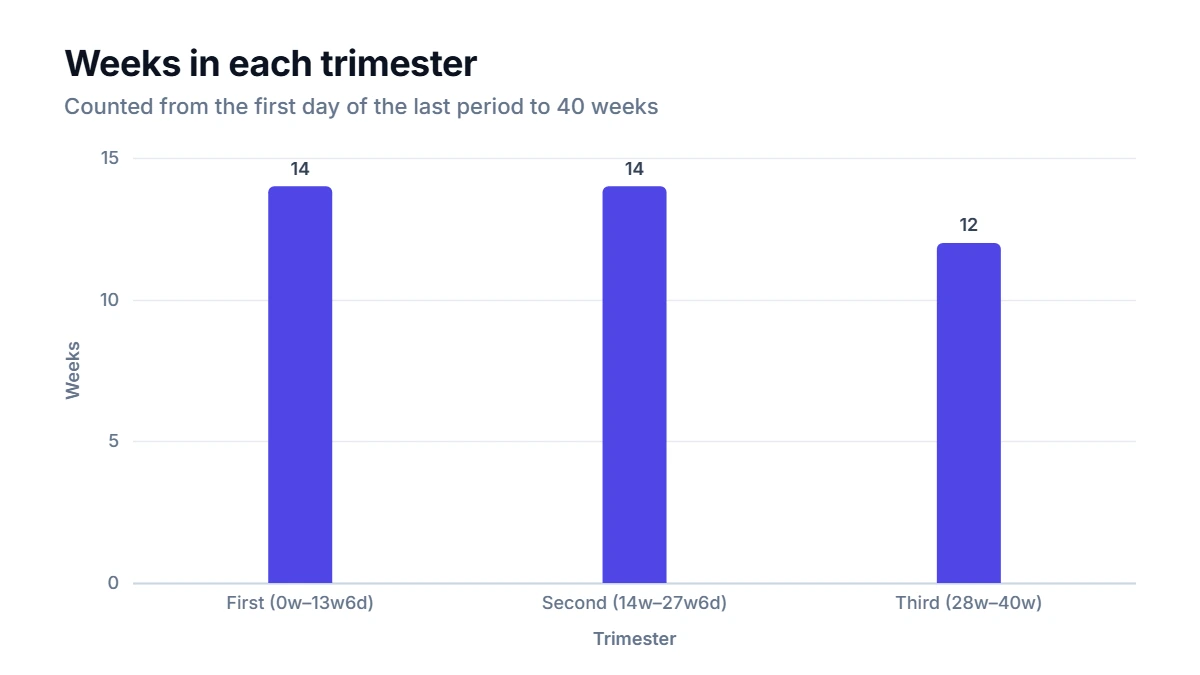
Weeks are written as completed weeks plus days. On June 15, 2026, the same pregnancy is 105 days along, which is written 15 weeks 0 days, and it is in the second trimester. "15 weeks" means 15 full weeks have passed, so you are in your sixteenth week.
How to use the due date calculator
Choose the method that matches what you know: last period, conception date or IVF transfer. For the last-period method, enter the first day of the period and your usual cycle length; use 28 if you are unsure. For IVF, enter the transfer date and choose a day 3 or day 5 embryo. The result shows the estimated due date, how far along you are today, the current trimester and the milestone dates above.
What the due date really means
A due date marks the point at which a pregnancy reaches 40 weeks, not the day labor is expected to start. Only a small share of babies arrive on that exact day. Most are born in the weeks around it, which is why many people find it helpful to think of a due month rather than a due date.
Your care provider may also change the date. An ultrasound in early pregnancy measures the baby directly and is often more reliable than period-based dating, especially with irregular cycles or an uncertain start date. If the scan and your calculated date disagree, the scan usually wins.
This article and the calculator give estimates for general information only. They are not medical advice. Always follow the guidance of your doctor, midwife or fertility clinic.
FAQ
Why does my due date from the clinic differ from the calculator?
Clinics often date a pregnancy from an early ultrasound measurement, which reflects the baby's actual size. If that suggests a different age than your period date, they will usually use the scan-based date for the rest of the pregnancy.
Does a leap year change the due date?
No. The calculation counts 280 actual days, so if February 29 falls inside the pregnancy, it is simply one of those days. Shortcuts like Naegele's rule ignore it, which is another reason they can be a day off.
What if I do not remember the first day of my last period?
Use the closest date you are reasonably sure of, or the conception date if you know it, and treat the result as a rough guide. An early dating scan can then give a more accurate estimate.
Is 40 weeks the same as nine months?
Roughly. Forty weeks is 280 days, which is a little over nine calendar months. Because pregnancy is counted from the last period, the baby's actual development time is closer to 38 weeks.
