How Long Will It Take to Pay Off Your Loan?
If you know what you can pay each month, you can work out exactly when a debt will be gone and what it will cost. See how the payoff time is calculated and why a slightly bigger payment shortens it so much.

Most loan tools start with the term and tell you the payment. Real life often works the other way around. You know you can spare 400 a month, and you want to know when the debt will be gone. That question has a precise answer, and the answer is often surprising: a modest increase in the payment can take years off the loan.
What happens each month
Every month, two things happen to the balance:
- Interest is added: balance × monthly rate, where the monthly rate is the annual rate divided by 12.
- Your payment is subtracted.
Whatever is left of the payment after the interest reduces the debt. That leftover is what really drives the payoff time, and it is why the payoff time reacts so strongly to the payment size.
Take a balance of 15,000 at 9% a year. The monthly rate is 0.75%, so the first month's interest is 15,000 × 0.0075 = 112.50. A payment of 250 therefore reduces the debt by only 137.50 in the first month. A payment of 500 reduces it by 387.50, almost three times as much, even though the payment is only twice as large.
The payoff formula
Repeating those monthly steps until the balance reaches zero gives a closed formula for the number of months:
n = −ln(1 − P × r / M) / ln(1 + r)
where P is the balance, r is the monthly rate and M is the monthly payment.
For 15,000 at 9% with a payment of 400: P × r / M = 112.50 / 400 = 0.28125. Then 1 − 0.28125 = 0.71875, ln(0.71875) ≈ −0.3302 and ln(1.0075) ≈ 0.00747. Dividing gives n ≈ 44.2 months.
You cannot make a fraction of a payment, so the answer is rounded up to 45 months, or 3 years 9 months. The first 44 payments are 400 each, and the final payment covers only what is left: 79.09. In total you repay 17,679.09, of which 2,679.09 is interest.
Notice the term inside the logarithm. If the payment is equal to or smaller than the first month's interest, P × r / M is 1 or more, the logarithm has no answer and the loan never ends. With 15,000 at 9%, any payment of 112.50 or less leaves you paying interest forever.
Payment size versus payoff time
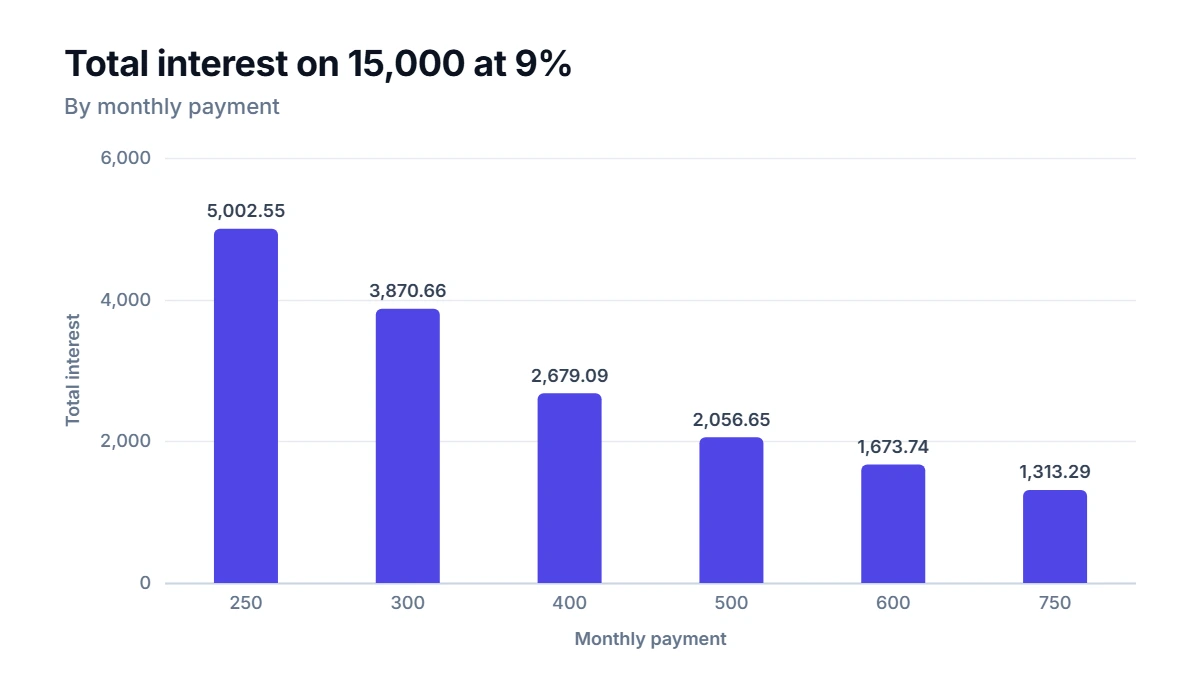
Here is the same 15,000 debt at 9% with different monthly payments:
- 250 a month: 81 months (6 years 9 months), 5,002.55 interest
- 300 a month: 63 months (5 years 3 months), 3,870.66 interest
- 400 a month: 45 months (3 years 9 months), 2,679.09 interest
- 500 a month: 35 months (2 years 11 months), 2,056.65 interest
- 600 a month: 28 months (2 years 4 months), 1,673.74 interest
- 750 a month: 22 months (1 year 10 months), 1,313.29 interest
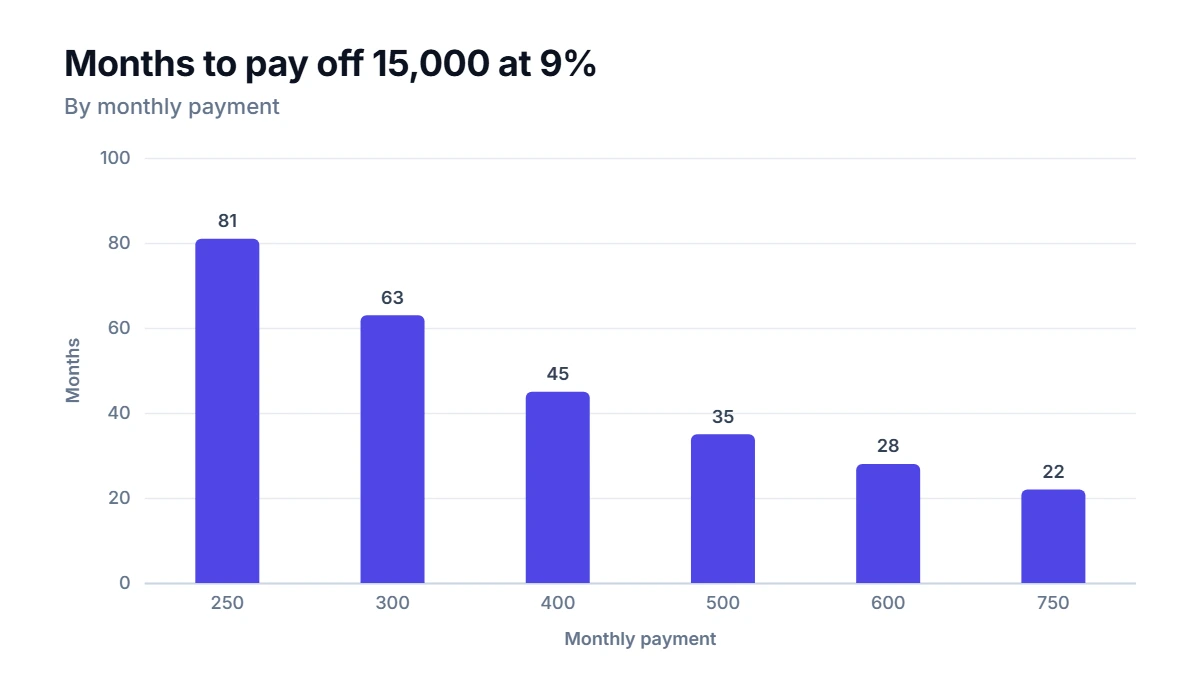
The first 50 of extra payment, from 250 to 300, removes 18 months and saves 1,131.89 in interest. Going from 600 to 750 still helps, but it removes only 6 months. The closer your payment is to the monthly interest, the more each extra unit matters.
Fixed payment or fixed term?
The two questions are really the same loan seen from opposite sides. Asking for a 3-year term on 15,000 at 9% gives a payment of 477.00 and total interest of 2,171.86. Paying 500 instead finishes one month sooner and saves a little more interest.
Which way should you plan? If you are taking out a new loan, the lender sets the term, and the payment follows. If you are paying down an existing balance you can overpay, such as a credit card or a flexible personal loan, thinking in terms of "what can I pay?" is often more useful, because it turns a vague goal into a specific finish date.
How to use the payment calculator
Choose Fixed payment in the Payment Calculator, then enter the balance, the annual interest rate and the amount you plan to pay each month. The result shows how long repayment will take, the final payment, the total paid and the total interest, with a yearly schedule underneath. Switch to Fixed term if you want the payment for a given number of years instead. Try a few payment levels side by side to find the point where the time saved still feels worth the stretch.
Good to know
- Keep the rate honest. Use the rate you are actually charged. If the rate is variable, the real payoff time will change whenever it does.
- Fees and charges added to the balance make the loan last longer than the calculation shows.
- Check overpayment rules. Some loans charge for early repayment or limit how much extra you can pay. Read your agreement or ask the lender.
- Card minimums are not fixed. Credit card minimum payments often shrink as the balance falls, which stretches the payoff time. Paying a fixed amount instead avoids that trap.
The figures are estimates based on a fixed rate and payments at the end of each month, not financial advice.
FAQ
How do I find the payment that clears a debt by a specific date?
Count the months until your target date and use the fixed-term mode with that number of months. The result is the payment you need. If it is more than you can afford, push the date out a few months and check again.
Is it better to pay extra every month or make one large payment?
Both reduce the balance and the interest. Regular extra payments are easier to sustain and start saving interest immediately, while a lump sum saves the most when it is paid early. The best choice is the one you can actually keep up.
Why is my final payment so small?
The payoff time is rounded up to a whole month. The last month only needs to cover the balance that remains plus one month of interest, so it is usually less than a full payment.
Does paying twice a month help?
Splitting the same monthly amount into two halves makes only a small difference with monthly interest. It helps more when the lender calculates interest daily, or when the two halves add up to more than your normal monthly payment over the year.

