How Many Calories Does Exercise Burn? METs Explained
How calorie burn is estimated from MET values, body weight and time, the difference between gross and net calories, and why your watch may show a different number.

"How many calories did that workout burn?" is one of the most asked fitness questions, and the answers you see vary wildly. A treadmill says one number, a watch says another, and a magazine table says a third. Most of these estimates start from the same idea, the MET, and once you know how it works you can judge the numbers yourself and use them sensibly.
What a MET is
A MET (metabolic equivalent of task) compares an activity with sitting still. Sitting quietly is defined as 1 MET, about 1 kcal for every kilogram of body weight per hour. An activity rated 4 METs costs about four times as much energy as resting, and one rated 10 METs about ten times.
Researchers have measured or estimated MET values for hundreds of activities, from vacuuming to rock climbing, and collected them in the Compendium of Physical Activities. Some typical values:
- Watching TV: 1.0
- Hatha yoga: 2.3
- Brisk walking (3.5–3.9 mph): 4.8
- Slow freestyle swimming: 5.8
- Moderate cycling (12–13.9 mph): 8.0
- Running at 6 mph (10 minutes per mile): 9.3
- Jumping rope at a moderate pace: 11.8
The formula
Calories burned depend on three things: how hard the activity is (MET), how much you weigh and how long you do it.
Calories per minute = MET × 3.5 × weight in kg ÷ 200
The 3.5 is the oxygen use of 1 MET, in milliliters per kilogram per minute. The 200 comes from converting oxygen into calories: the body releases roughly 5 kcal per liter of oxygen, and 1,000 mL ÷ 5 kcal gives 200. Multiply the per-minute figure by your minutes and you have the estimate.
Worked example
Take someone weighing 80 kg (about 176 lb) who walks briskly for 45 minutes.
- Per minute: 4.8 × 3.5 × 80 ÷ 200 = 6.72 kcal.
- For 45 minutes: 6.72 × 45 = 302 kcal.
- Per hour, for comparison: 6.72 × 60 ≈ 403 kcal.
Swap the walk for 30 minutes of running at 6 mph and the same person burns 9.3 × 3.5 × 80 ÷ 200 × 30 ≈ 391 kcal: more in less time, because the MET value is almost twice as high.
Gross versus net calories
Those numbers include the energy the body would have used anyway. Sitting for the same 45 minutes would have cost about 1 MET, or 63 kcal. To estimate only the extra calories caused by the walk, use MET − 1 in the formula: 3.8 × 3.5 × 80 ÷ 200 × 45 ≈ 239 kcal. The difference matters most for gentle activities, where the resting part is a large share of the total.
How activities compare
The chart below shows the same 30 minutes for a 70 kg (154 lb) person across popular activities. Intensity makes a big difference: half an hour of jumping rope burns about five times as much as half an hour of yoga.
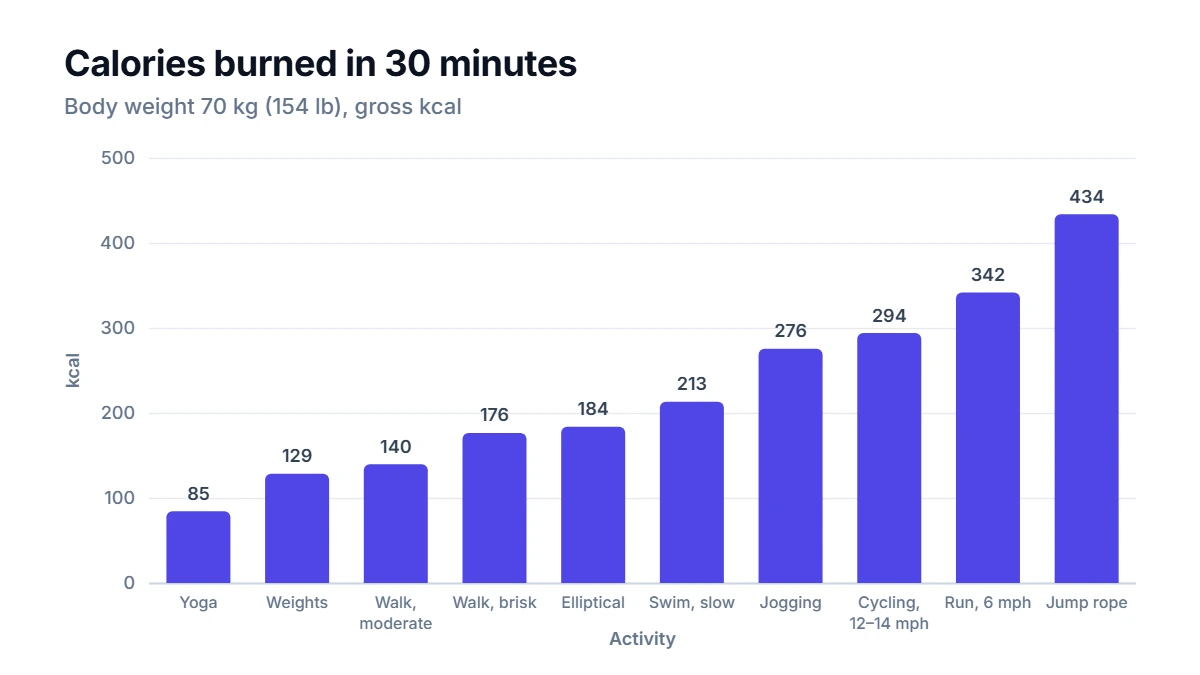
Body weight matters too, and in a simple way: the formula is proportional to it. An hour of brisk walking comes to about 277 kcal at 55 kg, 353 kcal at 70 kg, 428 kcal at 85 kg and 504 kcal at 100 kg. A heavier body takes more energy to move, so the same walk costs more.
How to use the calculator
The Calories Burned Calculator turns this formula into a quick estimate. Choose US or Metric units, enter your body weight, pick one of 45 activities (each shows its MET value) and type the duration in minutes. Press Calculate to see the calories for that time and per hour. The details card then lists ten popular activities for the same weight and duration, which is useful when you are choosing between, say, a swim and a bike ride.
If your effort falls between two entries, such as running at 7 mph, pick the closer one or average the two results.
Why your watch may disagree
MET-based figures are averages for a typical adult. Several things push your real number up or down:
- Fitness and efficiency. A trained runner uses less energy at a given pace than a beginner, because their stride and breathing are more economical.
- Effort, not label. "Weight training" can mean long rests between sets or a fast circuit. The MET value assumes an average session.
- Terrain and conditions. Hills, wind, soft sand, cold water and heavy backpacks all add to the cost.
- Body composition, age and sex. Two people of the same weight can have different resting metabolisms.
- Device methods. Fitness trackers mix heart rate, motion and their own models. Their numbers are also estimates and can differ by 20% or more from each other.
Treat any single figure as a ballpark. What is more reliable is the comparison: if one workout comes out at twice the calories of another, it really is the harder one.
Common mistakes
- Eating back every calorie. Calorie burns from apps and machines are often optimistic, and gross values already include your resting energy. Many people find their weight changes less than the numbers suggest.
- Counting the same calories twice. If your daily calorie target already assumes an active lifestyle, adding exercise calories on top double-counts them.
- Ignoring daily movement. Walking, chores and standing add up over a day. An hour of heavy house cleaning (3.5 METs) costs about as much as an hour of moderate weight training.
- Judging a workout only by calories. Strength training burns fewer calories per minute than running, but builds muscle and bone in ways the number does not capture.
These figures are estimates, not medical advice. If you have a health condition or are starting a hard new routine, talk to a doctor first.
FAQ
Is walking or running better for burning calories?
Per minute, running burns more: about 9.3 METs at 6 mph against 4.8 for a brisk walk. Per mile the gap is smaller, because a walk takes longer to cover the same distance. Walking is gentler on joints and easier to keep up, which can make it the better long-term choice.
Do I burn more calories in cold weather?
A little, if you are cold enough to shiver or your body works to stay warm. Clothing usually prevents most of that effect. MET values do not include it, so the calculator does not either.
Why do two people doing the same class burn different amounts?
Weight is the biggest factor in the formula, so a heavier person burns more. Effort, fitness and technique add further differences the formula cannot see. In a group class, two people can be working at quite different intensities without noticing.
How long do I need to walk to burn 300 calories?
It depends on your weight. At 80 kg, brisk walking burns about 6.7 kcal per minute, so roughly 45 minutes. At 60 kg it takes about an hour. Enter your own weight in the calculator and adjust the minutes until you reach the target.

