How Much House Can I Afford?
Lenders work backwards from your income using the 28/36 rule. This guide walks through the calculation, shows how rates, debts and the loan term move the result, and what else to weigh before you buy.

"How much house can I afford?" has two answers: what a lender is likely to approve, and what you are comfortable paying every month for decades. The first comes from a fairly mechanical set of ratios. The second is personal. This guide walks through the lender-style calculation step by step, so you can see which of your numbers really drive the result and where you have room to make your own choices.
The idea behind affordability
Lenders do not start from the house price. They start from your income and work backwards. The question they ask is: what monthly housing payment can this household carry, and what home price produces that payment at today's rate?
The tool most of them use is the debt-to-income ratio (DTI), your monthly debt payments divided by your gross (pre-tax) monthly income. A widely used rule of thumb is 28/36:
- Front-end ratio: housing costs (principal, interest, property tax, insurance and HOA) should stay at or below 28% of gross monthly income.
- Back-end ratio: housing costs plus all other monthly debts (car loans, student loans, minimum card payments) should stay at or below 36%.
Whichever limit is lower decides your housing budget. Actual lender limits vary by loan program, credit profile and savings, and can be higher or lower than 28/36.
Step by step
- Monthly income. Divide gross annual income by 12.
- Front-end budget. Multiply monthly income by 0.28.
- Back-end budget. Multiply monthly income by 0.36, then subtract your monthly debts.
- Housing budget. Take the smaller of the two.
- Turn the budget into a price. Subtract the fixed costs (insurance and HOA), allow for property tax, which grows with the price, and find the loan that the rest can pay at your rate and term. Add your down payment to that loan.
Step 5 is the fiddly one, because property tax depends on the price you are trying to find. That is exactly the step a calculator is best at.
A worked example
A household earns 85,000 a year and pays 400 a month on a car loan. They have saved 40,000 for a down payment. The mortgage rate is 6.75% for 30 years, property tax is 1.1% of the price per year and insurance is 1,800 a year.
- Monthly income: 85,000 ÷ 12 = 7,083.33
- Front-end budget: 7,083.33 × 0.28 = 1,983.33
- Back-end budget: 7,083.33 × 0.36 − 400 = 2,550.00 − 400 = 2,150.00
- The front-end limit is lower, so the housing budget is 1,983.33.
That budget supports a home price of about 282,706, with a loan of 242,706. The monthly payment breaks down as:
- Principal and interest: 1,574.19
- Property tax: 259.15
- Insurance: 150.00
- Total: 1,983.33
Housing plus the car loan uses 33.65% of income, safely under the 36% back-end limit.
What moves the number
Interest rate
Rates have a big effect because they change how much loan each dollar of payment can support. Keeping everything else the same:
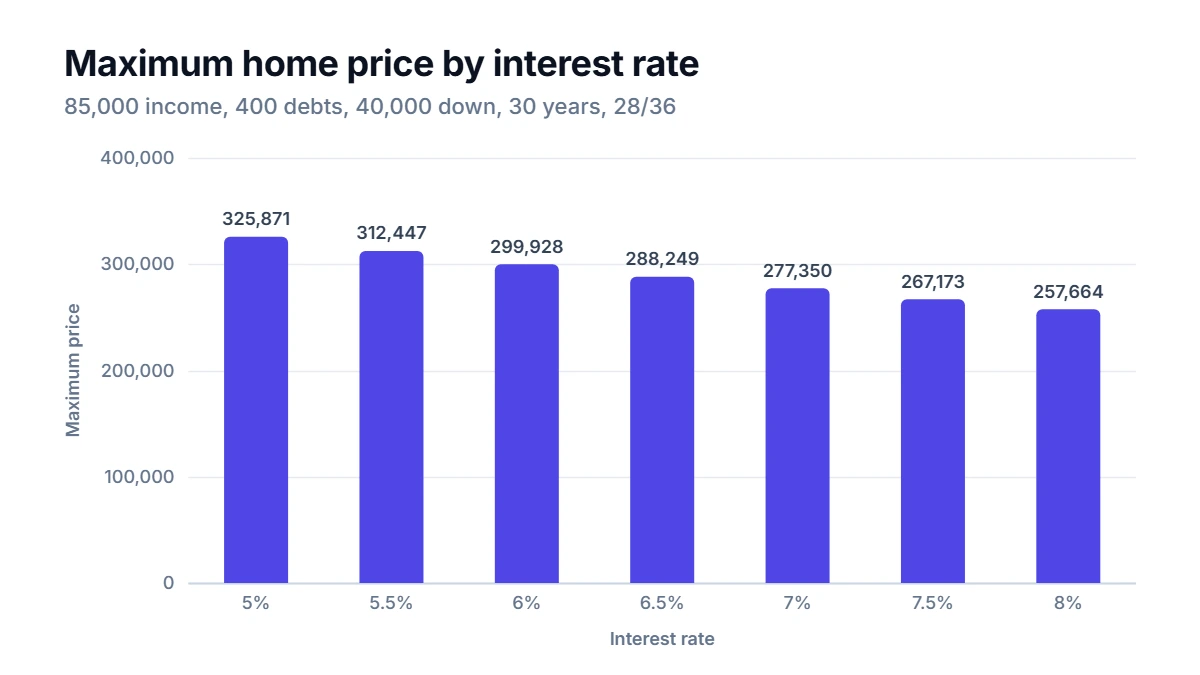
At 5% the same household could afford about 325,871. At 8% the figure drops to about 257,664, a difference of more than 68,000 from a three-point change in rate.
Monthly debts
Debts only start to matter once they push the back-end limit below the front-end one. In this example that happens above about 567 a month (2,550 − 1,983.33). Below that, the car loan does not change the answer at all. Above it, every extra dollar of debt removes a dollar from the housing budget.
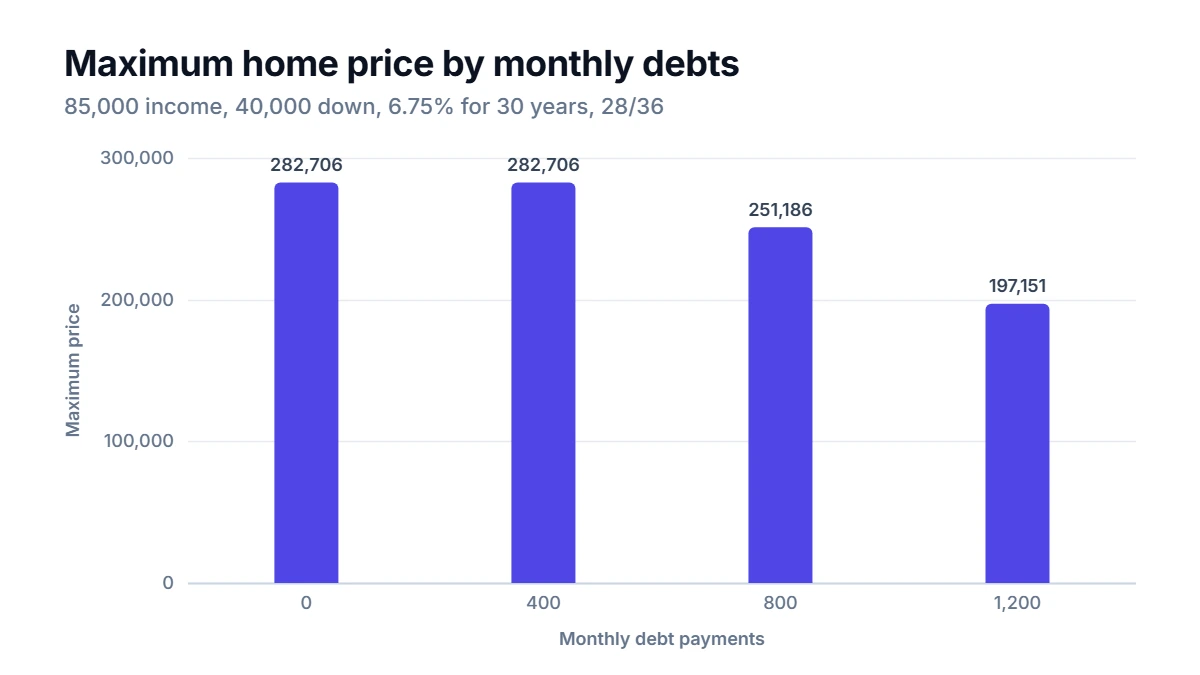
With 800 of monthly debts the maximum price falls to about 251,186. With 1,200 it falls to about 197,151. Paying off a 400-a-month car loan before applying can be worth tens of thousands in buying power.
Loan term
A 15-year term packs the repayment into half the time, so the same budget supports a smaller loan. In this example the maximum price falls from about 282,706 to about 223,976. You pay far less interest overall, but you buy a cheaper home or need a larger down payment.
Using the House Affordability Calculator
The House Affordability Calculator follows the steps above. Enter your annual gross income, monthly debt payments, down payment, interest rate, term, property tax rate, insurance and HOA. The front-end and back-end limits start at 28% and 36%; change them if a lender has told you different figures. The result shows the maximum price, the loan amount, the full monthly breakdown and which limit decided it.
Beyond the ratios
A lender's maximum is a ceiling, not a recommendation. Before you settle on a budget, think about:
- Cash after closing. Closing costs, moving, furniture and an emergency fund all come out of savings, on top of the down payment.
- Mortgage insurance. With less than 20% down, many loans add a monthly premium that the 28/36 calculation above does not include.
- Maintenance. Older homes in particular need regular repairs. Many owners set aside a percentage of the home's value each year.
- Your real take-home pay. DTI uses gross income. Retirement contributions, childcare and health costs come out of the same paycheck.
- Future changes. A new baby, a career break or a rising property tax bill can change what feels comfortable.
A common approach is to work out the lender-style maximum, then choose a price that leaves the monthly payment a few hundred below it. Results are estimates, not financial advice; check current rates and your lender's requirements.
FAQ
Should I use gross or take-home income?
DTI rules use gross income, before taxes and deductions, so the calculator does too. For your own comfort check, compare the monthly payment with your take-home pay as well.
Does a bigger down payment always raise the price I can afford?
Yes, though by a little less than the extra cash, because a higher price also means higher property tax. In the example, raising the down payment from 40,000 to 60,000 lifts the maximum price from about 282,706 to about 300,229. A bigger down payment also lowers the chance of needing mortgage insurance and reduces total interest.
Why do two lenders give me different maximums?
Different loan programs allow different DTI limits, and lenders also weigh credit scores, savings and job history. Some include estimated mortgage insurance and local tax rates that differ from your own estimates.
What if my income varies from year to year?
Lenders usually average variable income, such as bonuses or self-employment earnings, over a period of time. For your own planning, use a conservative figure rather than your best year.
