How Much Protein Do I Need a Day?
Protein needs scale with your body weight and your goal. Here are the ranges for sedentary adults, regular exercisers, muscle building, weight loss and older adults, with a worked example and ways to turn grams into meals.

Protein advice swings from "most people already eat too much" to "eat a gram per pound or lose your gains." Both camps have a point, because the right amount depends on your body weight and what you ask your body to do. Once you know which range applies to you, the daily target is a single multiplication, and the harder part becomes spreading it across real meals.
Why protein targets are given per kilogram
Your body constantly breaks down and rebuilds muscle, skin, enzymes and other tissues, and dietary protein supplies the amino acids for that rebuilding. A bigger body has more tissue to maintain, so protein needs scale with weight. That is why nutrition guidelines are written as grams per kilogram of body weight (g/kg) rather than one fixed number for everyone.
The baseline is the Recommended Dietary Allowance (RDA) of 0.8 g/kg. It was set to cover the needs of nearly all healthy adults who do little exercise. It is a floor for avoiding deficiency, not a target for performance. Sports nutrition research suggests that people who train regularly use more, and that older adults benefit from a little extra because muscle responds less strongly to protein with age.
The ranges, side by side
- Sedentary adult: 0.8 g/kg (about 0.36 g per lb)
- Regular exercise: 1.2–1.6 g/kg (0.54–0.73 g per lb)
- Building muscle with strength training: 1.6–2.2 g/kg (0.73–1 g per lb)
- Losing weight while training: 1.6–2.4 g/kg (0.73–1.09 g per lb)
- Older adult, 65 or over: 1.0–1.2 g/kg (0.45–0.54 g per lb)
Notice that the popular "1 gram per pound" rule sits at the very top of the muscle-building range. It is not wrong, but most people get the same benefit from somewhat less.
The weight-loss range is the highest of all. When you eat fewer calories than you burn, your body is more willing to break down muscle for fuel. Extra protein, together with strength training, helps you lose mostly fat instead. Protein is also filling, which makes a calorie deficit easier to stick to.
How to work out your number step by step
- Convert your weight to kilograms if you use pounds: divide by 2.2046, or multiply by 0.4536.
- Pick the range that matches your activity and goal.
- Multiply your weight in kg by the low and high end of the range.
- Divide by the number of meals you eat to get a per-meal amount.
Worked example
Take a person who weighs 165 lb. In kilograms that is 165 × 0.45359237 = 74.84 kg.
- As a sedentary adult: 74.84 × 0.8 ≈ 60 g a day.
- Exercising most days: 74.84 × 1.2 to 74.84 × 1.6 ≈ 90–120 g.
- Building muscle: 74.84 × 1.6 to 74.84 × 2.2 ≈ 120–165 g.
- Losing weight while training: ≈ 120–180 g.
- At 65 or over: ≈ 75–90 g.
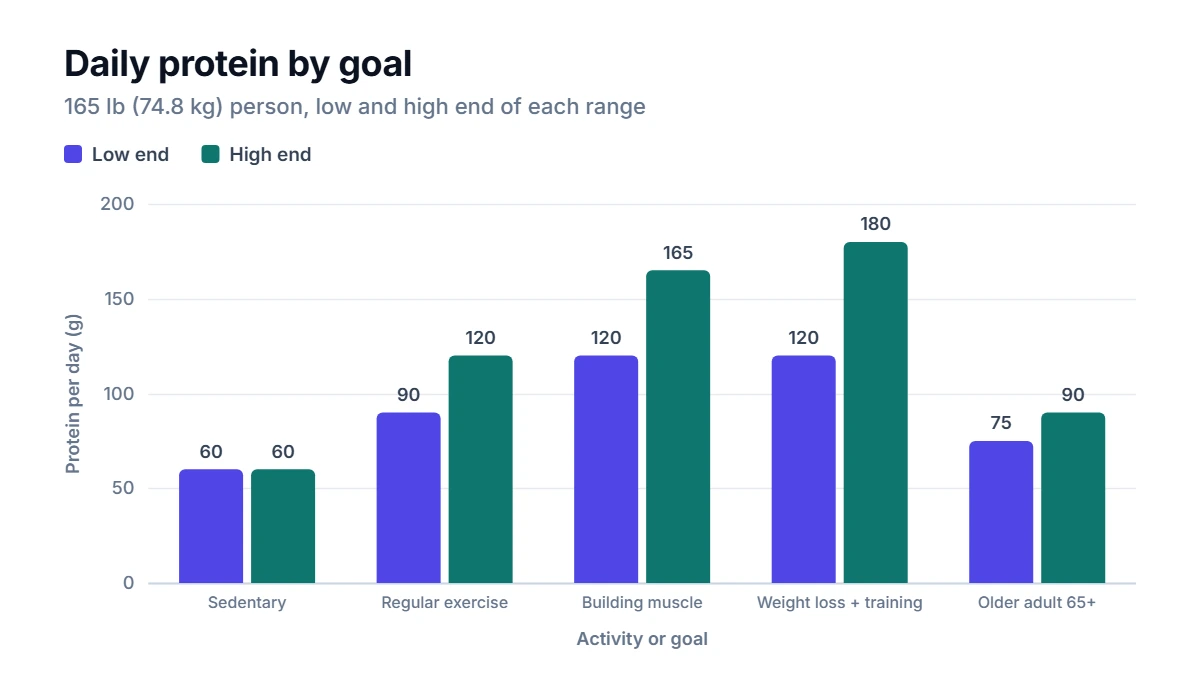
If this person exercises regularly and eats three meals, 90–120 g works out to 30–40 g per meal. With four meals it drops to 22–30 g, which many people find easier to reach without protein shakes.
Turning grams into food
A target only helps if you can picture it on a plate. These are rough, typical amounts; package labels give the exact figure for what you buy.
- A large egg: about 6 g
- A cup of plain Greek yogurt: often 15–20 g
- A 3.5 oz (100 g) cooked chicken breast: around 30 g
- A cup of cooked lentils: roughly 18 g
- A 3.5 oz portion of firm tofu: about 10–15 g, depending on the brand
So 30 g at breakfast could be two eggs plus a cup of Greek yogurt. Lunch could be a chicken salad, and dinner a lentil curry with a side of tofu. Snacks such as milk, cheese, nuts or edamame fill the gaps.
How to use the calculator
The Protein Calculator does the conversion and multiplication for you. Choose US or metric units, enter your body weight, pick the activity level or goal that fits best, and optionally add how many meals you eat a day. The result gives your daily range in grams, the same range per kg and per lb, and the amount per meal. The details table shows every goal at your weight, which is handy if you are moving from one phase, such as building muscle, to another, such as cutting.
Common mistakes
- Using the RDA as a goal while training hard. 0.8 g/kg prevents deficiency in inactive adults. It is usually not enough to support regular strength or endurance training.
- Using total weight when you carry a lot of body fat. Fat tissue needs very little protein. At a high body fat level, entering a goal or healthy weight gives a more realistic number.
- Eating it all at dinner. Your body can use a large meal of protein, but spreading it over three or four meals is a common and practical way to support muscle repair through the day.
- Forgetting plant sources. Beans, lentils, soy, grains and nuts all count toward the total. Mixing several sources over the day covers all the essential amino acids.
- Counting grams of food instead of grams of protein. A 100 g chicken breast is not 100 g of protein; it is about 30 g.
These figures are estimates, not medical or dietary advice. If you have kidney disease or another medical condition, or you are pregnant or breastfeeding, ask a doctor or registered dietitian what is right for you.
FAQ
Do I need more protein on rest days?
Not really. Muscle repair continues for a day or two after training, so it makes sense to keep a similar intake on rest days instead of cutting back sharply. Most people simply aim for the same daily range all week.
Is plant protein as good as animal protein?
Plant proteins are often a little lower in one or more essential amino acids, and some are digested slightly less completely. Eating a variety of plant foods across the day, and aiming toward the upper part of your range, makes up for most of the difference.
Does a protein target change as I lose weight?
Yes. Because the target is per kilogram, it falls as your weight falls. Recalculate every few kilos or pounds so your target follows your current weight.
Can teenagers use these ranges?
Growing teenagers have their own guidelines, and needs vary with growth stage and sport. The ranges here are written for adults, so a teen athlete is better served by advice from a pediatrician or sports dietitian.


