How Much Should You Save for Retirement?
A practical walk-through of how retirement savings grow, what inflation does to the final number and how to turn a nest egg into a monthly income, with a full worked example.

"How much do I need to retire?" has no single answer, because it depends on when you stop working, how long you live, what your money earns and how prices change along the way. What you can do is turn those unknowns into a clear estimate and then test what happens when you change them. This guide shows the method behind a retirement projection, works through one full example and explains how to read the result without fooling yourself.
The two phases of a retirement plan
Every retirement projection has two halves.
- The saving years. You add money every month and your investments earn a return. Growth compounds: returns earn returns of their own, so the balance accelerates over time.
- The spending years. You stop contributing and start withdrawing. The remaining balance keeps earning, usually at a lower, more cautious rate, while your withdrawals slowly bring it down to zero.
The question "how much should I save?" is really the question "how big must the balance be at the switch-over point to pay the income I want for as long as I need it?"
The math, step by step
Growth while saving. With monthly compounding, each month the balance is multiplied by (1 + annual return ÷ 12) and then the contribution is added. Over many months that gives the familiar future-value formula:
FV = S × (1 + r)^n + C × ((1 + r)^n − 1) ÷ r
Here S is what you have saved today, C is the monthly contribution, r is the monthly return and n is the number of months until retirement.
Adjusting for inflation. A future amount buys less than the same amount today. Dividing by (1 + inflation)^years gives the value in today's money, which is the figure worth comparing with your current spending.
Income while spending. The level monthly withdrawal that empties the balance exactly at your chosen age works like a loan payment in reverse: W = B × r ÷ (1 − (1 + r)^−n), where B is the balance at retirement and r and n now refer to the retirement years.
A worked example
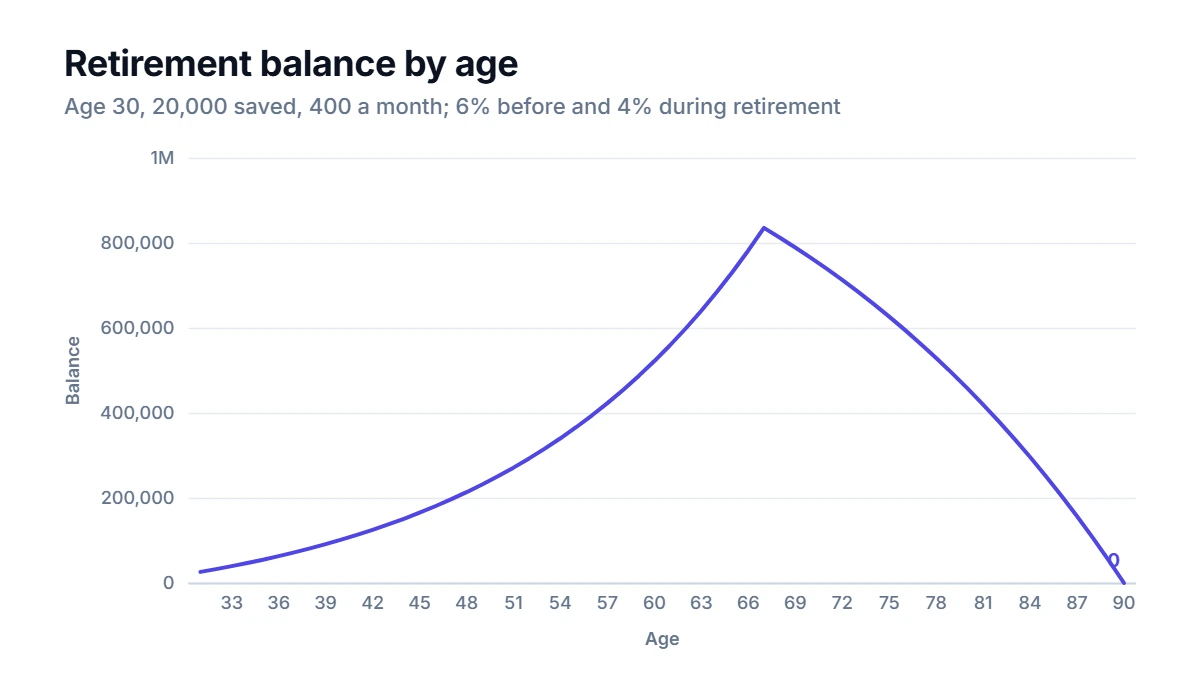
Meet a 30-year-old with 20,000 already saved who invests 400 a month and plans to retire at 67. Assume a 6% annual return before retirement, 4% during retirement, 2.5% inflation and a plan that lasts until age 90.
- Months of saving: 37 years × 12 = 444.
- Balance at 67: about 835,654.05.
- Own contributions: 400 × 444 = 177,600. The starting 20,000 plus 177,600 means only about 197,600 came out of pocket; investment growth added the other 638,054.05.
- In today's money: dividing by 1.025^37 gives about 335,153.30. That is the buying power the nest egg would have at today's prices.
- Monthly income from 67 to 90: about 4,635.79, which is roughly 1,859.26 a month in today's money at the start of retirement.
The chart traces the balance through both phases. The curve climbs slowly in the first decade, speeds up as growth compounds, then falls gradually after 67 as withdrawals take over.
Why starting early matters so much
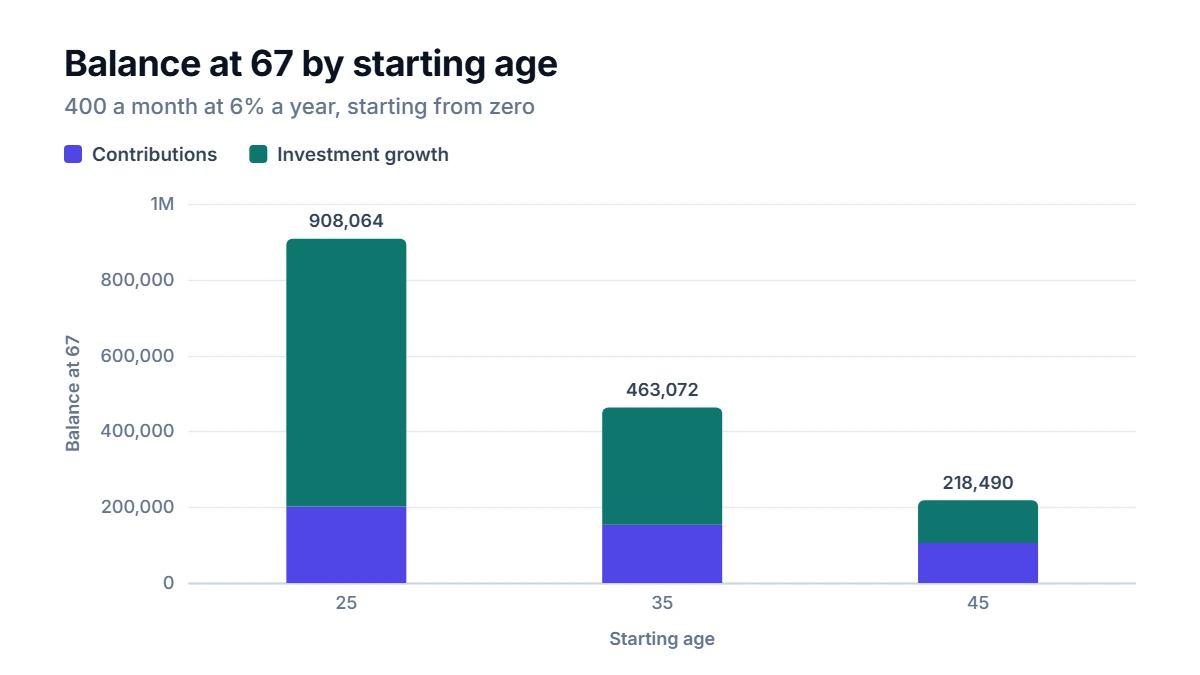
Compounding rewards time more than effort. Take the same 400 a month with nothing saved, the same 6% return and the same retirement age of 67:
- Starting at 25, you contribute 201,600 and reach about 908,064.
- Starting at 35, you contribute 153,600 and reach about 463,072.
- Starting at 45, you contribute 105,600 and reach about 218,490.
Ten extra years of saving add only 48,000 of contributions, but they roughly double the final balance. If you start later, you can close part of the gap by raising the monthly amount or working a few more years, both of which have a strong effect.
How to use the Retirement Calculator
The Retirement Calculator follows exactly the steps above. Enter your current age, retirement age and life expectancy, then your current savings and monthly contribution. Set the expected return before and during retirement and an inflation rate, and press Calculate. You will see the balance at retirement, its value in today's money, the monthly income it could pay and a year-by-year table of both phases.
The most useful habit is to run it several times. Try a lower return, a later retirement age or a higher life expectancy and watch how the income changes. A plan that only works under the most hopeful assumptions is not a plan yet.
Common mistakes
- Reading the nominal figure as if it were today's money. 835,654 sounds large, but at 2.5% inflation it buys what about 335,000 buys now. Always look at the inflation-adjusted value.
- Using an optimistic return. Long-run averages hide bad decades. Testing 4% or 5% instead of 7% shows how much safety margin you have.
- Planning to an average lifespan. Many people live well past average. Planning to 90 or 95 lowers the monthly income but reduces the risk of running short.
- Forgetting other income and costs. Pensions and social security can add a lot; taxes and fund fees take some away. Neither is in this estimate, so check current rules where you live and add them separately.
These projections are estimates, not financial advice. Markets do not deliver a steady return each year, and a downturn just before or after retiring has a bigger effect than the same downturn decades earlier.
FAQ
Is there a rule of thumb for how much to save?
A common one is to save 10% to 15% of your income from your twenties onward. Rules of thumb are a starting point only; your own retirement age, lifestyle and other income can move the right number a lot in either direction.
What return should I assume?
Use a rate that matches how your money is actually invested, minus fees. Many people run one cautious and one middle scenario, for example 4% and 6%, and plan around the cautious one.
Why is the income in today's money lower than the withdrawal?
The withdrawal is fixed in money terms. Because prices rise every year, the same monthly amount buys less as time goes on. Converting it to today's money shows what it would feel like if you had it now.
What if I want money left over at the end?
The estimate assumes the balance reaches zero at your chosen age. If you would like to leave something behind or keep a buffer, enter a higher life expectancy. The calculator then spreads the money over more years, which lowers the monthly income and leaves more in the account at any given age.

