How Much Will My Savings Grow?
See how a monthly saving habit grows with compound interest, why starting ten years earlier beats saving twice as much later, and how to work out the deposit you need for a goal.

Saving a fixed amount every month is one of the simplest money habits there is, but it is hard to picture where it leads. 250 a month does not sound like much. Kept up for 30 years at a steady 5% interest, it grows to more than 200,000, and more than half of that is interest you never deposited. This guide shows how that happens and how to estimate it for your own plans.
All the numbers below are estimates that assume a fixed interest rate and no taxes, fees or inflation. They are for planning, not financial advice.
What makes savings grow
A savings balance grows from two sources:
- Your deposits. The money you put in yourself.
- Interest. What the bank or account pays you on the balance. Because interest is added to the balance, next month's interest is paid on last month's interest too. That is compounding.
In the early years, deposits do almost all the work. Later, the balance is large enough that interest becomes the main engine. The longer you save, the more of the final balance comes from interest.
The formula, step by step
Picture a month at a time. Each month:
- The balance earns one month of interest: balance × monthly rate.
- Your monthly deposit is added at the end of the month.
With monthly compounding, the monthly rate is just the annual rate divided by 12. At 5% a year, that is 0.05 ÷ 12 ≈ 0.4167% a month.
If you repeat that for N months, there is a neat shortcut for the result:
FV = C × ((1 + i)^N − 1) ÷ i
where C is the monthly deposit, i the monthly rate and N the number of months. If you also start with a lump sum P, add P × (1 + i)^N.
A fully worked example
You save 250 a month for 30 years at 5% compounded monthly, starting from zero.
- Monthly rate: 5% ÷ 12 ≈ 0.004167
- Number of months: 30 × 12 = 360
- Final balance: about 208,064.66
- Your deposits: 250 × 360 = 90,000
- Interest earned: 118,064.66
Look at how the balance builds over time. After 10 years you have about 38,821. After 20 years, about 102,758. The last 10 years add more than 105,000, even though you deposit the same 30,000 in each decade.
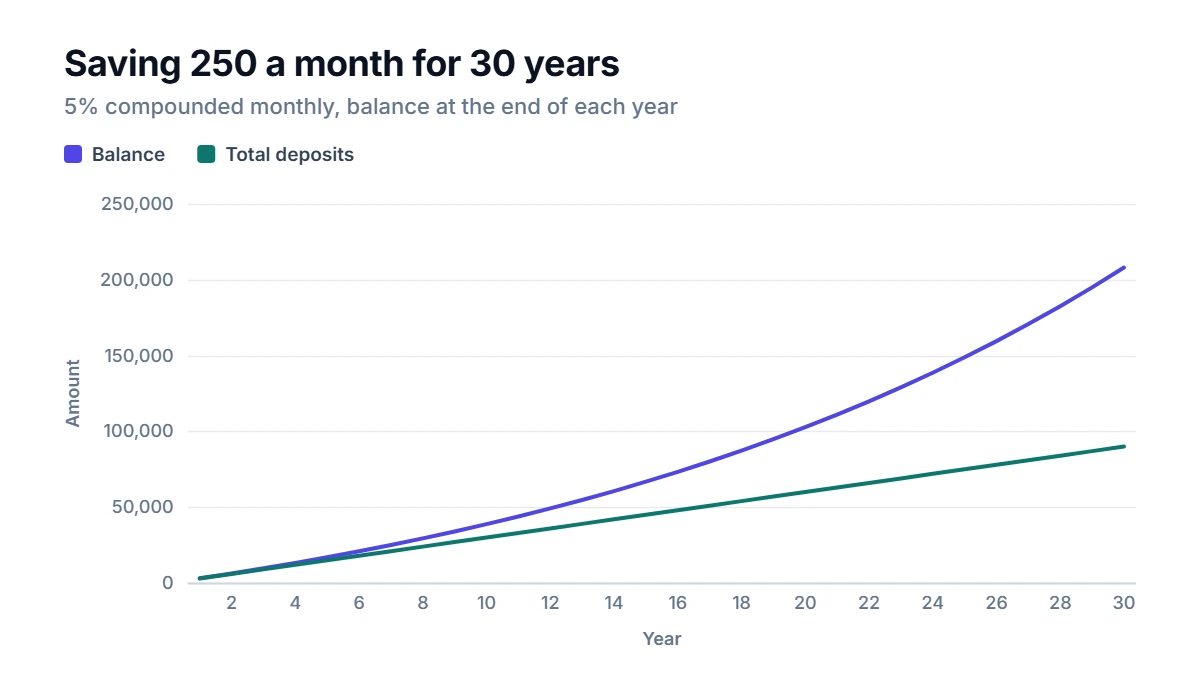
The gap between the two lines is the interest. It is thin at first and then widens quickly.
Starting early versus saving more later
Here is a comparison that surprises many people. Using the same 5% rate:
- Start now: 250 a month for 30 years ends at about 208,065, from 90,000 of deposits.
- Wait 10 years, then double up: 500 a month for 20 years ends at about 205,517, from 120,000 of deposits.
The late saver puts in 30,000 more and still ends up with less. The first decade of deposits had 20 to 30 years to earn interest, and that time is very hard to make up.
How much the rate matters
The interest rate has a large effect over long periods. Here is the same 250 a month for 30 years at different rates:
- 0%: 90,000 (just your deposits)
- 2%: about 123,181
- 4%: about 173,512
- 6%: about 251,129
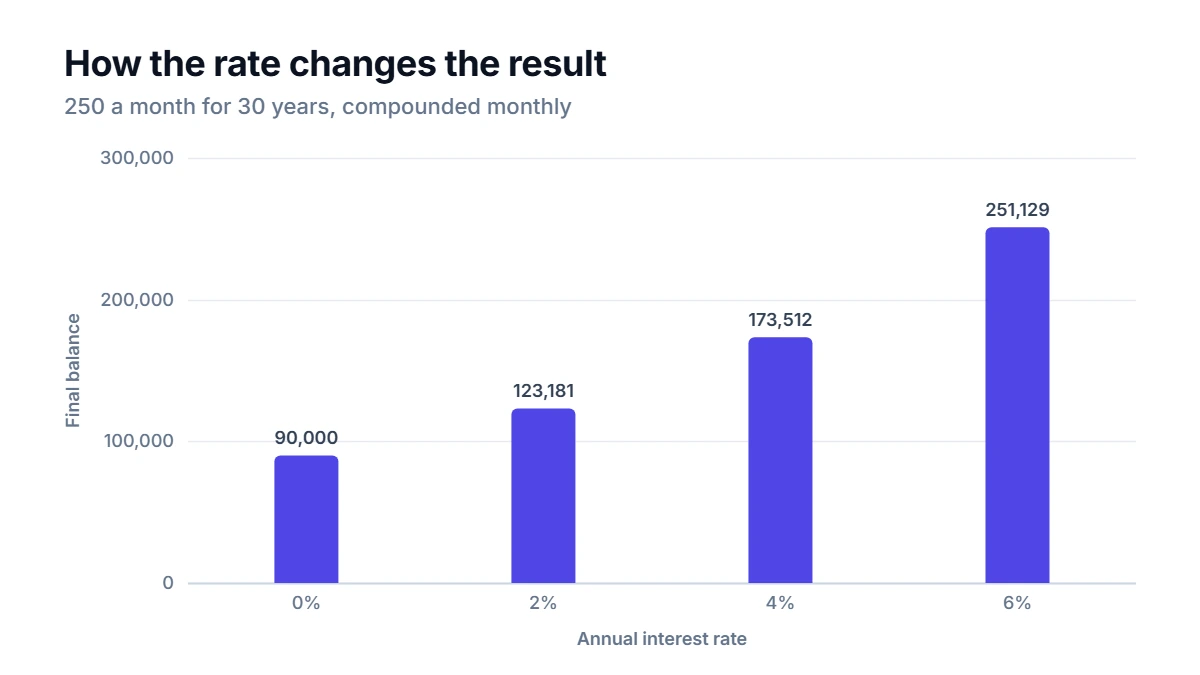
Real rates change over time and differ between accounts, so check what your bank currently offers and treat any long-term rate as an assumption, not a promise.
Raising your deposit each year
Most people earn more over time, so a fixed 250 a month for 30 years is a cautious plan. If you raise the deposit by 3% each year, you start at 250 a month and finish at about 589 a month in year 30. At 5%, the final balance becomes about 295,989, from 142,726 of deposits. A small yearly step-up adds almost 88,000 compared with the flat plan.
Working backwards from a goal
Sometimes you know the target, not the deposit. Say you have 2,000 saved and want 15,000 in 3 years for a car, with savings earning 4% compounded monthly.
The shortcut formula, solved for the deposit, gives about 333.82 a month. Over 36 months you deposit 12,017.52 on top of the 2,000 you already have, and interest adds about 982.79, which brings you to just over 15,000. At 0% you would need 361.12 a month, so even a modest rate saves you about 27 a month here.
How to use the Savings Calculator
The Savings Calculator has two modes:
- Future value: enter an initial deposit, a monthly contribution, the annual rate, the compounding and the number of years. You can add a yearly contribution increase. You get the final balance, total deposits and total interest, plus a year-by-year table.
- Savings goal: enter the target, any initial deposit, the rate, the compounding and the years, and it tells you the monthly contribution you need.
Try a few scenarios side by side: start now versus in five years, a 3% step-up versus none, or a lower and a higher rate. The differences are often more useful than any single answer.
Good to know
- Inflation reduces what the final balance can buy. 208,000 in 30 years will not buy what 208,000 buys today. One rough way to account for it is to use a rate that is your expected interest minus expected inflation.
- Taxes and fees reduce growth. Interest may be taxable, and some accounts charge fees. Check current rules for your account type.
- Timing of deposits matters a little. The calculator adds deposits at the end of each month. Saving on payday at the start of the month gives you slightly more.
- Consistency beats precision. An automatic transfer that never misses a month will usually do more than a perfect plan you stop following.
FAQ
What is a good amount to save each month?
There is no single right number. A common starting point is a fixed share of take-home pay, then raising it whenever your income rises. The best amount is one you can keep up every month without dipping back into it.
Should I build an emergency fund before saving for long-term goals?
Many people do, because an emergency fund stops a surprise bill from wiping out other savings or turning into debt. Once it is in place, regular saving for longer goals is easier to keep going.
Why does my bank statement not match the calculator exactly?
Banks may compound daily, pay interest on a different day, round each month's interest to the cent, or change the rate over time. Small differences are normal; the calculator gives a planning estimate.
Is it better to save a lump sum once or a little every month?
If you already have the lump sum, it starts earning interest right away, so it usually ends higher. If you do not, a monthly habit is how you build one. Many people do both: save monthly and add windfalls like a tax refund or a bonus.
