How Pregnancy Weeks Are Counted
Pregnancy weeks start before conception and a due date is 280 days from your last period. Here is how the count works, how cycle length shifts it and how to read weeks and days.

"How far along are you?" sounds like a simple question, but the answer uses a counting system that surprises many people. Pregnancy weeks start before conception, a "month" of pregnancy is not quite a calendar month, and "18 weeks" actually means you are in your 19th week. Here is how the count works, why it is done that way and how to read the numbers you get.
Why the count starts before conception
Doctors and midwives date a pregnancy from the first day of the last menstrual period, often shortened to LMP. The reason is practical: most people know when their last period started, while the exact day of conception is rarely known. In a typical 28-day cycle, ovulation and conception happen about two weeks after the period begins, so by the time a period is missed, the pregnancy is already counted as about four weeks along.
This convention is called gestational age. It is what scans, appointments and due dates are based on. A second measure, fetal or conceptional age, counts from conception and is about two weeks less. If you read that a baby develops a certain feature "at 10 weeks", it nearly always refers to gestational age.
The 280-day rule
A standard pregnancy is counted as 280 days, or 40 weeks, from the LMP. Adding 280 days to the start date gives the estimated due date.
A traditional shortcut, often called Naegele's rule, does the same in your head: take the first day of the last period, add seven days, subtract three months and add one year. It is handy, but because months have different lengths it can land a day or two away from an exact 280-day count. For an LMP of March 10, 2026, the shortcut gives December 17, while counting 280 days gives December 15.
Adjusting for cycle length
The 280-day rule assumes ovulation on day 14 of a 28-day cycle. If your cycles are longer, you probably ovulated later, so the pregnancy started later too. The usual adjustment is to move the start date forward by one day for every day your cycle is longer than 28, and back by one day for every day it is shorter.
A worked example
Suppose the last period began on Tuesday, March 10, 2026, cycles are usually 32 days, and today is Monday, July 20, 2026.
- Cycle adjustment: 32 − 28 = 4 days, so the adjusted start date is March 14, 2026.
- Days since the adjusted start: 128.
- 128 ÷ 7 = 18 remainder 2, so the pregnancy is 18 weeks and 2 days.
- That falls in the second trimester, which runs from 14 weeks 0 days to 27 weeks 6 days.
- Due date: March 14 + 280 days = Saturday, December 19, 2026, with 152 days to go.
- Progress: 128 of 280 days, or about 45.7%.
Had the 32-day cycle been ignored and 28 days assumed, the result would be 18 weeks 6 days with a due date of December 15, four days earlier. Over a whole pregnancy that difference can matter when deciding whether a baby is early or late.
The same example also gives the key milestones: the first trimester ends on June 19, approximate viability (24 weeks) is August 29, term begins on November 28 and 42 weeks falls on January 2, 2027.
How the 40 weeks divide up
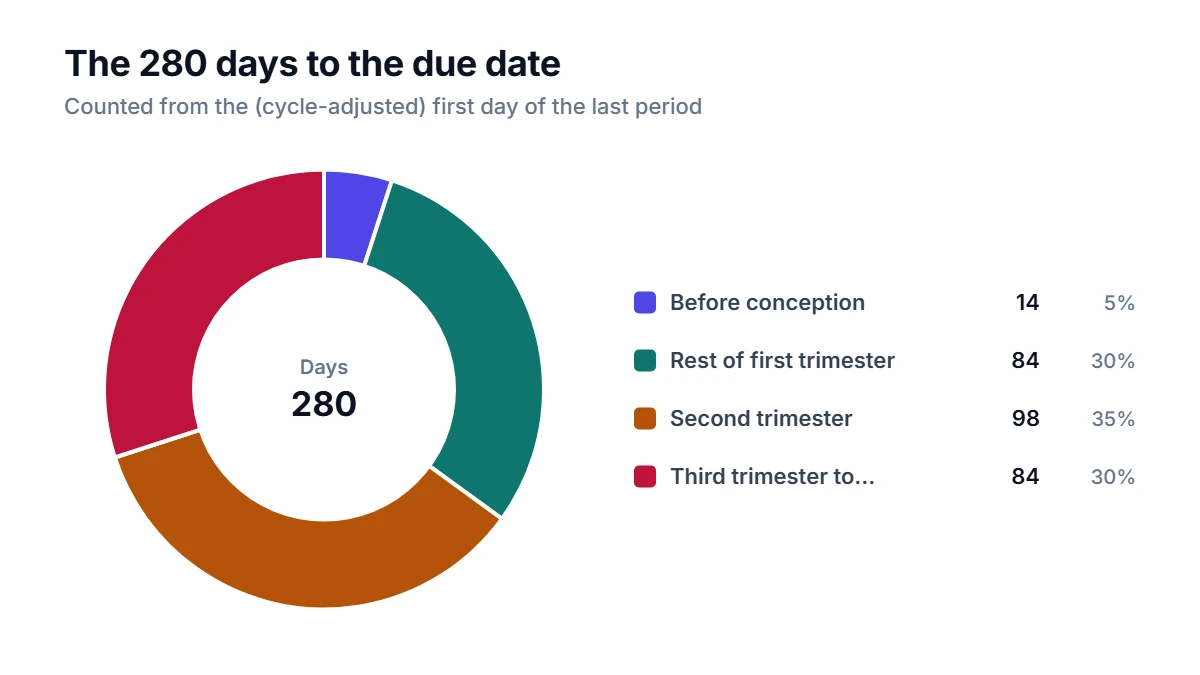
The weeks are not split evenly into three equal thirds. Counting from the adjusted start date, the first two weeks happen before conception, the first trimester ends at 13 weeks 6 days, the second at 27 weeks 6 days, and the third continues to the due date and beyond.
Weeks versus months
People often say a pregnancy lasts nine months, yet 40 weeks is 280 days, which is a little over nine calendar months (an average month has about 30.4 days). That is why converting weeks to months always feels slightly off. Most clinics avoid months altogether and use weeks plus days, written as "18+2" or "18w2d".
One more detail: "18 weeks" means 18 full weeks have passed, so you are in your 19th week. It works the same way as age: a child who is 5 is in their sixth year.
Using the Pregnancy Calculator
The Pregnancy Calculator works from whichever date you know best: the first day of your last period (with your average cycle length), a conception date or a due date you were given after a scan. It shows how many weeks and days pregnant you are today, your trimester, the due date, the days left and how much of the 40 weeks has passed, plus a table of milestone dates. Today's date comes from your own device.
If you start from a conception date, the calculator moves back 14 days to find the start date. Entering a conception date of March 28, 2026 in the example above gives exactly the same results as the 32-day cycle calculation.
Good to know
- Due dates are estimates. Only a small share of babies arrive on the exact day; most are born within about two weeks either side.
- Early scans refine the date. An ultrasound in the first trimester measures the baby's size and is usually more accurate than LMP dating, especially with irregular cycles. If your scan gives a new due date, use that one from then on.
- Irregular cycles make LMP less reliable. If your cycle length varies a lot, treat any LMP-based result as rough until a scan confirms it.
- IVF dates are different. With assisted conception the timing is known precisely and dating is based on the transfer date and embryo age instead.
Everything here is an estimate and not medical advice. Your doctor or midwife will confirm your dates and guide your care.
FAQ
What does "18+2" mean on my notes?
It is shorthand for 18 weeks and 2 days of gestational age, counted from the first day of your last period (or from a date set by a scan). It means you are in your 19th week.
Why did my due date change after the scan?
Early scans measure the baby, and size in the first trimester is a good guide to age. If it points to a date that differs by more than a few days from your LMP-based date, clinics usually switch to the scan date.
How many weeks pregnant am I when I get a positive test?
Most home tests turn positive around the time of a missed period, which is about 4 weeks of gestational age in a regular 28-day cycle, even though conception happened only about two weeks earlier.
Is a 41-week pregnancy overdue?
From 41 weeks a pregnancy is often described as late term, and from 42 weeks as post-term. Care teams usually discuss monitoring or other options as the due date passes, so follow their advice.
