How to Calculate a Car Loan Payment
Tax, fees, trade-ins and the loan term all change what a car really costs. Follow a full worked example and see how a longer term quietly adds thousands in interest.

The sticker price of a car is only the starting point. By the time you add sales tax and fees, subtract your down payment and trade-in, and spread the rest over several years at interest, the amount you really pay can be thousands more. Knowing how each piece fits together helps you compare offers and spot a deal that only looks cheap because the monthly number is small.
The pieces of a car loan
Before any payment can be calculated, you need the amount you are actually borrowing. That depends on five things:
- Vehicle price: the agreed price, after any negotiation.
- Sales tax: in many US states charged on the price minus your trade-in value. Rules vary, so check current local rules.
- Fees: title, registration and dealer documentation charges. You can pay them upfront or roll them into the loan.
- Down payment: cash you pay at signing.
- Net trade-in: what your old car is worth minus anything you still owe on it.
Put together: loan amount = price + sales tax + financed fees − down payment − net trade-in.
From loan amount to monthly payment
Car loans are almost always simple amortizing loans: the same payment every month, part interest and part principal. The payment comes from the annuity formula M = P × r / (1 − (1 + r)^−n), where P is the loan amount, r the monthly rate (annual rate ÷ 12) and n the number of months.
Each month, interest is charged on the balance you still owe. Early payments are therefore interest-heavy; later ones mostly repay principal.
A worked example, step by step
Say you buy a car for 35,000, put 4,000 down, have no trade-in, pay 6% sales tax and 800 in fees that you finance. The rate is 7% APR over 60 months.
- Sales tax: 35,000 × 6% = 2,100.
- Loan amount: 35,000 + 2,100 + 800 − 4,000 = 33,900.
- Monthly rate: 7% ÷ 12 ≈ 0.0058333.
- Growth factor: (1.0058333)^60 ≈ 1.41763.
- Payment: 33,900 × 0.0058333 / (1 − 1 / 1.41763) ≈ 671.26 per month.
- Total interest over the loan: 6,375.64.
- Total cost of the car: 35,000 + 2,100 + 800 + 6,375.64 = 44,275.64.
So a 35,000 car ends up costing a little over 44,000 once tax, fees and five years of interest are included.
How the loan term changes everything
Dealers often talk about the monthly payment because a longer term makes it look friendlier. Here is the same 33,900 loan at 7% across common terms:
- 36 months: 1,046.73 a month, 3,782.41 total interest
- 48 months: 811.78 a month, 5,065.33 total interest
- 60 months: 671.26 a month, 6,375.64 total interest
- 72 months: 577.96 a month, 7,713.21 total interest
- 84 months: 511.64 a month, 9,077.92 total interest
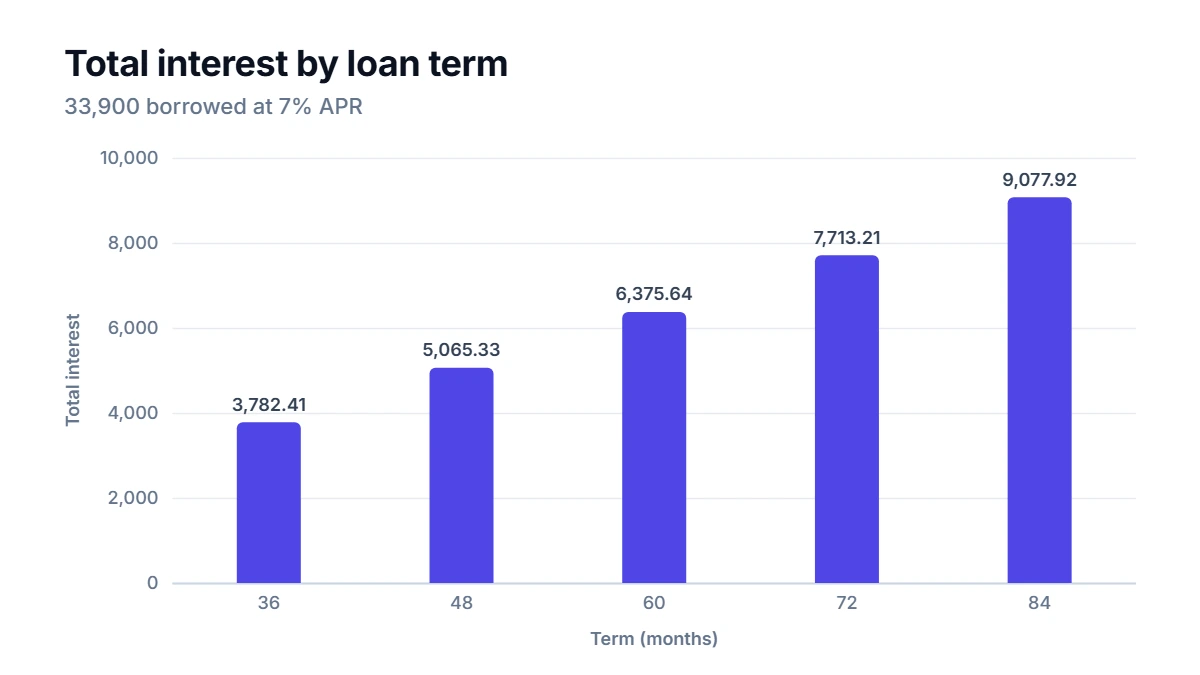
Going from 60 to 84 months saves about 160 a month but adds about 2,700 in interest. The longer loan also keeps your balance high for longer:
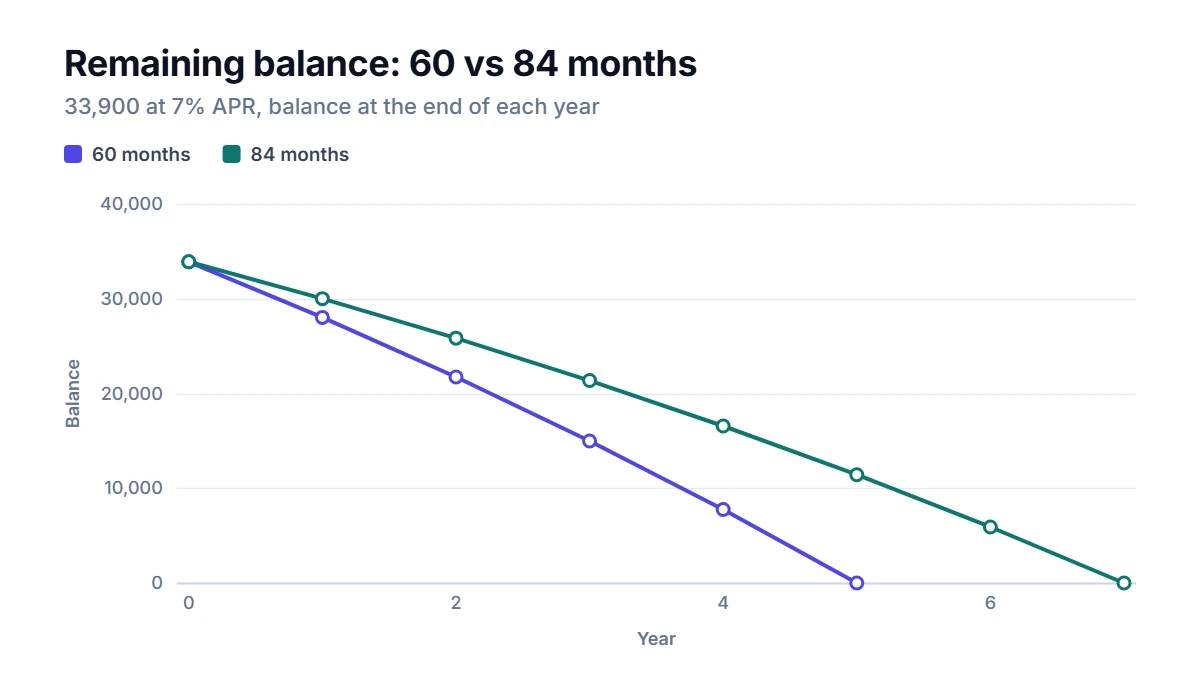
After three years you would still owe about 14,993 on the 60-month loan but about 21,366 on the 84-month loan. Cars usually lose value fastest in their first years, so a long term makes it more likely you owe more than the car is worth if you want to sell or trade it early.
Three levers that cut the cost
Small changes to the same deal show where your money goes:
- A lower rate. At 5% instead of 7%, the payment drops to 639.73 and total interest falls to 4,484.09, a saving of nearly 1,900. Getting a pre-approval from a bank or credit union gives you a rate to compare against the dealer's offer.
- Paying fees upfront. Paying the 800 in fees in cash cuts the loan to 33,100, the payment to 655.42 and the interest to 6,225.18, about 150 less.
- Avoiding negative equity. If you trade in a car worth 8,000 but still owe 11,000 on it, the 3,000 gap is added to the new loan. The trade-in lowers the taxable amount, so the tax falls to 1,620, but the loan rises to 36,420 and the payment to 721.16. You pay interest on the old car's debt for another five years.
Using the Auto Loan Calculator
The Auto Loan Calculator takes all of these inputs at once: price, down payment, trade-in value and amount owed, sales tax, fees (financed or upfront), rate and term. It shows the monthly payment, the loan amount, total interest, the full cost of the car and a year-by-year schedule of interest, principal and remaining balance. Try the same deal at two or three terms and rates side by side before you sign anything.
Good to know
- APR versus interest rate. The APR includes some fees, so it is the better number for comparing lenders. Use the rate quoted on the actual loan contract for the payment.
- The monthly payment is not the price. Always ask for the total amount financed and the total of payments.
- Extras add up. Extended warranties, gap insurance and service plans are often bundled into the loan. Each one raises the balance you pay interest on.
- Budget for running costs. Insurance, fuel, maintenance and registration renewals come on top of the payment.
All results are estimates, not financial advice. A lender's figures can differ because of rounding, fees or the exact payment dates.
FAQ
Is a bigger down payment always better?
It lowers the loan, the payment and the interest, and it reduces the chance of owing more than the car is worth. The trade-off is less cash on hand, so many people keep an emergency fund intact first and put the rest down.
Why does my dealer's payment differ from my calculation?
Common reasons are extra products added to the loan, a different tax treatment of the trade-in, fees you did not include, or a first payment date that falls more than a month after signing, which adds a little extra interest.
Can I pay off a car loan early?
Usually yes, and every extra payment goes to principal, cutting the remaining interest. Read the contract first to check for prepayment penalties and how the lender applies extra payments.
What is a reasonable loan term?
There is no single right answer, but shorter terms cost less in interest and build equity faster. If a car only fits your budget at 72 or 84 months, it may be worth looking at a cheaper model or a larger down payment.
