How to Calculate the Electricity Cost of a Device
Find out what any appliance costs to run with one simple formula. Worked examples for a gaming PC, bulbs, a kettle and standby power, plus a comparison of common devices.

Your electricity bill shows one total for the whole home, which makes it hard to know where the money goes. Is the gaming PC expensive to run? Is it worth replacing old bulbs? Does the space heater cost more than you think? You can answer all of these with one short formula and two numbers you can find yourself: the device's power and your price per kilowatt-hour.
All costs in this guide use an example price of 0.16 per kWh. Prices vary a lot by country, supplier and time of day, so use the price from your own bill and check current rates.
Watts, kilowatt-hours and your bill
Two units do all the work:
- Watts (W) measure power: how fast a device uses energy at a given moment. A 1,500 W heater uses energy fifteen times as fast as a 100 W TV.
- Kilowatt-hours (kWh) measure energy: how much was used over time. One kWh is what a 1,000 W device uses in one hour, or a 100 W device in ten hours.
Your supplier charges you per kWh. So the question "how much does this device cost?" becomes "how many kWh does it use, and what do I pay for each one?"
The formula, step by step
- Find the power in watts. Look on the label, the charger or the manual. If you only see volts and amps, multiply them for an approximate wattage.
- Multiply by the hours of use. Power × hours gives watt-hours.
- Divide by 1,000 to turn watt-hours into kWh.
- Multiply by your price per kWh to get the cost.
As one line:
cost = watts × hours ÷ 1,000 × price per kWh
For a month, multiply the daily kWh by the number of days you use the device. For a year, multiply the monthly figure by 12.
A fully worked example: a gaming PC
A gaming PC draws about 350 W while you play, and you play 3 hours a day, every day.
- Energy per day: 350 × 3 ÷ 1,000 = 1.05 kWh
- Cost per day: 1.05 × 0.16 ≈ 0.17
- Energy per month (30 days): 1.05 × 30 = 31.5 kWh, costing 5.04
- Energy per year (12 such months): 378 kWh, costing 60.48
Now add standby. If the PC and its accessories draw 5 W during the other 21 hours of each day, that adds 5 × 21 ÷ 1,000 = 0.105 kWh a day. The monthly cost rises to 5.54 and the yearly cost to 66.53. Standby adds about 10% to this device's bill.
What common devices cost
Here is the monthly cost of some typical devices, each used 4 hours a day for 30 days at 0.16 per kWh. The power values are typical figures; yours may differ.
- LED light bulb (10 W): 0.19
- Laptop (50 W): 0.96
- LED TV (100 W): 1.92
- Desktop computer (150 W): 2.88
- Window air conditioner (1,000 W): 19.20
- Space heater (1,500 W): 28.80
- Electric oven (2,400 W): 46.08
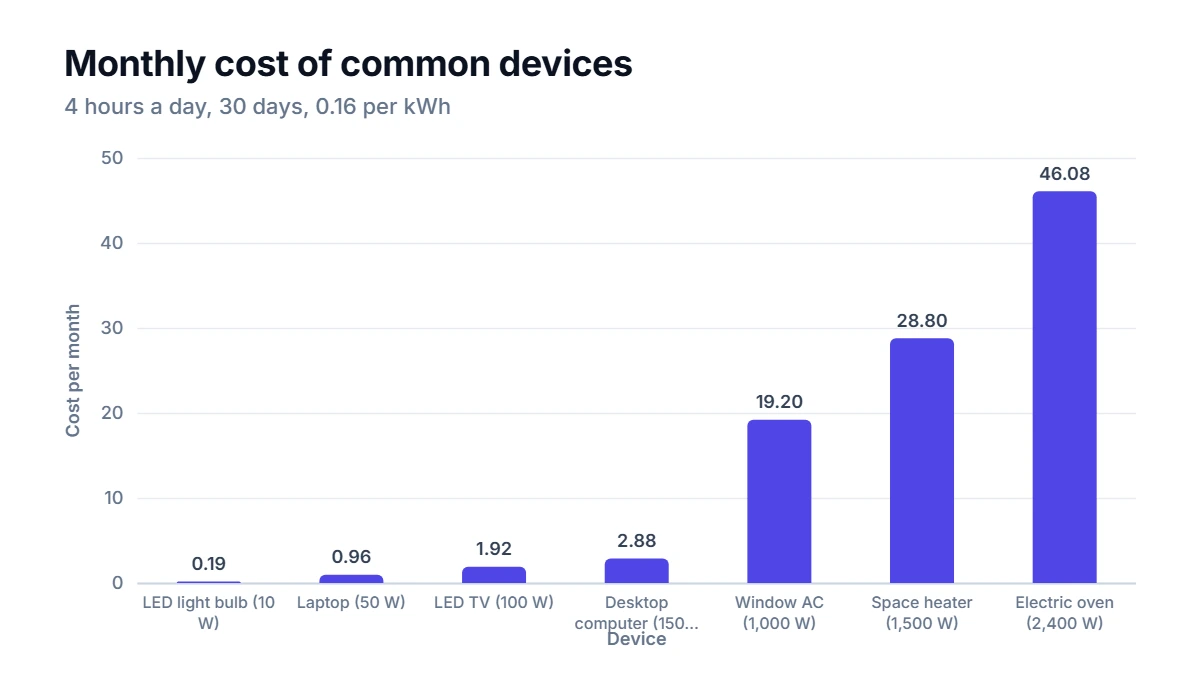
The pattern is clear: anything that makes heat or cold is in a different league. A space heater for 4 hours a day costs about as much as fifteen LED TVs.
Big watts, short time
High wattage does not always mean a high bill. A 2,000 W kettle sounds hungry, but if it runs 15 minutes a day in total, it uses 2,000 × 0.25 ÷ 1,000 = 0.5 kWh a day, about 2.40 a month. A low-power device that runs all day can cost more than a powerful one used briefly. What matters is power multiplied by time.
Is it worth switching bulbs?
Compare an old 60 W incandescent bulb with a 9 W LED that gives similar light, each on for 5 hours a day:
- 60 W bulb: 0.3 kWh a day, about 1.44 a month or 17.28 a year
- 9 W LED: 0.045 kWh a day, about 0.22 a month or 2.59 a year
That is a saving of almost 15 a year for a single bulb at this price. Multiply by the number of bulbs you use most and the payback is usually quick.
Small loads that never switch off
Standby power is small but constant. A device that draws 5 W around the clock uses 5 × 24 ÷ 1,000 = 0.12 kWh a day, or about 43 kWh a year, which is roughly 6.91 a year at 0.16. Ten such devices in a home add up to almost 70 a year for things nobody is using. A switched power strip makes it easy to turn several off at once.
How to use the Electricity Cost Calculator
The Electricity Cost Calculator turns this into a few boxes:
- Enter the device power and choose watts or kilowatts.
- Enter the hours used per day. Decimals are fine: 15 minutes is 0.25.
- Enter the days used per month, 30 for daily use.
- Enter the price per kWh from your bill.
- Optionally add the standby power in watts.
Press Calculate to see the cost per day, month and year and the energy used. The details table also shows what common devices would cost with the same hours, days and price, which makes quick comparisons easy.
For seasonal devices, set the days to match. A 1,500 W heater used 6 hours a day on 20 days a month uses 180 kWh a month, about 28.80, during the months you use it. Leave the summer months out when you estimate a yearly total.
Common mistakes
- Using the maximum rating for cycling devices. Fridges, freezers, air conditioners and heaters with thermostats switch on and off. Their average draw is lower than the rated power. Use the yearly kWh rating on an energy label if there is one.
- Forgetting fixed charges. Many bills include a daily or monthly standing charge and taxes that do not depend on usage. Your cost per kWh on paper may be lower than your total bill divided by kWh.
- Ignoring time-of-use pricing. If your price changes by time of day, use the price for the hours the device actually runs.
- Mixing up kW and kWh. kW is how fast; kWh is how much. A 2 kW heater for 3 hours uses 6 kWh.
FAQ
How can I measure a device's real power use?
A plug-in energy meter sits between the device and the wall socket and shows the actual watts and the kWh used over time. It is the most accurate way to check devices whose use varies, like computers and fridges.
Does turning a device off and on use more electricity than leaving it on?
For almost all home electronics and lights, no. Switching off saves energy for every minute the device is off. The idea that switching uses a large burst of power is a myth for modern devices.
How do I estimate the cost of charging an electric car?
Use the same formula with the energy added to the battery, then allow for some loss during charging. A dedicated EV charging cost tool is easier, because it works from battery size and charge level.
Why is my bill higher in winter?
Heating, longer lighting hours and more time indoors all add up. Even if only part of your home is heated with electricity, a few hours of a high-wattage heater can outweigh everything else, as the device comparison above shows.