How to Calculate the Gas Cost of a Road Trip
Three numbers tell you what a drive will cost in fuel: distance, fuel economy and price. Learn the formula in MPG and L/100 km, work through a real trip and see why fuel economy gains matter most at the low end.

Before a road trip, it helps to know what the fuel will cost: to set a budget, to decide between driving and another option, or to split the cost fairly with friends. The good news is that the calculation needs only three numbers, and you probably know two of them already. The tricky part is making the estimate realistic.
The three inputs
- Distance: how far you will drive in total. Use a route planner and remember the return leg.
- Fuel economy: how much distance your vehicle gets from a unit of fuel (MPG) or how much fuel it uses per distance (L/100 km).
- Fuel price: what you expect to pay per gallon or per liter along the route.
The formula in miles and MPG
Miles per gallon tells you how far one gallon takes you, so you divide:
- Gallons needed = miles / MPG
- Fuel cost = gallons × price per gallon
The formula in kilometers and L/100 km
Liters per 100 km tells you how much fuel each 100 km uses, so you multiply:
- Liters needed = km × L/100 km / 100
- Fuel cost = liters × price per liter
The two units work in opposite directions. A higher MPG is better, while a lower L/100 km is better. To convert between them, divide 235.215 by the figure you have: 28 MPG is about 8.40 L/100 km, and 8.40 L/100 km is about 28 MPG.
A worked example
Four friends plan a weekend away, 420 miles each way. Their car gets about 28 MPG, and they budget 3.40 per gallon.
- Total distance for the round trip: 420 × 2 = 840 miles.
- Fuel needed: 840 / 28 = 30 gallons.
- Fuel cost: 30 × 3.40 = 102.00.
- Cost per person: 102.00 / 4 = 25.50.
- Cost per mile: 102.00 / 840, about 0.12.
If they took a more efficient car rated at 36 MPG instead, the same trip would need about 23.3 gallons and cost 79.33, or 19.83 each.
The metric version works the same way. A 650 km one-way drive in a car that uses 7.2 L/100 km needs 650 × 7.2 / 100 = 46.8 liters. At 1.75 per liter, that is 81.90, about 0.13 per kilometer.
Why MPG gains matter most for thirsty cars
Because fuel used is distance divided by MPG, the savings from better fuel economy are not linear. Each extra MPG saves less than the one before. Here is the fuel cost of driving 1,000 miles at 3.50 per gallon:
- 15 MPG: 233.33
- 20 MPG: 175.00
- 25 MPG: 140.00
- 30 MPG: 116.67
- 35 MPG: 100.00
- 40 MPG: 87.50
- 45 MPG: 77.78
- 50 MPG: 70.00
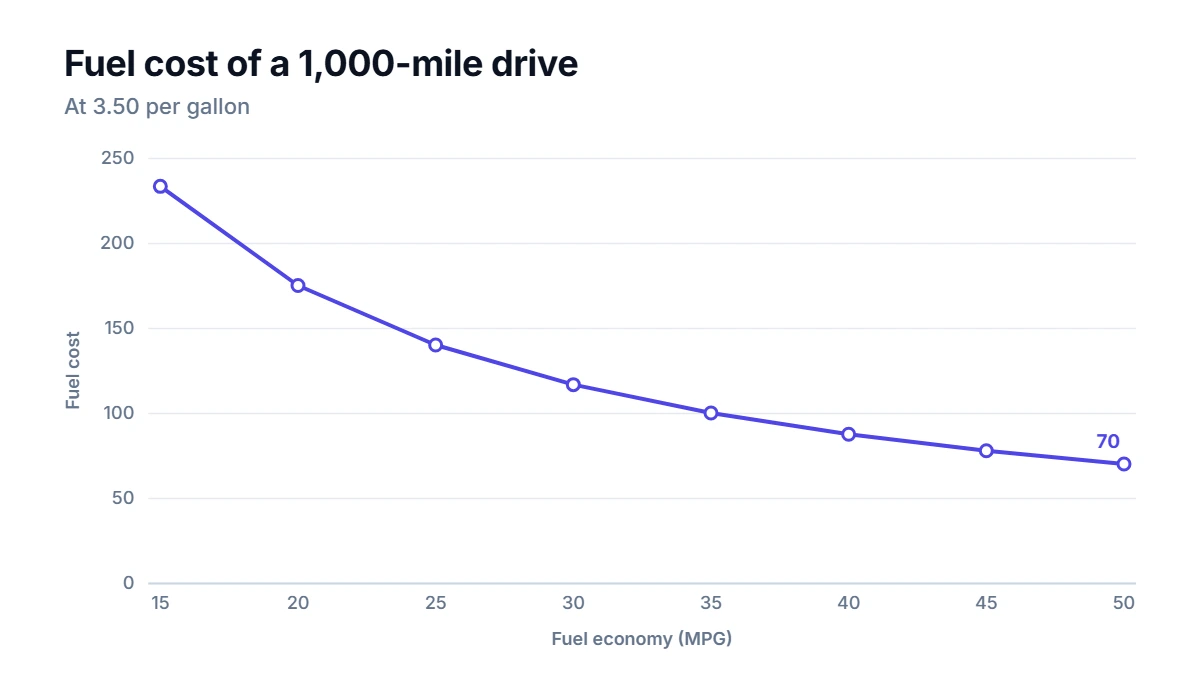
Over a year of 12,000 miles at the same price, moving from 20 to 25 MPG saves 420 (2,100 down to 1,680). Moving from 40 to 50 MPG, a bigger-looking jump, saves only 210 (1,050 down to 840). Replacing the least efficient vehicle in a household usually saves more than upgrading an already efficient one. This is also why L/100 km is often considered the easier unit for comparisons: it is directly proportional to fuel use.
Making the estimate realistic
The formula is exact, but the inputs are not. A few habits make the result much closer to what you will actually spend:
- Use your own fuel economy. Fill the tank, reset the trip meter, and at the next fill divide the miles driven by the gallons added. Official ratings are measured under test conditions and are often higher than real-world results.
- Adjust for the type of driving. Steady highway driving at moderate speed is usually efficient. High speeds, heavy traffic, mountains, a roof box or a fully loaded car all increase consumption, sometimes by a lot.
- Add a buffer. Adding 10% to 15% to the estimate covers detours, idling and price differences along the route.
- Check prices along the way. Fuel prices vary by region and change over time, so look up current prices for your route rather than relying on a figure from memory.
How to use the fuel cost calculator
Choose US or metric units in the Fuel Cost Calculator, then enter the one-way distance, your vehicle's fuel efficiency and the fuel price. Tick round trip to double the distance, and enter the number of people to split the cost. The result shows the fuel needed, the total cost, the cost per person and the cost per mile or kilometer. Run it twice with a cautious and an optimistic fuel economy to get a sensible range.
Splitting the cost fairly
Sharing fuel equally is simple, but it is not the only fair option. If some passengers join for only part of the route, split each leg separately and add up each person's share. Some groups also add tolls and parking to the pot, since those are part of the trip cost but not part of the fuel calculation. Agree on the method before you leave and nobody has to argue about it at the end.
FAQ
Is it cheaper to drive or to take the train or a flight?
Compare the fuel cost for everyone in the car with the ticket price per person. Driving gets cheaper with every extra passenger, while tickets scale with the group size. Remember to include tolls, parking and wear on the car for a fair comparison.
Does using air conditioning really change the cost?
It can increase fuel use, especially in slow city driving and hot weather. On the highway the effect is usually smaller. Your own measured fuel economy on similar trips is the best guide.
How do I estimate fuel economy if I do not know it?
Look up the official rating for your vehicle and reduce it a little for real-world driving, or measure it on your next full tank. For a rental car, ask for the typical figure or assume a cautious value and add a buffer.
My car shows UK MPG. Can I use it directly?
Not with US units. A UK gallon is larger than a US gallon, so UK MPG figures are higher for the same car. Convert the figure to US MPG first, or switch to the metric option and use L/100 km.
