How to Calculate Your GPA (and How to Raise It)
GPA is a credit-weighted average, which is why one heavy course can move it more than three light ones. Learn the method, work through a real example and see how much a strong term can lift your cumulative GPA.

Your grade point average turns a whole term of letter grades into one number between 0 and 4.0. Schools use it for honors and probation, scholarships use it as a cut-off, and many graduate programs and employers ask for it. Knowing exactly how it is built helps you check your transcript, predict where you will land and decide where extra effort will pay off most.
GPA is a weighted average
The key idea is that GPA is not the plain average of your grades. Each grade is weighted by the credits of its course. A 4-credit lab science counts four times as much as a 1-credit seminar, because it represents four times as much work on your record.
On the common 4.0 scale, letter grades convert to grade points like this: A and A+ = 4.0, A- = 3.7, B+ = 3.3, B = 3.0, B- = 2.7, C+ = 2.3, C = 2.0, and so on down to F = 0. Some schools use other values, so check your own handbook if your result must match an official transcript.
The method, step by step
- Convert each letter grade into grade points.
- Multiply the grade points by the course credits. The result is that course's quality points.
- Add up the quality points for all courses.
- Add up the credits for all graded courses.
- Divide total quality points by total credits.
A worked example
Here is a typical 14-credit term:
- Statistics, 3 credits, B: 3 × 3.0 = 9.0 quality points
- Biology with lab, 4 credits, A-: 4 × 3.7 = 14.8
- Composition, 3 credits, B+: 3 × 3.3 = 9.9
- Economics, 3 credits, C+: 3 × 2.3 = 6.9
- Fitness, 1 credit, A: 1 × 4.0 = 4.0
That is 44.6 quality points over 14 credits, so the semester GPA is 44.6 / 14 = 3.19.
Now compare that with the mistake many students make: averaging the five grade points without credits. That gives (3.0 + 3.7 + 3.3 + 2.3 + 4.0) / 5 = 3.26. The plain average flatters this student because the easy A sits in a 1-credit course, while the C+ sits in a 3-credit one. The credit-weighted figure, 3.19, is the one your school reports.
Updating your cumulative GPA
Your cumulative GPA covers every graded course so far. You cannot average the old GPA and the new semester GPA directly unless both cover the same number of credits. Instead, turn the old GPA back into quality points first.
Say the student above already had a 3.10 GPA over 30 credits. That record is worth 3.10 × 30 = 93 quality points. Add this term's 44.6 and divide by all 44 credits: 137.6 / 44 = 3.13. The strong term moved the cumulative GPA up only three hundredths, because 30 credits of history were already on the books.
Why GPA gets harder to move over time
Every new term is a smaller share of your total record. To see how much that matters, imagine a student with a 2.80 GPA after 30 credits who then takes 15 credits each semester.
- If they earn straight A's, the cumulative GPA climbs to 3.20, 3.40, 3.52, 3.60, 3.66 and 3.70 over six terms.
- If they earn straight B+ grades, it climbs to 2.97, 3.05, 3.10, 3.13, 3.16 and 3.18.
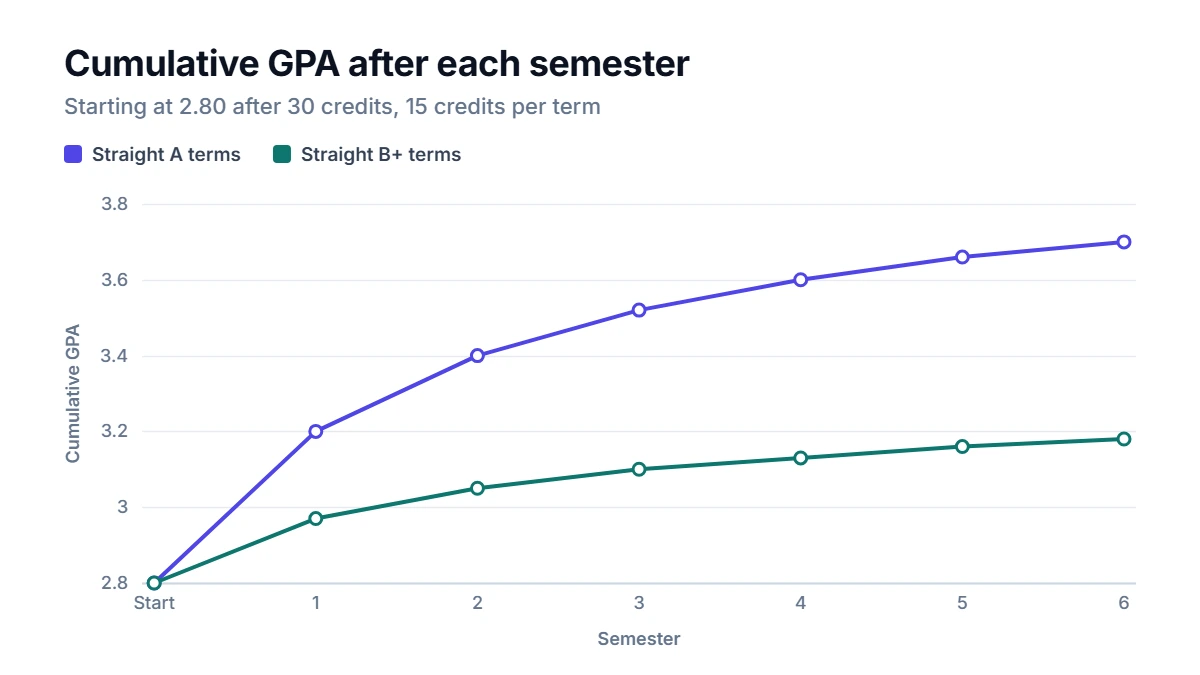
The first strong semester produces the biggest jump. By the sixth term, even a perfect 4.0 adds only about 0.04. The practical lesson: if your GPA matters for a scholarship or program, the earlier you raise it, the cheaper it is to do so.
Working out the grades you need
You can turn the cumulative formula around to find the term GPA required for a target:
needed term GPA = (target × total credits after the term − current quality points) / credits this term
Our student has 137.6 quality points over 44 credits and wants a 3.30 after a 15-credit term. That requires (3.30 × 59 − 137.6) / 15 = 57.1 / 15 = 3.81, so mostly A and A- grades. If the answer comes out above 4.0, the target cannot be reached in one term and you need to spread it over two or more.
How to use the GPA calculator
Enter each course's credits and letter grade in the GPA Calculator. Course names are optional. To see your new cumulative figure, also fill in your current cumulative GPA and the credits you have already completed. The result shows the semester GPA, total credits, quality points and, if you entered your record, the updated cumulative GPA. Try a few "what if" grades for courses that are still in progress to see which ones move the result most.
Common mistakes
- Leaving out credits. A plain average of grades is not your GPA.
- Including ungraded courses. Pass/fail, audited and many transfer courses give credit but no grade points, so they usually stay out of the calculation.
- Assuming retakes simply add. Many schools replace or average a retaken grade. Check your school's repeat policy before you count both attempts.
- Mixing scales. A weighted high school GPA on a 5.0 scale, or a school that gives A+ 4.3, will not match a standard 4.0 calculation.
FAQ
Can a 1-credit course hurt my GPA?
Only a little. A 1-credit F adds zero quality points but one credit, so on a 15-credit term it lowers the semester GPA by roughly a fifteenth of your average. A 4-credit F would do about four times as much damage.
What is a good GPA?
It depends on your goal. Many scholarships and honors lists set thresholds around 3.0 to 3.5, and competitive programs often look for higher. Look up the specific requirement you are aiming for rather than relying on a general rule.
How do I convert a percentage grade to GPA?
First convert the percentage to a letter grade using your course syllabus, because cut-offs differ between schools and instructors. Then use the letter grade's grade points in the normal calculation.
Does my semester GPA or cumulative GPA matter more?
Applications and transcripts usually report the cumulative GPA. The semester GPA matters for dean's lists, academic probation and showing an upward trend, which some admissions readers do notice.

