How to Calculate Your Macros
Turn a calorie target into grams of protein, carbs and fat in four simple steps, see how different diet splits change your plate and learn practical tips for hitting your numbers.

Counting macros means planning what your calories are made of, not just how many there are. Two diets with the same 1,700 kcal can feel completely different: one leaves you hungry by mid-afternoon, the other keeps you full and helps you hold on to muscle. Working out your macros is a short calculation, and once you understand it you can adjust it to fit the way you like to eat.
What macros are
Macronutrients are the three nutrients that supply almost all of your calories:
- Protein (about 4 kcal per gram) builds and repairs muscle and other tissue, and it is the most filling of the three.
- Carbohydrates (about 4 kcal per gram) are the body's preferred fuel for hard exercise and the brain.
- Fat (about 9 kcal per gram) supports hormones and helps you absorb some vitamins. It is the most energy-dense.
Alcohol also has calories (about 7 per gram), but it is not counted as a macro you plan for.
How to calculate your macros in four steps
- Find your calorie target. Estimate your total daily energy expenditure (TDEE) from your BMR and activity level, then subtract or add calories for your goal. About 500 kcal less per day aims for roughly 1 lb of loss a week.
- Choose a split. Decide what percentage of calories comes from protein, carbs and fat. The three must add up to 100%.
- Convert calories to grams. Multiply the target by each percentage, then divide by 4 for protein and carbs, or by 9 for fat.
- Spread it over your meals. Divide each daily gram total by the number of meals you eat.
A worked example
A 28-year-old woman is 5 ft 5 in tall, weighs 150 lb and exercises 3–5 times a week. She wants to lose about 1 lb a week and chooses a high-protein split of 40 / 30 / 30, eaten over 4 meals.
- Her BMR is about 1,411 kcal, and at the moderate activity level her TDEE is about 2,187 kcal.
- Subtracting 500 kcal gives a target of 1,687 kcal a day.
- Protein: 40% of 1,687 = 675 kcal ÷ 4 ≈ 169 g
- Carbs: 30% = 506 kcal ÷ 4 ≈ 127 g
- Fat: 30% = 506 kcal ÷ 9 ≈ 56 g
Over 4 meals that is roughly 42 g of protein, 32 g of carbs and 14 g of fat per meal. In food terms, 42 g of protein is about a palm-and-a-half of chicken breast, or a serving of Greek yogurt plus a couple of eggs.
How the split changes your plate
Keeping the same 1,687 kcal, here is what each common split means in grams:
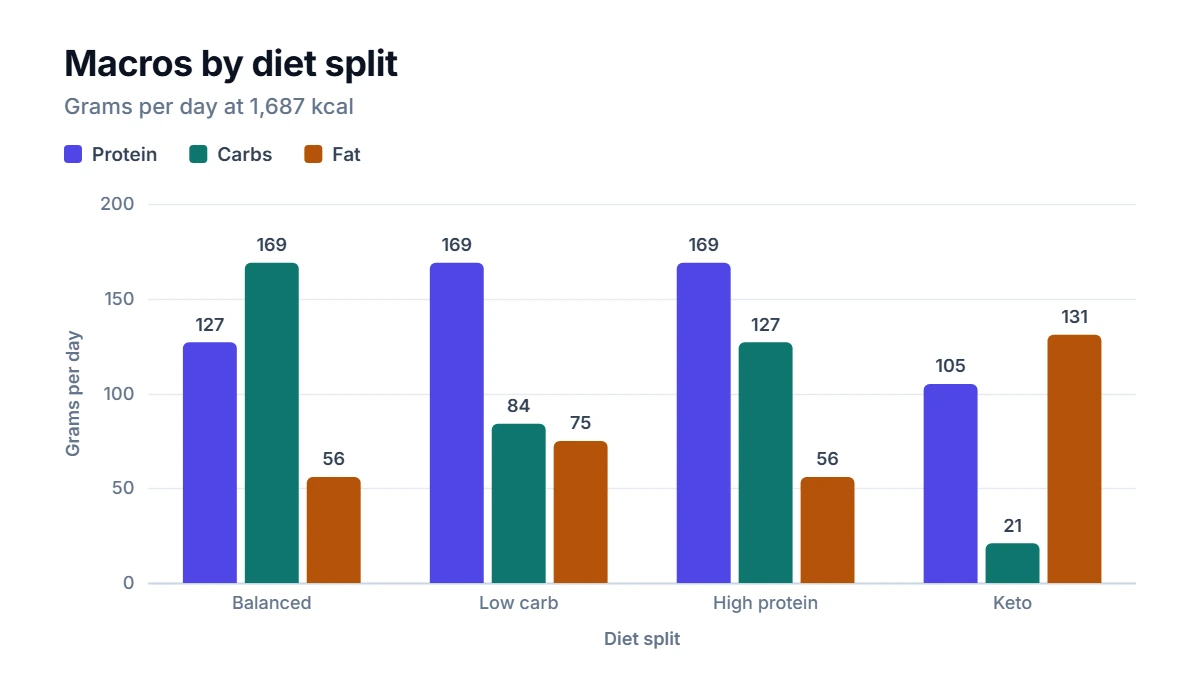
- Balanced (30 / 40 / 30): 127 g protein, 169 g carbs, 56 g fat
- Low carb (40 / 20 / 40): 169 g protein, 84 g carbs, 75 g fat
- High protein (40 / 30 / 30): 169 g protein, 127 g carbs, 56 g fat
- Keto (25 / 5 / 70): 105 g protein, 21 g carbs, 131 g fat
Notice how carbs swing from 169 g to 21 g. That is the difference between a bowl of pasta at dinner and no starchy foods at all. Keto in particular is a big change from the way most people eat, and 21 g of carbs is used up quickly by vegetables, dairy and sauces.
Percentages or grams per body weight?
Splits are percentages of calories, so your protein grams go up and down with your calorie target. That has a side effect: in a deep deficit, a balanced split can leave protein lower than you might want, and in a large surplus, a high-protein split can give more than you need.
Many people therefore set protein first in grams per kilogram (or per pound) of body weight, set fat at a reasonable floor, and give the rest of the calories to carbs. If you go that route, use the calculator's Custom split: work out what percentage your protein grams represent and enter those percentages. For our example, 120 g of protein is 480 kcal, about 28% of 1,687 kcal.
Either approach is fine. What matters most is that the plan is one you can follow week after week.
Using the Macro Calculator
The Macro Calculator combines both stages. Enter your age, sex, weight, height and activity level, pick a goal, a split and 3, 4 or 5 meals per day, and it returns your calorie target and the grams of each macro, per day and per meal. If you know your body fat percentage, switch the energy formula to Katch-McArdle. If you want your own percentages, choose Custom and make sure they add up to 100.
Tips for hitting your numbers
- Prioritize protein and calories. If you get those two right most days, small misses on carbs and fat matter little.
- Weigh foods for a week or two. Eyeballed portions are often off by 20–30%. After a short period of weighing, your estimates improve a lot.
- Count cooking oils. A tablespoon of oil is around 14 g of fat, about a quarter of the daily fat in our example.
- Read labels per 100 g. Serving sizes on packages vary; per-100 g figures make comparisons easy.
- Recalculate as you change. After losing 10 lb or so, your TDEE drops and your target should follow.
All figures are estimates, not medical or dietary advice. If you have a health condition, are pregnant or are planning a major diet change, check with a doctor or registered dietitian first.
FAQ
Do I need to hit my macros exactly every day?
No. Being within about 5–10 g of protein and carbs and a little more on fat is close enough for most goals. Looking at your weekly average is more useful than worrying about a single day.
Should fiber be subtracted from carbs?
Some apps count "net carbs" by subtracting fiber, mainly for low-carb and keto diets. The Macro Calculator counts fiber as part of carbs. Whichever method you choose, use the same one for both your target and your tracking.
Can I change my split on training and rest days?
Yes. Some people eat more carbs on hard training days and fewer on rest days while keeping weekly calories and protein the same. Treat it as a fine-tuning step once the basic plan is working.
Why did my calorie target change when I switched to metric units?
The weight-change goals are set per unit: 1 lb a week in US units (about 500 kcal a day) and 0.5 kg a week in metric (about 550 kcal a day). Half a kilogram is slightly more than a pound, so the deficit is slightly larger.

