How to Calculate Your Mortgage Payment
Learn how lenders turn a home price, a rate and a term into one monthly number, with a worked example, a look at where your money goes each year and what changes the payment most.

Your monthly mortgage payment is the number that decides whether a home fits your life, so it pays to know exactly where it comes from. It is not one cost but a bundle: the loan itself, the interest on it, and the running costs of owning the home. Once you can rebuild that bundle by hand, comparing loans, terms and down payments becomes much easier.
The four parts of a mortgage payment
Lenders often call the full payment PITI, short for principal, interest, taxes and insurance:
- Principal is the part that pays back the money you borrowed.
- Interest is what the lender charges for the loan, worked out on the balance you still owe.
- Property tax is set by your local government, usually as a yearly amount.
- Home insurance protects the building and is also priced per year.
Many homes add a fifth piece: a monthly HOA (homeowners association) fee for shared areas and services. Principal and interest are fixed for the whole term on a fixed-rate loan. Taxes, insurance and HOA fees can rise over time, so treat them as today's best guess.
The formula, step by step
Principal and interest come from the standard loan payment formula:
M = P × r / (1 − (1 + r)^−n)
- P is the loan amount: the home price minus your down payment.
- r is the monthly rate: the annual rate divided by 100, then by 12. A 6.5% rate becomes 0.065 / 12 ≈ 0.0054167.
- n is the number of monthly payments: 30 years is 360, 15 years is 180.
- Work out
(1 + r)^−n, subtract it from 1, and divideP × rby the result. That is M, your principal and interest. - Add the yearly property tax divided by 12, the yearly insurance divided by 12, and the monthly HOA fee.
The formula looks strange, but the idea is simple: it finds the one fixed payment that, month after month, covers that month's interest and slowly pays the balance down to exactly zero on the last payment.
A fully worked example
Say you buy a 350,000 home with 20% down. The down payment is 70,000, so you borrow 280,000. The rate is 6.5% for 30 years, property tax is 4,200 a year and insurance 1,500 a year, with no HOA.
- Principal and interest: 1,769.79 a month
- Property tax: 4,200 / 12 = 350.00
- Insurance: 1,500 / 12 = 125.00
- Total monthly payment: 2,244.79
Over 360 payments you would pay 637,124.57 in principal and interest, of which 357,124.57 is interest. That is more than the amount you borrowed.
Where the first payment goes
In month one the interest is 280,000 × 0.065 / 12 = 1,516.67. The rest of the 1,769.79, just 253.12, reduces the balance. In the whole first year you pay 18,107.85 in interest and only 3,129.63 in principal.
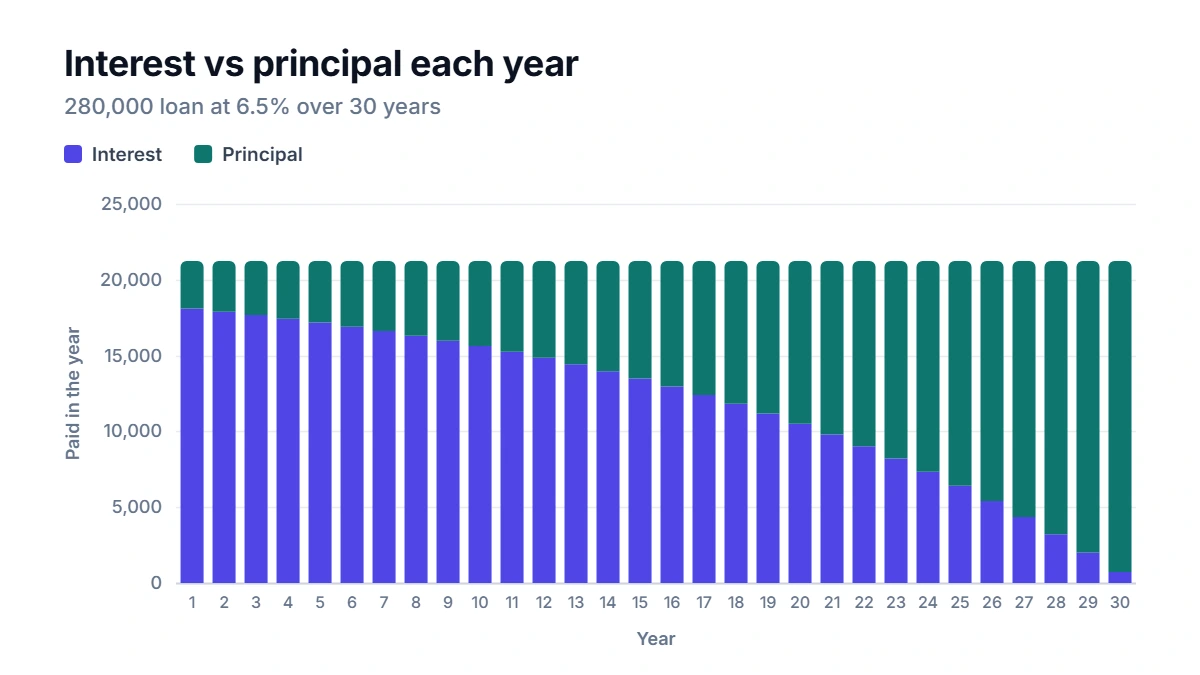
The balance falls slowly at first. After 15 years, half the term, you still owe 203,165.60. Principal only overtakes interest in year 20, when 10,725.05 of the year's payments go to principal and 10,512.43 to interest.
What changes the payment most
Using the same 350,000 home, here is what happens when you change one thing at a time:
- A higher rate. At 7.5% instead of 6.5%, principal and interest rise to 1,957.80, about 188 more each month and roughly 67,700 more interest over 30 years.
- A smaller down payment. With 10% down you borrow 315,000, and principal and interest become 1,991.01. Total interest grows to 401,765.14. A lender will usually also require mortgage insurance when you put down less than 20%, which adds to the payment.
- A shorter term. A 15-year loan at the same 6.5% costs 2,439.10 a month in principal and interest, 669.31 more than the 30-year loan. But total interest drops to 159,038.11, a saving of about 198,000.
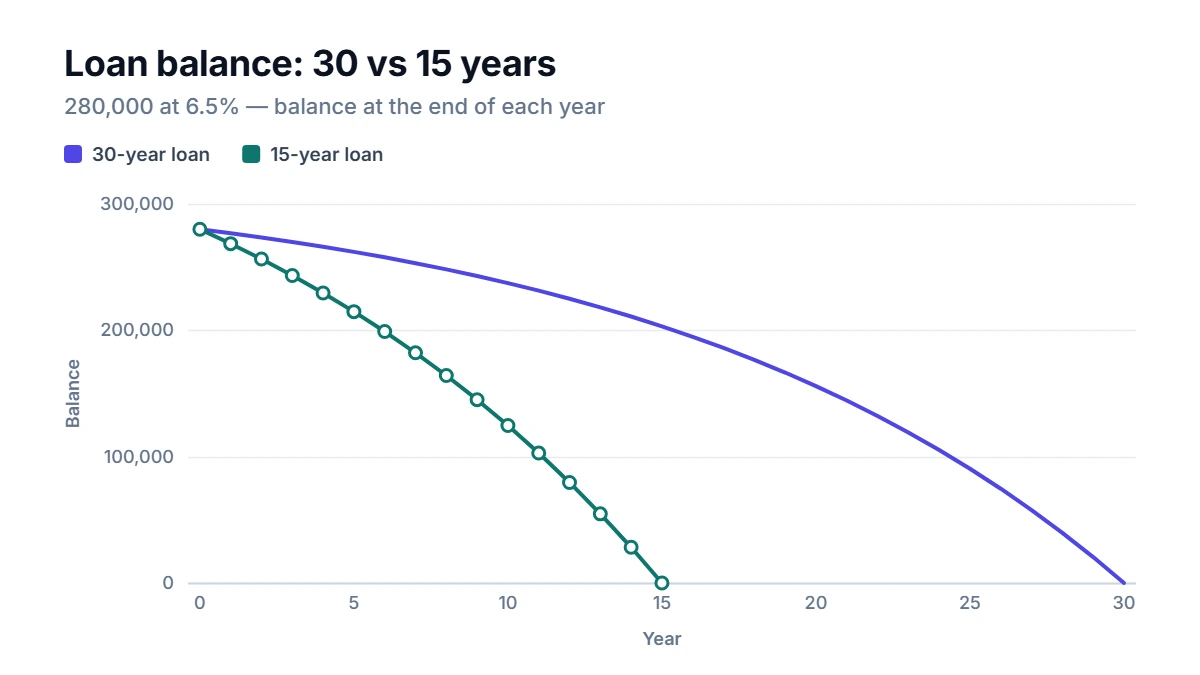
The shorter term is not automatically better. A lower required payment leaves room for savings, emergencies and other goals, and you can still pay extra on a 30-year loan when money allows. A higher required payment forces faster saving, but it gives you no breathing room in a bad month.
Using the Mortgage Calculator
The Mortgage Calculator does the steps above for you. Enter the home price, the down payment as an amount or a percentage, the rate and the term, then add property tax, insurance and HOA if you know them. You get the monthly breakdown, the total interest and a year-by-year table showing interest paid, principal paid and the remaining balance.
A good way to use it is to run three versions of the same home: the rate you have been quoted, a rate one point higher, and a different down payment. The gap between them shows how sensitive your budget is.
Common mistakes
- Forgetting taxes and insurance. Principal and interest alone can understate the real payment by several hundred a month.
- Entering the rate wrong. Type 6.5 for 6.5%, not 0.065. The calculator divides by 100 and by 12 for you.
- Mixing up the rate and the APR. The APR includes some fees, so it is slightly higher than the note rate used for the payment.
- Ignoring other costs of ownership. Closing costs, mortgage insurance, maintenance and utilities are not part of this payment, but they come out of the same budget.
All results are estimates, not financial advice. Check current rates, local tax rules and your lender's actual terms before you decide.
FAQ
How much does a 1% higher interest rate change my payment?
It depends on the loan size and term. On a 280,000, 30-year loan, going from 6.5% to 7.5% adds about 188 a month and about 67,700 in total interest. The longer the term, the bigger the effect of the rate.
What is PMI and why is it not in the result?
Private mortgage insurance protects the lender, not you, and is usually required on conventional loans with less than 20% down. Its price depends on your credit and down payment, so ask your lender for a quote and add it to the monthly total yourself.
Do extra payments lower my monthly payment?
On a normal fixed-rate loan, no. Extra payments go straight to principal, so the loan ends sooner and costs less interest, but the required payment stays the same unless the lender agrees to recast the loan.
Why does my lender's number differ from my own calculation?
Lenders often collect taxes and insurance through an escrow account, may add mortgage insurance, and use their own estimates for local taxes. The principal and interest part should match closely if the loan amount, rate and term are the same.
