How to Calculate When You Ovulate
Ovulation is not always on day 14. Learn how to estimate your ovulation day and fertile window from your cycle length, with a worked example and the signs that confirm it.

Ovulation is the moment an ovary releases an egg, and it is the only time in each cycle when pregnancy can begin. Knowing roughly when it happens helps if you are trying to conceive, and it also makes sense of your cycle: why your period comes when it does, and why "day 14" is not the right answer for everyone. You can estimate ovulation with nothing more than a calendar, as long as you understand which part of the cycle moves and which part stays put.
The two halves of a menstrual cycle
A cycle starts on the first day of your period (cycle day 1) and ends the day before the next period begins. It has two main phases:
- The follicular phase runs from day 1 until ovulation. During this time a follicle in the ovary matures. Its length varies from person to person and can change from one cycle to the next, which is why cycle lengths differ.
- The luteal phase runs from ovulation until the next period. After the egg is released, the empty follicle produces progesterone for a fairly fixed time. For most people this phase lasts about 12 to 14 days, and it stays relatively constant for the same person.
This is the key to the calculation. Because the luteal phase is the steady part, you find ovulation by counting backwards from your next expected period, not forwards from your last one.
Why ovulation is not always on day 14
The "day 14" rule comes from a textbook 28-day cycle with a 14-day luteal phase: 28 − 14 = 14 days after day 1. Change the cycle length and ovulation moves with it. With a 14-day luteal phase:
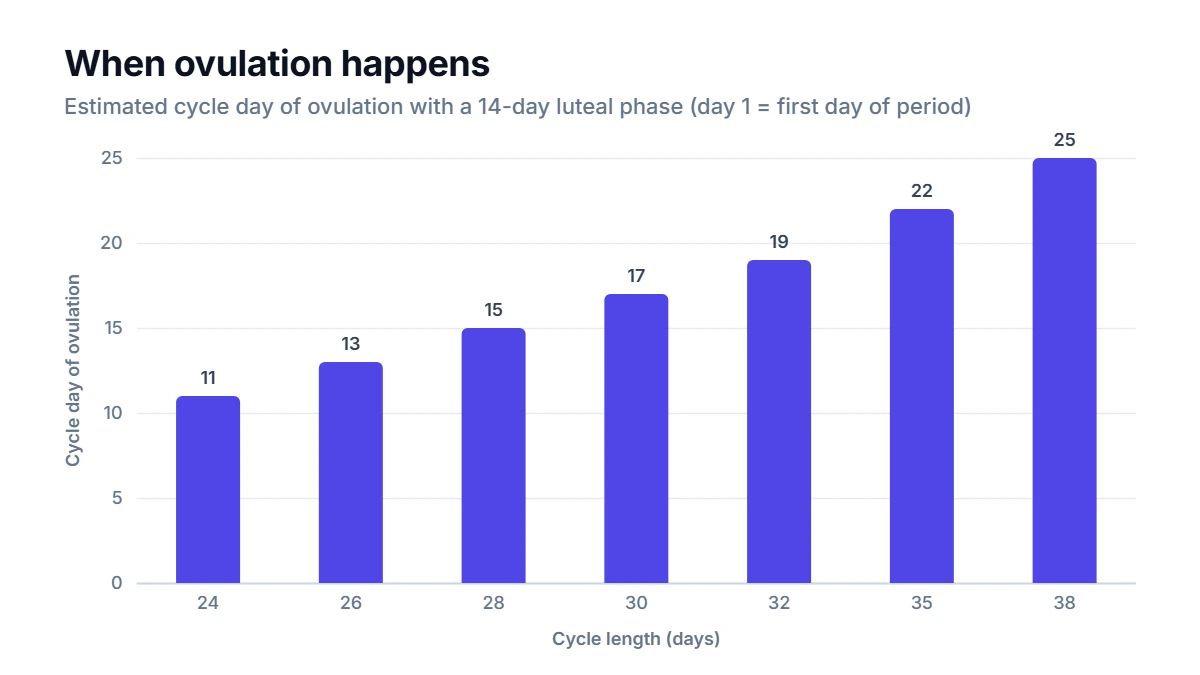
Someone with a 35-day cycle who assumes ovulation on day 14 would be more than a week too early. Counting back from the next period puts it on cycle day 22 instead.
The calculation step by step
- Find your average cycle length. Count the days from the first day of one period to the first day of the next. Average the last three to six cycles if you can.
- Estimate your luteal phase. Use 14 days if you do not know it. If you track ovulation with tests or temperature, count the days from ovulation to your next period.
- Subtract. Cycle length minus luteal phase gives the number of days from the start of your period to ovulation.
- Add that number to the first day of your last period. The result is your estimated ovulation day.
- Mark the fertile window. It covers the five days before ovulation and the ovulation day itself. Sperm can survive for several days, while an egg survives for only about a day after release.
A worked example
Your last period started on Monday, January 12, 2026. Your cycles average 32 days and you assume a 14-day luteal phase.
- Days to ovulation: 32 − 14 = 18
- Ovulation: January 12 + 18 days = Friday, January 30, 2026 (cycle day 19)
- Fertile window: Sunday, January 25 to Friday, January 30
- Next period expected: Friday, February 13, 2026, which is also the earliest day a home pregnancy test is likely to be reliable
The Ovulation Calculator gives exactly these dates and projects them forward. The following cycles start on February 13, March 17, April 18, May 20 and June 21, with estimated ovulation on March 3, April 4, May 6, June 7 and July 9.
What a shorter luteal phase changes
Suppose temperature tracking shows that your luteal phase is only 11 days. Keeping everything else the same, ovulation moves to 32 − 11 = 21 days after the start of your period: Monday, February 2, 2026. That is three days later than the default estimate, and enough to shift the whole fertile window. If you know your own luteal phase, entering it makes the estimate noticeably more personal.
How to check the estimate against your body
A calendar estimate is a starting point. These signs help you confirm where ovulation really falls:
- Ovulation predictor kits detect the surge of luteinizing hormone (LH) in urine that usually comes a day or so before ovulation.
- Basal body temperature rises slightly after ovulation and stays higher until your period. It confirms ovulation after the fact, which over several cycles reveals your pattern and your luteal phase length.
- Cervical mucus often becomes clear, slippery and stretchy, similar to raw egg white, in the days just before ovulation.
Using the calendar to know when to start testing, and the tests to pin down the day, is a practical combination.
Common mistakes
- Using last month's cycle only. A single unusually short or long cycle skews the estimate. Average several cycles.
- Counting from the end of the period. Cycle day 1 is the first day of full bleeding, not the last day.
- Treating the estimate as exact. Stress, illness, travel, changes in sleep and breastfeeding can all delay ovulation in a given cycle.
- Using the dates as contraception. Calendar estimates are not reliable enough to prevent pregnancy. Talk to a healthcare provider about contraception options.
These results are estimates, not medical advice. If you have very irregular cycles, very painful periods, or have been trying to conceive without success for a year (six months if you are over 35), talk to a doctor.
FAQ
Does ovulation always happen on day 14?
No. Day 14 only fits a 28-day cycle with a 14-day luteal phase. In a 24-day cycle ovulation is closer to day 11, and in a 35-day cycle closer to day 22.
How do I find my own luteal phase length?
Track basal body temperature or use ovulation tests for a few cycles. Count from the day you ovulated to the day before your next period starts. If the number is similar each time, use it in the calculator instead of the default 14.
What if my cycle length changes every month?
Use your average, but treat the result as a rough guide and widen the window you watch. Ovulation tests are much more useful than a calendar when cycles vary by more than a few days.
Which days give the best chance of conceiving?
The two or three days leading up to ovulation and the ovulation day itself are generally considered the most fertile, because sperm are then already present when the egg is released.
