How to Calculate Ratios: Simplify, Scale and Split
Ratios compare amounts, scale recipes and split costs fairly. Learn how to simplify a ratio, solve a proportion with cross-multiplication and divide a total in any ratio.

A ratio compares two amounts by saying how many of one there are for each of the other. Three cups of flour to two cups of water, 16 to 9 for a screen, 1 to 50 for a map: all are ratios. They turn up in cooking, mixing paint or concrete, sharing bills, reading maps and scaling photos. Three skills cover almost every situation: simplifying a ratio, solving a proportion and splitting a total. This guide walks through each one with real numbers.
What a ratio says
The ratio A : B, read "A to B", means that for every A units of the first thing there are B units of the second. A ratio can also be written as a fraction, A/B, or with the word "to". Two things about ratios matter right away:
- Order matters. 2 : 3 and 3 : 2 describe different mixtures.
- Ratios compare parts with parts. In a class with 12 girls and 18 boys, the ratio of girls to boys is 12 : 18, but girls make up 12 out of 30 students, which is a fraction of the whole.
Simplifying a ratio
A ratio is in simplest form when both terms are whole numbers that share no common factor except 1. To simplify:
- Find the greatest common factor (GCF) of the two terms.
- Divide both terms by it.
Example: 18 : 24. The factors of 18 are 1, 2, 3, 6, 9 and 18; the factors of 24 include 1, 2, 3, 4, 6, 8, 12 and 24. The largest one they share is 6, so 18 : 24 = 3 : 4.
If a term has decimals, first multiply both terms by 10, 100 or 1,000 to make them whole. For 0.75 : 2, multiply by 100 to get 75 : 200. The GCF of 75 and 200 is 25, so the simplest form is 3 : 8.
Simplifying does not change the relationship, just as 18/24 and 3/4 are the same fraction. It only makes the ratio easier to read and compare.
Solving a proportion
A proportion is a statement that two ratios are equal: A : B = C : D. If you know three of the values you can find the fourth with cross-multiplication:
A × D = B × C
Example: 3 : 4 = C : 20. Cross-multiplying gives 3 × 20 = 4 × C, so C = 60 ÷ 4 = 15.
Scaling a recipe
Proportions are the natural tool for resizing recipes. Say a recipe uses 250 g of flour for 4 servings and you want 6 servings:
- Set up the proportion: 250 : 4 = C : 6.
- Cross-multiply: 250 × 6 = 4 × C, so C = 1,500 ÷ 4 = 375 g.
Do the same for every ingredient and the recipe keeps its balance. The same method works for map scales, fuel use per mile, or converting a price per pack into a price per item.
Splitting a total in a ratio
To divide an amount in a given ratio:
- Add the terms of the ratio to get the total number of parts.
- Divide the amount by the number of parts to get the value of one part.
- Multiply each term by the value of one part.
Example: two friends put money into a shared purchase in the ratio 3 : 5 and sell it for 1,200. There are 3 + 5 = 8 parts, so one part is 1,200 ÷ 8 = 150. The first friend gets 3 × 150 = 450 and the second gets 5 × 150 = 750. A quick check: 450 + 750 = 1,200.
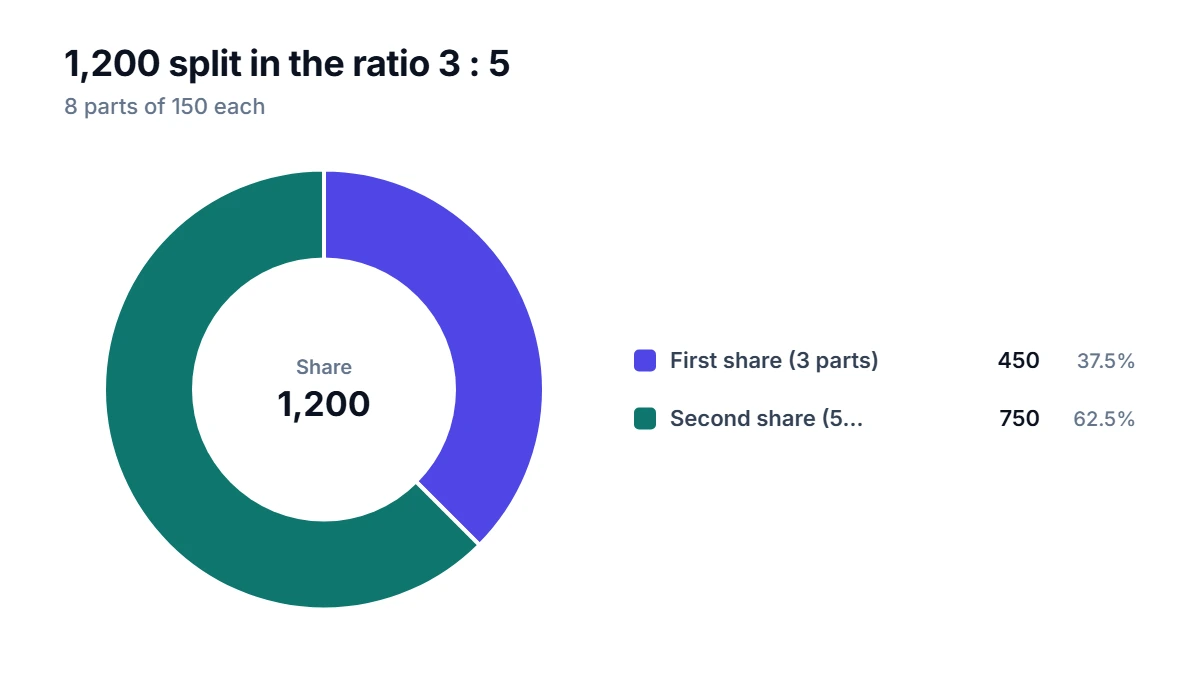
This is the fair way to share costs or profits when people contribute different amounts, or to divide rent when rooms differ in size.
How to use the Ratio Calculator
The Ratio Calculator has three small sections. To simplify, enter A and B; decimals are allowed. To solve a proportion, fill in three of the four boxes in A : B = C : D and leave the unknown one empty. To split, enter the total and the ratio. Each answer comes with the short steps, such as the multiplier used to clear decimals, the greatest common factor, or the value of one part, so you can check the working or copy it into homework.
Common mistakes
- Swapping the order. If the recipe says 2 parts water to 1 part rice, writing 1 : 2 gives you a very different dinner. Keep the same order on both sides of a proportion.
- Mixing units. 1 cup to 250 ml is not a ratio of 1 : 250. Convert both amounts to the same unit before comparing.
- Confusing part-to-part with part-to-whole. A 3 : 5 split gives the first person 3/8 of the total, not 3/5.
- Adding instead of multiplying when scaling. Going from 4 to 6 servings means multiplying every ingredient by 1.5, not adding two of everything.
- Rounding too early. In a proportion, keep the full values until the end, especially when the answer is used again in another step.
FAQ
Can a ratio have more than two terms?
Yes. Concrete is often mixed as 1 : 2 : 3 for cement, sand and gravel. You simplify and split three-term ratios the same way: divide all terms by their common factor, or add all terms to find the number of parts.
How do I turn a ratio into a percentage?
Add the terms to get the whole, then divide each term by the whole. For 3 : 5, the first part is 3 ÷ 8 = 37.5% and the second is 5 ÷ 8 = 62.5%.
What does a ratio like 1 : 0.5 mean?
It means that for every 1 unit of the first thing there is half a unit of the second. Multiply both terms by 2 to write it with whole numbers: 2 : 1.
How are ratios different from rates?
A ratio compares amounts measured in the same kind of unit, such as cups to cups. A rate compares different units, such as miles per hour or price per pound. You can still solve problems with rates using proportions.
