How to Calculate ROI and Compare Returns Fairly
Return on investment is one of the simplest numbers in finance, and one of the easiest to misread. Learn the formula, why time changes everything, and how to compare two investments on equal terms.

Return on investment, or ROI, answers a simple question: for every unit of money you put in, how much did you get back on top? It works for shares, a rental flat, a marketing campaign, solar panels or a used car you fixed up and sold. Because it is just a percentage, it lets you compare things of very different sizes. But a plain ROI figure hides one important detail, the time it took, and that detail is where most bad comparisons start.
The basic ROI formula
You need two numbers: what you invested and what you ended up with.
- Gain = amount returned − amount invested
- ROI = gain ÷ amount invested × 100
The amount returned should be everything the investment gave you: the sale price plus any dividends, interest, rent or other income you received along the way. Another way to read the same result is the money multiple, amount returned ÷ amount invested. A multiple of 1.5 means you got back one and a half times your money, which is the same as a 50% ROI.
A worked example
You put 8,000 into a fund and two and a half years later it is worth 11,000.
- Gain: 11,000 − 8,000 = 3,000
- ROI: 3,000 ÷ 8,000 × 100 = 37.5%
- Money multiple: 11,000 ÷ 8,000 = 1.375
That looks like a solid result. Now suppose a friend put the same 8,000 into something else and had 10,400 after one year. Their ROI is 2,400 ÷ 8,000 = 30%. On plain ROI you win, 37.5% against 30%. But you needed two and a half years and your friend needed one. To compare fairly, you have to put both results on a yearly basis.
Annualized ROI: putting time back in
Annualized ROI asks: what steady yearly return, compounded, would turn the starting amount into the final amount over the same period?
Annualized ROI = (amount returned ÷ amount invested)^(1 ÷ years) − 1
For your fund: 1.375^(1 ÷ 2.5) − 1 ≈ 13.59% a year. Your friend's 30% over one year is simply 30% a year. Seen that way, your friend's investment grew more than twice as fast, even though your total ROI was higher.
This figure is the same thing as the compound annual growth rate, or CAGR. It is the number to use whenever you compare investments held for different lengths of time, or compare an investment with a savings account rate.
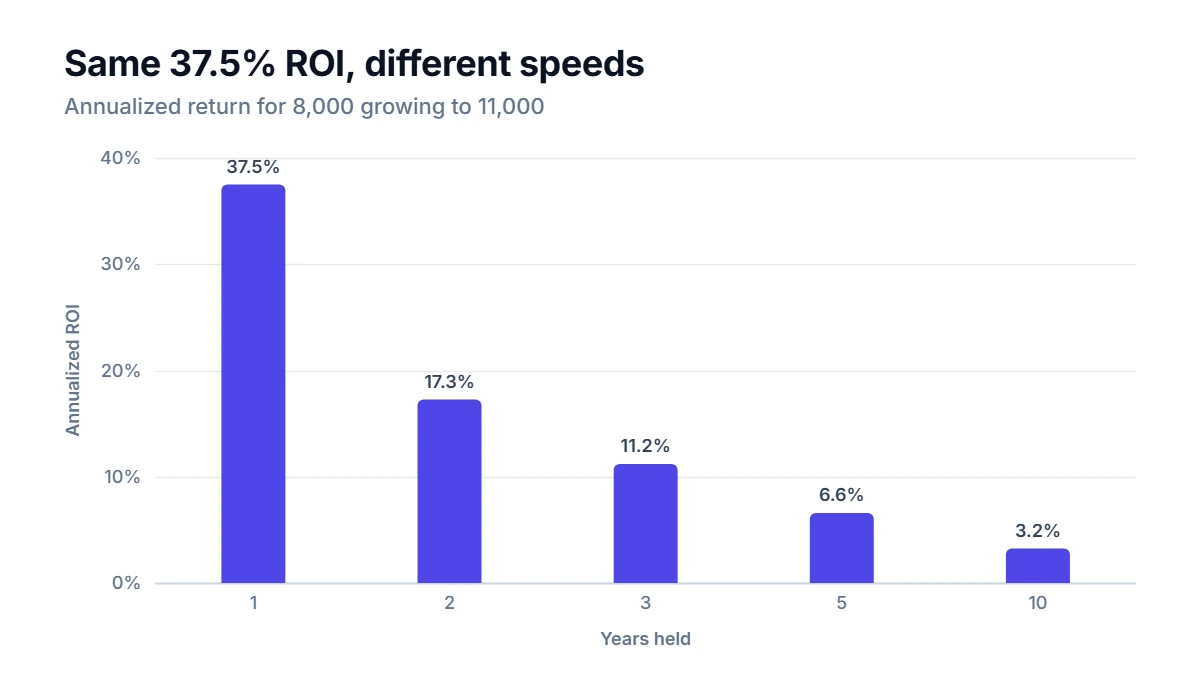
The chart shows how much the holding period matters. A 37.5% total return is 37.5% a year if it takes one year, about 17.26% a year over two years, 11.20% over three, 6.58% over five and only 3.24% a year over ten. Same total, very different investment.
Watch out for very short periods
Annualizing works in the other direction too, and that can mislead. Say you buy something for 2,000 and sell it 30 days later for 2,100. The ROI is a modest 5%, but the annualized figure is about 81% a year. That number assumes you could repeat the same 5% gain every month and reinvest it all year, which almost never happens. For holdings of a few weeks, report the plain ROI and the time it took, and be skeptical of anyone quoting a huge annual rate based on a short lucky run.
Count all the costs
ROI is only as honest as the numbers you feed it. Before you calculate, take out the costs that came with the investment:
- trading commissions and platform fees
- fund management fees, if they were not already deducted from the value
- taxes you paid on the gain or the income
- for property: repairs, insurance, agent fees and periods without a tenant
- for a business project: staff time, software and advertising
Go back to the fund example. If 150 of fees came out of the 11,000, the net return is 10,850, the gain is 2,850 and the ROI drops to 35.6%. Small costs make a bigger difference the shorter the holding period and the smaller the gain.
Inflation is another silent cost. A 13.59% yearly return is excellent in a year of low inflation and less impressive in a year of high inflation. Comparing your annualized ROI with the inflation rate for the same years gives a rough feel for the real gain in buying power.
How to use the ROI Calculator
Enter the amount you invested and the amount you got back, including any income. The ROI Calculator shows the gain or loss, the ROI percentage and the money multiple straight away. Add the investment length, either as years and months or as a start and end date, to get the annualized ROI as well. The what-if table then shows the annual return the same total ROI would represent over 1, 2, 3, 5 and 10 years, which is a quick way to see whether a result is truly strong or just slow and steady.
Limits of a single ROI figure
- It ignores risk. A 12% return from a volatile stock and a 12% return from a government bond are not equally good, because one could easily have been a loss.
- It assumes one deposit and one withdrawal. If you added money every month or took income out along the way, a simple ROI misstates the result. Methods such as the internal rate of return handle uneven cash flows.
- It looks backward. Past ROI says nothing certain about the next few years.
All results are estimates for comparison, not financial advice. For decisions with real money, check current fees and tax rules for your situation.
FAQ
Is ROI the same as profit?
No. Profit is an amount, such as 3,000. ROI is that profit as a percentage of what you invested, such as 37.5%. Two projects can both make 3,000 profit, but the one that needed 5,000 has a far better ROI than the one that needed 50,000.
How do I calculate ROI on a stock that paid dividends?
Add the dividends you received to the sale price, or to the current value if you still hold the shares, and use that total as the amount returned. Leaving dividends out understates the return, especially for income-focused shares held for many years.
What is the difference between ROI and ROE?
ROI measures the return on a particular investment you made. Return on equity, ROE, is a company accounting ratio: net income divided by shareholders' equity. They use similar math but answer different questions.
Can I compare ROI across different currencies?
Only if you measure both in the same currency. An investment abroad can show a good ROI in its local currency and a poor one in yours after the exchange rate moves, so convert the amount invested and returned at the rates of the day you actually moved the money.
