How to Calculate Simple Interest
Simple interest is the easiest interest to calculate: principal times rate times time. Learn the formula, how to handle months and days, and when simple interest is used instead of compound.

Simple interest is interest calculated only on the original amount, called the principal. It never earns interest on itself, so the same amount is added every year. That makes it the easiest kind of interest to work out by hand, and it is still used for many short-term loans, some car loans, treasury bills and quick estimates. Once you know the formula, you can also run it backwards to find the rate or the time.
The formula
I = P × r × t
- I is the interest.
- P is the principal, the amount borrowed or deposited.
- r is the annual interest rate written as a decimal, so 6% is 0.06.
- t is the time in years.
The total you end up with, or owe, is A = P + I, which can also be written A = P × (1 + r × t).
A worked example
You deposit 5,000 at 6% simple interest for 4 years.
- Write the rate as a decimal: 6 ÷ 100 = 0.06.
- Interest for one year: 5,000 × 0.06 = 300.
- Interest for four years: 300 × 4 = 1,200.
- Total: 5,000 + 1,200 = 6,200.
The balance grows by exactly 300 every year: 5,300, 5,600, 5,900 and 6,200. That steady, straight-line growth is the signature of simple interest.
When the time is not in whole years
The rate is per year, so the time must be in years too. Convert first:
- Months: divide by 12. For 18 months, t = 18 ÷ 12 = 1.5, and the interest is 5,000 × 0.06 × 1.5 = 450, for a total of 5,450.
- Days: divide by 365. For 120 days, t = 120 ÷ 365 ≈ 0.3288, and the interest is about 98.63, for a total of 5,098.63.
Some lenders and money markets use a 360-day year instead. With 360, the same 120 days gives 5,000 × 0.06 × 120 ÷ 360 = 100.00, a little more than with 365. If the exact figure matters, check which day count your agreement uses.
Solving for rate, time or principal
Rearranging the formula answers other questions:
- Rate: r = I ÷ (P × t). If 5,000 earned 450 in 1.5 years, r = 450 ÷ 7,500 = 0.06, or 6%.
- Time: t = I ÷ (P × r). To earn 1,500 on 5,000 at 6% takes 1,500 ÷ 300 = 5 years.
- Principal: P = I ÷ (r × t). To earn 900 in 3 years at 6%, you need 900 ÷ 0.18 = 5,000.
Simple versus compound interest
With compound interest, each year's interest is added to the balance and earns interest itself. Over a short time the two are nearly the same, but the gap widens every year. Here is 5,000 at 6% over 20 years, with simple interest and with interest compounded once a year:
- After 4 years: 6,200 simple, 6,312.38 compound.
- After 10 years: 8,000 simple, 8,954.24 compound.
- After 20 years: 11,000 simple, 16,035.68 compound.
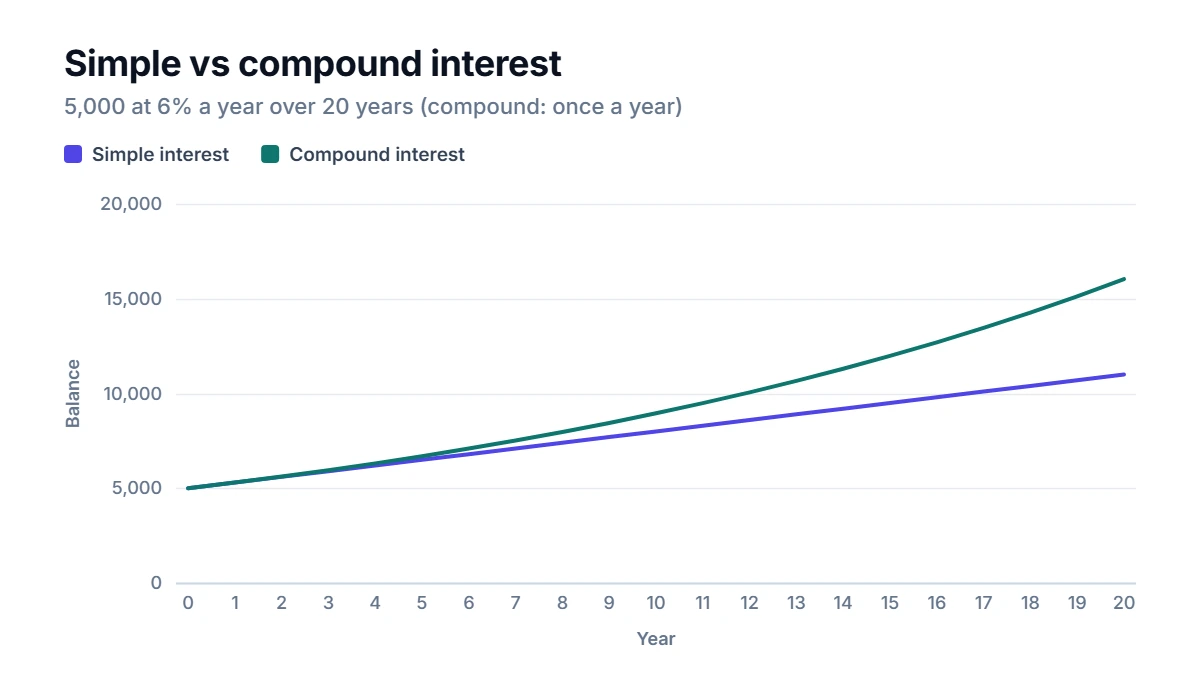
Simple interest grows in a straight line; compound interest curves upward. As a saver, compounding works in your favor. As a borrower, a simple-interest loan means you never pay interest on interest, as long as you pay on time.
How to use the Simple Interest Calculator
Enter the principal, the annual interest rate and the time, and pick years, months or days from the list next to the time box. The Simple Interest Calculator shows the interest and the total amount. When the time is one year or longer, a table shows the interest for each year, the running total and the balance, with a final row for any partial year. It uses a 365-day year for days.
Where simple interest shows up
- Short-term loans and notes. Many personal and business loans of a year or less charge simple interest on the amount borrowed.
- Some auto loans. Here interest is charged on the outstanding balance each day, so it is simple interest on a balance that falls as you pay. Paying early saves interest.
- Treasury bills and some bonds. Returns on short-term government debt are often quoted on a simple-interest basis.
- Late fees and penalties. Interest on an overdue bill is often calculated as a simple rate per day or per month.
Common mistakes
- Using the percentage instead of the decimal. 5,000 × 6 × 4 gives 120,000, which is clearly wrong. Divide the rate by 100 first.
- Mixing time units. An annual rate with a time in months gives an answer 12 times too large. Convert months to years.
- Confusing a monthly rate with an annual one. 1.5% a month is 18% a year. Make sure the rate and the time use the same unit.
- Assuming a loan is simple interest. Most mortgages and credit cards compound. Read the terms before using this formula for them.
Results are estimates; the exact amount is set by your loan or deposit agreement.
FAQ
Is simple interest better for borrowers?
At the same rate and term, yes, because you never pay interest on interest. In practice, compare the total cost of the loan, including fees, rather than just the interest method.
How do I calculate simple interest per month?
Multiply the principal by the annual rate and divide by 12. For 5,000 at 6%, that is 5,000 × 0.06 ÷ 12 = 25 a month.
Can simple interest be negative?
Not with a positive rate and time. Interest is zero when the rate is zero, and it grows in proportion to both the rate and the time.
How long does it take to double money with simple interest?
Doubling means the interest equals the principal, so r × t = 1. At 6%, that takes 1 ÷ 0.06 ≈ 16.7 years. With annual compounding at the same rate, it takes about 11.9 years.


