How to Calculate Square Roots by Hand
What a square root is, how to estimate one in a minute without a calculator, how to simplify radicals with prime factors, and what to do with cube roots and negative numbers.

A square root answers one question: what number, multiplied by itself, gives this number? The square root of 49 is 7 because 7 × 7 = 49. That idea turns up far beyond math class: in the diagonal of a room, the size of a screen, the distance on a map, the standard deviation in a report. This guide covers what square roots are, how to find them by hand, how to simplify them, and what to do with the awkward cases.
Squares and square roots
Squaring a number multiplies it by itself: 6² = 36. Taking the square root reverses that: √36 = 6.
Numbers like 1, 4, 9, 16, 25, 36, 49, 64, 81 and 100 are perfect squares, because their roots are whole numbers. Every other positive whole number has a square root that is irrational: its decimal goes on forever without repeating. √2 ≈ 1.414213562… is the classic example.
Strictly, every positive number has two square roots: 6 and −6 both square to 36. The √ symbol means the principal root, the non-negative one. When you solve an equation like x² = 36, remember both answers: x = 6 or x = −6.
How square roots grow
Square roots grow quickly at first and then more and more slowly. Going from 0 to 4 gives a root of 2; going from 64 to 100, a much bigger jump, only takes the root from 8 to 10.
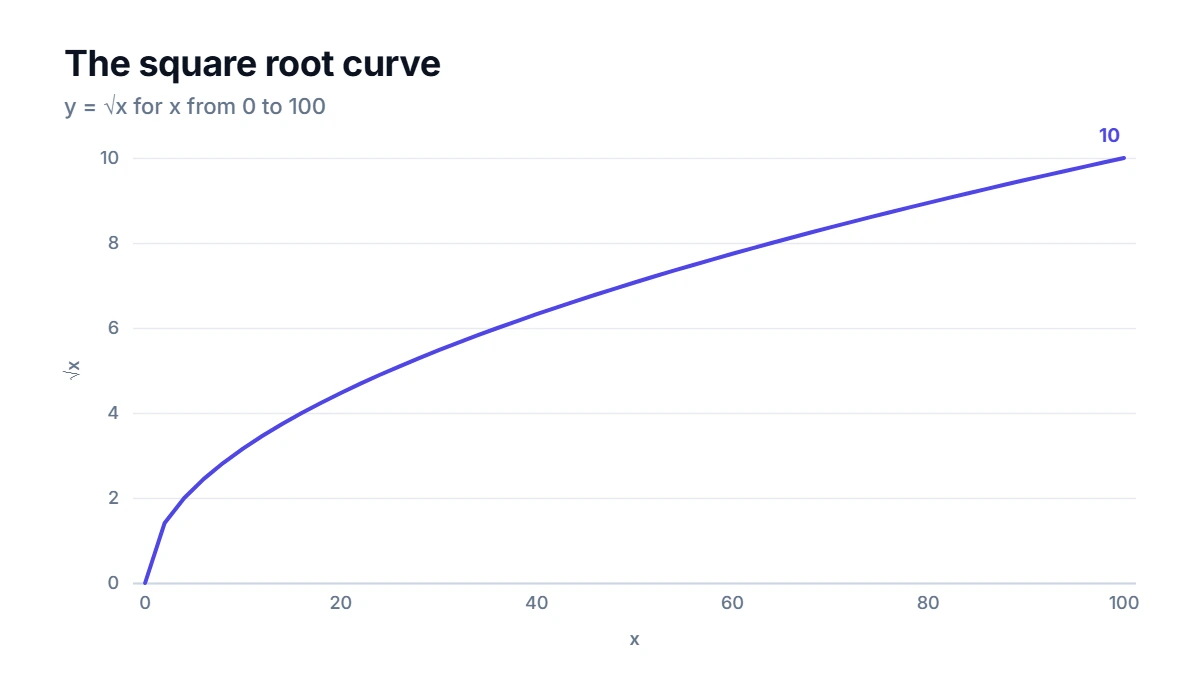
This shape explains a lot of everyday rules. Doubling a screen's diagonal quadruples its area. To halve the error of an average, you need four times as much data.
Estimating a square root by hand
You can get close to any square root in a minute without a calculator.
- Bracket it between two perfect squares. For √30: 25 < 30 < 36, so the root is between 5 and 6.
- Make a first guess. Take the lower root and add the distance to the next square divided by twice the root: 5 + (30 − 25) ÷ (2 × 5) = 5.5.
- Refine it. Divide the number by your guess and average the two: (5.5 + 30 ÷ 5.5) ÷ 2 = (5.5 + 5.4545) ÷ 2 ≈ 5.47727.
The true value is 5.477225575, so after one refining step the guess is already within 0.0001 of it. Repeat step 3 and the result improves dramatically each time. This is the Babylonian (or Newton's) method, and it is close to how computers do it.
Simplifying a square root
In algebra and geometry you are often asked for the exact answer, written in simplified radical form. The trick is to pull out any perfect-square factor.
Example: √50
- Find the prime factors: 50 = 2 × 5².
- Look for pairs. 5² is a pair; the single 2 is not.
- Each pair comes out as one factor: 5 comes out.
- What is left stays inside: √2.
So √50 = 5√2, which is about 7.071067812.
Example: √180
180 = 2² × 3² × 5. Two pairs come out, 2 and 3, giving 2 × 3 = 6, and the 5 stays inside: √180 = 6√5 ≈ 13.41640786.
Example: √1764
1764 = 2² × 3² × 7². Everything pairs up, so nothing is left inside: √1764 = 2 × 3 × 7 = 42. That is the quickest way to prove a big number is a perfect square.
Quick check
Square the simplified answer and you should get back the original: (5√2)² = 25 × 2 = 50.
Cube roots and higher roots
A cube root asks which number, used three times in a product, gives the target: ∛1000 = 10 because 10 × 10 × 10 = 1000. Simplifying works the same way, but you look for groups of three instead of pairs:
- 54 = 2 × 3³, so ∛54 = 3∛2 ≈ 3.77976315.
- For a 4th root you group in fours: 81 = 3⁴, so ∜81 = 3.
Odd roots of negative numbers are fine and negative: ∛−8 = −2, since (−2)³ = −8.
Square roots of negative numbers
No real number squared gives a negative result, so √−50 has no real answer. Mathematics extends the number line with the imaginary unit i, defined by i² = −1. Then √−50 = √50 × √−1 = 5i√2, about 7.071067812i. You will meet this in algebra courses, electrical engineering and physics.
Where square roots show up
- Distance and diagonals. The Pythagorean theorem says the long side of a right triangle is √(a² + b²). A room 10 ft by 24 ft has a corner-to-corner diagonal of √(100 + 576) = √676 = 26 ft.
- Screen sizes. A 16:9 screen's width and height come from its diagonal through the same theorem.
- Statistics. Standard deviation is the square root of the variance.
- Physics. The time a dropped object takes to fall grows with the square root of the height.
Using the Square Root Calculator
The Square Root Calculator gives you the decimal value and, for whole numbers, the simplified radical form with each prime-factor step written out. Choose Square or Cube, or Other for any whole-number root from 2 to 100, and enter a number between −1e15 and 1e15, decimals included. It also tells you whether the number is a perfect square, cube or higher power, and it returns an imaginary or complex answer for even roots of negative numbers.
Common mistakes
- Splitting a sum. √(9 + 16) is √25 = 5, not √9 + √16 = 7. Roots split over multiplication, √(a × b) = √a × √b, but never over addition.
- Forgetting the negative solution. x² = 49 has two answers, 7 and −7.
- Stopping too soon when simplifying. √72 = 3√8 is not finished, because 8 still contains 4. The full answer is 6√2.
- Rounding before the end. Keep the radical form or several decimals until the last step of a longer problem.
FAQ
Is the square root of a decimal smaller or larger than the number?
For numbers between 0 and 1, the square root is larger than the number itself. √0.25 = 0.5, because 0.5 × 0.5 = 0.25. For numbers above 1, the root is smaller.
What is the square root of 0?
Zero, because 0 × 0 = 0. It is the only number with just one square root.
How can I tell quickly that a number is not a perfect square?
Look at the last digit. Perfect squares can only end in 0, 1, 4, 5, 6 or 9. A number ending in 2, 3, 7 or 8 is never a perfect square. The reverse is not true: 26 ends in 6 but is not a square.
What does the small number in front of the root sign mean?
It is the degree of the root. No number means a square root, a small 3 means a cube root, and a small n means an nth root, the number that gives the target when multiplied by itself n times.

