How to Calculate a Weighted Grade
A weighted grade gives each assignment the influence the syllabus says it should have. Learn the method, check your grade mid-term and work out exactly what you need on the final.

Most courses do not count every assignment equally. A final exam might be worth 30% of the grade while a week of homework is worth a few percent, so a simple average of your scores can give a very misleading picture. A weighted grade fixes that by giving each piece of work the influence the syllabus says it should have. Knowing how to calculate it lets you see where you stand at any point in the term and what you need on the remaining work.
Weighted vs simple average
A simple average adds your scores and divides by how many there are. A weighted average multiplies each score by its weight first, so items that count more pull the result harder.
Imagine a course with five graded categories:
- Homework, worth 15%: you scored 92%
- Quizzes, worth 10%: 88%
- Midterm exam, worth 25%: 76%
- Project, worth 20%: 84%
- Final exam, worth 30%: 81%
The simple average is (92 + 88 + 76 + 84 + 81) ÷ 5 = 84.2%. It treats your homework as if it mattered as much as the final. The weighted average gives a different and more accurate answer.
How to calculate a weighted grade
- Write down each score and its weight from the syllabus, both as percentages.
- Multiply each score by its weight.
- Add all the products.
- Divide by the total of the weights. If the weights add up to 100, this is the same as dividing by 100.
Using the course above:
- Homework: 92 × 15 = 1,380
- Quizzes: 88 × 10 = 880
- Midterm: 76 × 25 = 1,900
- Project: 84 × 20 = 1,680
- Final: 81 × 30 = 2,430
The total is 8,270, and 8,270 ÷ 100 = 82.7%. On a common US scale that is a B-, while the simple average of 84.2% would suggest a B. The lower midterm and final, which carry the most weight, are what pull the grade down.
Seeing what each item contributes
Each product divided by 100 shows how many percentage points that item adds to the final grade. Homework adds 13.8 points, quizzes 8.8, the midterm 19, the project 16.8 and the final 24.3.
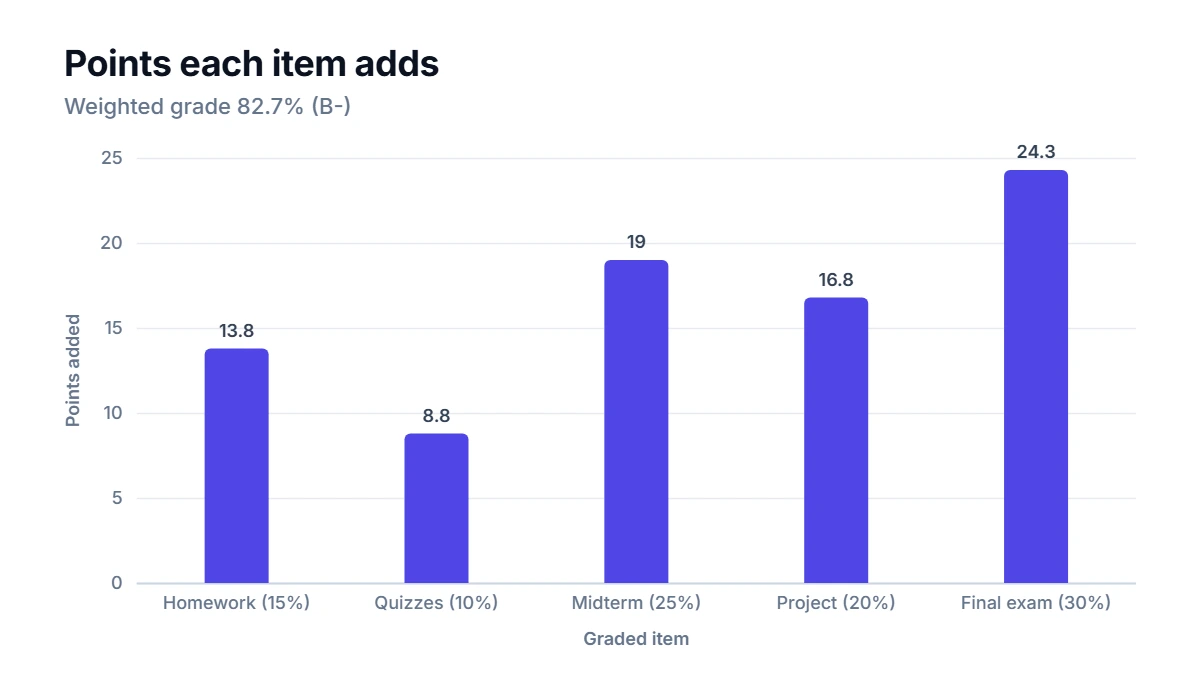
This view is useful for deciding where to spend effort. Raising the final from 81% to 91% would add 3 points to the course grade, because it carries 30% of the weight. Raising quizzes by the same 10 points would add only 1.
Checking your grade in the middle of a term
Before the final, you only have grades for 70% of the course. Dividing by 100 would treat the missing final as a zero and badly understate your standing. Divide by the weights you actually have instead:
- 1,380 + 880 + 1,900 + 1,680 = 5,840
- 5,840 ÷ 70 = 83.43%, currently a B.
This "so far" grade is the right one to track during the term. It tells you how you are doing on the work completed.
What do I need on the final?
This is the question most students actually ask. Write the course grade as the points you already have plus the final's share:
target = (points so far + final score × final weight) ÷ 100
Points so far are 5,840 ÷ 100 = 58.4, and the final is worth 30%. To finish with at least 80% (a B- on this scale):
- 80 = 58.4 + 0.3 × final score
- final score = (80 − 58.4) ÷ 0.3 = 72%
To reach 83% (a B), you would need (83 − 58.4) ÷ 0.3 = 82% on the final.
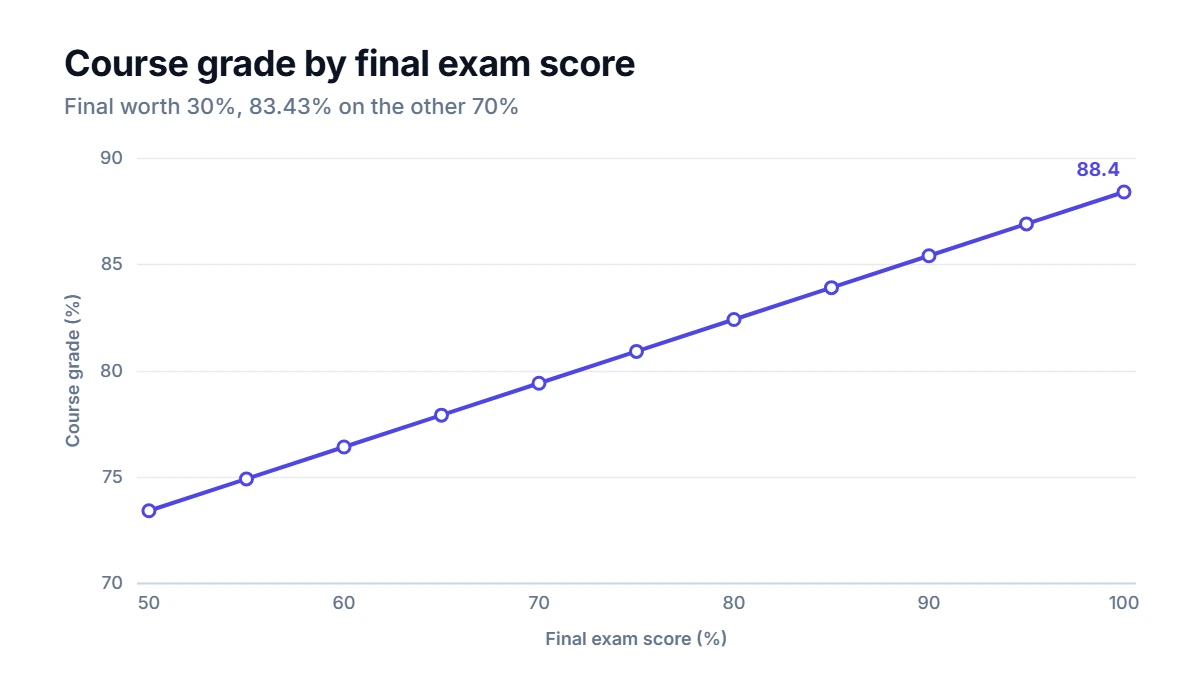
The chart shows the whole range at once. Even a 50% on the final leaves a course grade of 73.4%, and a perfect 100% tops out at 88.4%. Because the final is worth 30%, the course grade moves 3 points for every 10 points on the exam. That keeps expectations realistic in both directions.
Using the Weighted Grade Calculator
The Weighted Grade Calculator has one row per graded item. Enter the grade and the weight as percentages, add an optional name, and use Add row for more items. Press Calculate to get the weighted average, the letter grade and the points each item contributes. If your weights add up to less than 100, the calculator divides by the total you entered and tells you so, which gives the "so far" grade described above. To test what you need on an upcoming exam, add it as a row and try different scores.
Common mistakes
- Averaging the averages. If homework has ten assignments, first average them into one homework score, then weight that score by the homework percentage. Do not enter each assignment with the full category weight.
- Mixing points and percentages. A score of 45 out of 50 is 90%, not 45. Convert raw points to percentages before you start.
- Assuming the letter cut-offs. The common US scale puts a B- at 80 and an A- at 90, but many schools and instructors use their own. Check the syllabus.
- Forgetting dropped scores. Some courses drop the lowest quiz or homework. Leave it out before averaging the category.
- Ignoring rounding rules. Some instructors round 89.5 up to 90, others do not. The calculator rounds to two decimals and bases the letter on that value.
FAQ
Can a weight be larger than 100%?
No. Each weight is a share of the whole course, so all weights together should add up to 100%. Individual grades, on the other hand, can exceed 100% when extra credit is involved.
How do I handle a course graded on total points?
If the syllabus says the course has 1,000 points in total, each item's weight is simply its maximum points divided by 1,000. A 200-point exam is worth 20%. You can also enter the points as weights directly; the calculator divides by the total.
Does a weighted grade work for GPA?
The idea is the same: a GPA is a weighted average of grade points, with credit hours as the weights. The scale is different, though, so use a GPA calculator for that.
What if my teacher has not published the weights?
Ask. Without the weights, any calculation is a guess. If the course is graded purely on equal-value assignments, a simple average is the same as a weighted one.

