How to Compare Loan Offers and Understand Your Payment
The lowest monthly payment is rarely the cheapest loan. Learn what really drives a loan payment and how to compare offers by their total cost, with worked numbers.

When a lender sends you a loan offer, the number that jumps out is the monthly payment. It is the figure that has to fit your budget, so it matters. But two loans with similar payments can cost you thousands apart, and a loan with a lower payment is often the more expensive one. This guide explains what moves a loan payment up or down and how to line up several offers so you can see which one is really cheaper.
The three things that set your payment
For an ordinary fixed-rate loan, the payment depends on only three inputs: how much you borrow, the interest rate and the number of months. Fees and insurance can sit on top, but those three do the heavy lifting.
- Amount. The payment scales in a straight line with the amount. Borrow 10% more and the payment rises by exactly 10%.
- Interest rate. A higher rate raises the payment, but less dramatically than most people expect on short loans, and much more on long ones.
- Term. Spreading the loan over more months lowers each payment, but you pay interest for longer, so the total cost climbs.
The rate and the term pull in opposite directions on how the deal feels: a long term makes the payment comfortable while quietly increasing what you hand over in total.
How the term changes the picture
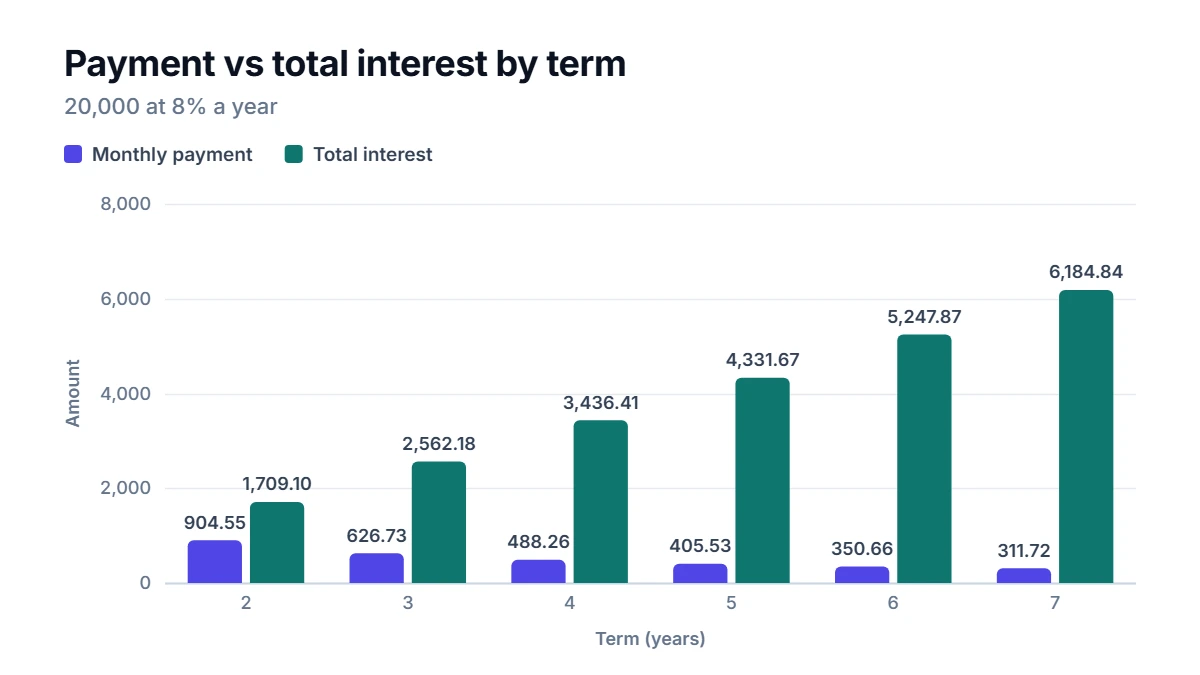
Take a 20,000 loan at 8% a year and change only the term:
- 2 years: 904.55 a month, 1,709.10 total interest
- 3 years: 626.73 a month, 2,562.18 total interest
- 4 years: 488.26 a month, 3,436.41 total interest
- 5 years: 405.53 a month, 4,331.67 total interest
- 6 years: 350.66 a month, 5,247.87 total interest
- 7 years: 311.72 a month, 6,184.84 total interest
Going from 3 to 7 years cuts the payment roughly in half, but the interest bill grows to almost two and a half times its size. Notice also that each extra year saves less on the payment than the one before it: moving from 2 to 3 years lowers the payment by about 278, while moving from 6 to 7 years lowers it by only about 39. The extra interest, on the other hand, keeps arriving at nearly 900 a year.
How the rate changes the picture
Now keep the term at 5 years and change the rate on the same 20,000:
- 6%: 386.66 a month, 3,199.36 total interest
- 8%: 405.53 a month, 4,331.67 total interest
- 10%: 424.94 a month, 5,496.45 total interest
- 12%: 444.89 a month, 6,693.34 total interest
- 15%: 475.80 a month, 8,547.92 total interest
Each two percentage points add only about 19 to 20 to the monthly payment, which can make a higher rate look harmless. Over 60 months, though, the jump from 6% to 15% more than doubles the interest. A small difference per month becomes a large one once you multiply it by the number of payments.
Comparing three real-looking offers
Suppose you need 20,000 and receive these offers:
- Offer A: 7.5% for 36 months, no fee
- Offer B: 8.5% for 60 months, no fee
- Offer C: 6.9% for 48 months, with a 4% origination fee added to the loan
Running each through the Loan Calculator gives:
- Offer A: 622.12 a month, 22,396.48 repaid in total, so 2,396.48 is the cost of borrowing.
- Offer B: 410.33 a month, 24,619.84 in total, a cost of 4,619.84.
- Offer C: the fee raises the amount you owe to 20,800, so you pay 497.12 a month and 23,861.64 in total. Measured against the 20,000 you actually receive, the cost is 3,861.64.
Offer C has the lowest advertised rate, yet the fee makes it more expensive than Offer A. Without the fee it would cost 2,943.88, so the fee alone adds about 918. Offer B has by far the friendliest payment and by far the highest cost.
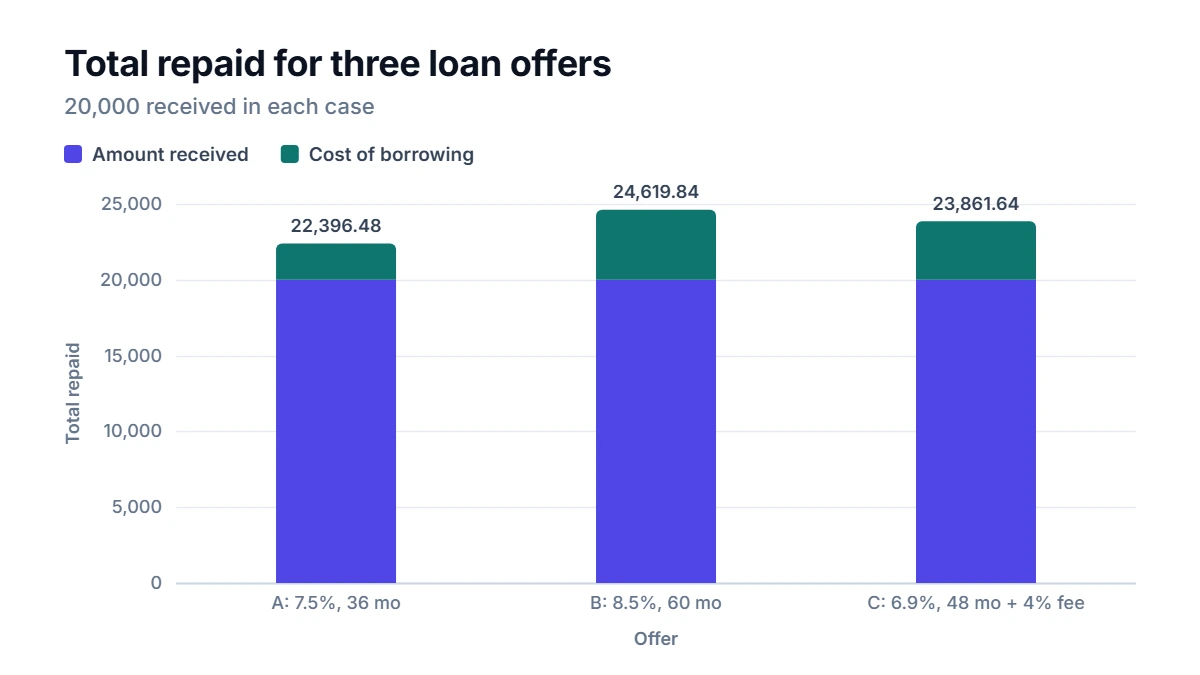
The fair way to compare is therefore: same amount received, then look at the total you repay. If you cannot afford the payment of the cheapest option, pick the shortest term whose payment you can carry comfortably, not the longest term on offer.
A simple comparison routine
- Write down the amount you will actually receive after any fees are deducted or added.
- For each offer, enter the amount you will owe, the rate and the term into the Loan Calculator.
- Note the monthly payment and the total of payments.
- Subtract the amount you receive from the total of payments. That is the true cost of each offer.
- Rule out any offer whose payment does not fit your budget with room to spare, then choose the lowest true cost among the rest.
If one lender quotes an APR and another quotes only a rate, the APR is usually the better yardstick because it folds certain fees into a single yearly figure. Rules on what an APR must include differ by country and loan type, so check current rules where you live.
Things that are easy to miss
- Fees that are deducted, not added. Some lenders take the fee out of the money they send you. You then owe 20,000 but receive less, which raises your real cost just as much.
- Optional add-ons. Payment protection or insurance can be bundled into the monthly figure. Ask for the payment with and without them.
- Prepayment rules. If you plan to pay early, a loan without a prepayment penalty can be worth more than a slightly lower rate.
- Variable rates. The calculator assumes the rate never changes. A variable-rate loan can start cheaper and end up costing more.
All of the figures here are estimates for comparison, not financial advice. Your loan agreement and the lender's own disclosure are the final word.
FAQ
Is a lower monthly payment always better?
No. A lower payment usually comes from a longer term, and a longer term means more months of interest. Choose the lowest payment only if a higher one would truly strain your budget, and know what that comfort costs in total.
How much does one percentage point of interest change my payment?
It depends on the amount and the term. On 20,000 over 5 years, each point adds roughly 10 a month. On a 30-year mortgage the effect per point is far larger, because the interest has decades to build up.
Should I compare offers with different terms?
Yes, but compare them on the same basis: the total you repay for the same amount received. You can also ask each lender for a quote at the same term, which makes the rates and fees easier to compare directly.
Does a bigger down payment work the same way as borrowing less?
Yes. Every unit you do not borrow lowers the payment in proportion and removes the interest that unit would have earned for the lender. On long loans, borrowing less is one of the most effective ways to cut the total cost.

