How to Convert Celsius to Fahrenheit (and Back)
The two formulas behind every temperature conversion, worked examples for body, oven, room and freezer temperatures, and a mental shortcut that is surprisingly accurate for weather.

A recipe says 180 degrees, the weather app says 68, and a thermometer reads 37.5. Whether you need to switch between Celsius and Fahrenheit depends on where you live and what you are reading, but the conversion itself is always the same two formulas. This guide explains where the numbers come from, works through real examples, and gives you a mental shortcut that is surprisingly accurate for weather.
Why the two scales differ
Both scales are anchored to water, but they place it differently. On the Celsius scale water freezes at 0 and boils at 100 at sea level, so there are 100 steps between the two. On the Fahrenheit scale water freezes at 32 and boils at 212, which puts 180 steps between them.
That gives two facts you need for any conversion:
- The size of a degree differs. 100 Celsius degrees cover the same range as 180 Fahrenheit degrees, so one Celsius degree equals 1.8 Fahrenheit degrees, or 9/5.
- The zero points differ. 0 °C lines up with 32 °F, so there is an offset of 32.
The formulas
To go from Celsius to Fahrenheit, scale first, then shift:
- °F = °C × 9/5 + 32
To go from Fahrenheit to Celsius, undo those steps in reverse order, shift first, then scale:
- °C = (°F − 32) × 5/9
The order matters. Subtracting 32 after multiplying, or forgetting the parentheses, is the most common reason for a wrong answer.
Worked examples
Body temperature: 37 °C
- 37 × 9/5 = 66.6
- 66.6 + 32 = 98.6 °F
Oven temperature: 350 °F
- 350 − 32 = 318
- 318 × 5/9 = 176.67 °C
Ovens rarely show 176.67, so recipes written for Celsius ovens usually round this to 180 °C. Going the other way, 180 °C is exactly 356 °F, which is close enough to 350 that baking results are rarely affected.
Room temperature: 20 °C
20 × 9/5 + 32 = 36 + 32 = 68 °F. Likewise 25 °C is 77 °F, a warm summer afternoon.
Freezer: −18 °C
−18 × 9/5 + 32 = −32.4 + 32 = −0.4 °F. This is why freezer guidance often says 0 °F or −18 °C: they are practically the same temperature.
The mental shortcut: double it and add 30
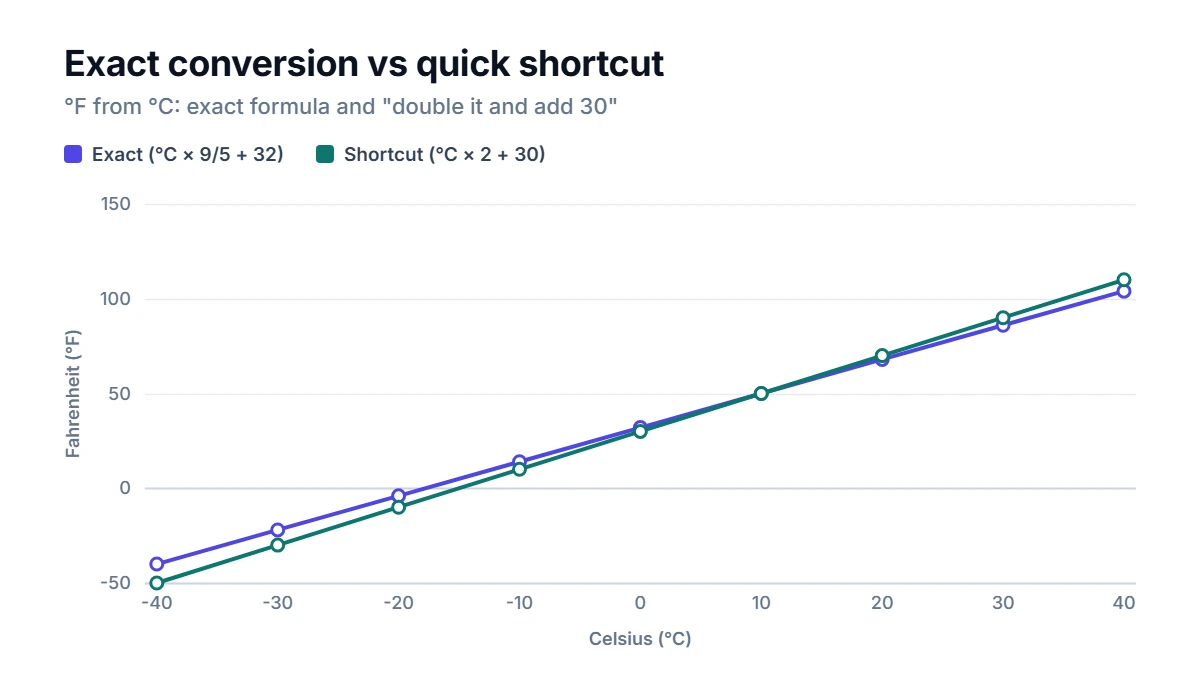
For weather you rarely need decimals. A quick approximation for Celsius to Fahrenheit is to double the Celsius number and add 30. It works because doubling is close to multiplying by 1.8, and 30 is close to 32.
- 10 °C: 10 × 2 + 30 = 50, and the exact answer is 50 °F. Spot on.
- 20 °C: shortcut 70, exact 68. Two degrees high.
- 0 °C: shortcut 30, exact 32. Two degrees low.
- 30 °C: shortcut 90, exact 86. Four degrees high.
The shortcut is exact at 10 °C and drifts by 2 °F for every 10 °C you move away from it. Between about −5 °C and 25 °C it stays within 3 °F, which is plenty for deciding whether to take a jacket.
For the reverse direction, subtract 30 and halve. A 68 °F day gives (68 − 30) ÷ 2 = 19 °C, against an exact 20 °C.
Avoid the shortcut for cooking, medicine or anything scientific. At oven temperatures the error grows large: 180 °C by the shortcut would be 390 °F, 34 degrees too hot.
Kelvin and Rankine
Science uses a scale that starts at absolute zero, the coldest possible temperature. Kelvin uses Celsius-sized steps, so K = °C + 273.15. Rankine is the same idea built on Fahrenheit-sized steps, so °R = °F + 459.67. Absolute zero is 0 K, −273.15 °C, −459.67 °F and 0 °R.
Using the body temperature example, 37 °C is 310.15 K and 558.27 °R. Kelvin is written without a degree sign: 310.15 K, not 310.15 °K.
How to use the Temperature Converter
Type a temperature, pick the scale it is in (Celsius, Fahrenheit, Kelvin or Rankine) and press Convert. The result line shows the same temperature on the other three scales, and a table lists all four together. Negative numbers work for Celsius and Fahrenheit. If you enter something colder than absolute zero, the converter tells you it is not a possible temperature instead of returning a meaningless result.
Good to know
- Temperature differences convert without the 32. A change of 10 °C is a change of 18 °F, not 50 °F. The offset only applies to actual readings, not to the gap between two readings.
- −40 is the crossover. −40 °C and −40 °F are the same temperature, the only point where the scales meet.
- Fan ovens. Many recipes suggest a lower setting for fan or convection ovens. Convert the temperature first, then follow the recipe's fan adjustment.
- Fever thresholds. Thermometers and health guidance use specific cut-offs, which can differ slightly between sources. Follow the guidance that comes with your thermometer or from your doctor.
FAQ
Why does the United States still use Fahrenheit?
Mostly habit and history. Fahrenheit was the standard in Britain and its colonies for a long time, and the US kept it for everyday use while science and most other countries moved to Celsius.
Is a temperature twice as hot if the number doubles?
Not in Celsius or Fahrenheit, because their zero points are arbitrary. 20 °C is not twice as warm as 10 °C. Only scales that start at absolute zero, Kelvin and Rankine, support that kind of comparison.
What is a quick way to convert Fahrenheit oven temperatures?
Subtract 32, then multiply by 5 and divide by 9. As a rough guide, 350 °F is about 175 to 180 °C, 400 °F is about 200 °C, and 425 °F is about 220 °C.
How precise should my conversion be?
Match the precision of the original. If a weather forecast says 72 °F, 22 °C is a fair answer. For lab work, keep the decimals the converter shows.

