How to Estimate Your One Rep Max Without Maxing Out
You do not need to grind out a true max to know how strong you are. Learn how 1RM formulas turn a hard set of a few reps into a reliable estimate, and how to use it to pick your training weights.

Your one rep max, or 1RM, is the most weight you can lift once with good form. Strength programs love it because it turns vague advice like "go heavy" into exact numbers: three sets of five at 80%, a top single at 90%. The problem is that testing a real max is tiring, needs a spotter and is easy to get wrong on a bad day. The good news is that you can estimate it from an ordinary hard set, and the estimate is usually close enough to plan months of training.
Why a set of reps predicts your max
Every rep you can do with a weight tells you something about how far that weight is from your limit. If you can squat a weight only once, it is your max. If you can squat it ten times, it is a lot lighter than your max. Researchers measured this relationship in groups of lifters and wrote it down as simple formulas. Each one says, in effect, "a person who can lift w for r reps can probably lift about this much once."
The relationship is fairly steady for heavy sets and gets looser as the reps climb. At three to eight reps, strength decides when the set ends. At fifteen or twenty reps, breathing, pain tolerance and muscle endurance matter just as much, and two people with the same max can get very different rep counts.
The four common formulas
With w as the weight lifted and r as the number of reps:
- Epley: w × (1 + r ÷ 30)
- Brzycki: w × 36 ÷ (37 − r)
- Lombardi: w × r^0.10
- O'Conner: w × (1 + 0.025 × r)
They agree closely for low reps and drift apart as the reps go up. The chart below shows what each formula predicts for a lifter who handles 100 kg for anywhere from 1 to 12 reps.
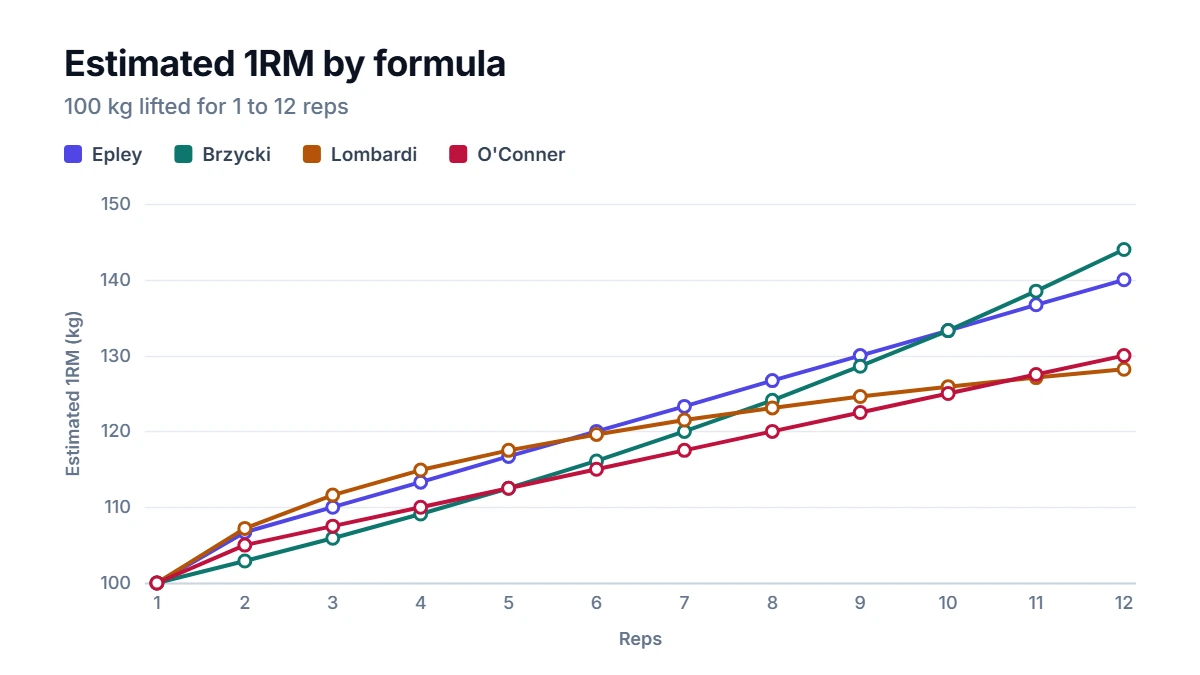
At 5 reps the four estimates range from 112.5 to 117.5 kg, a spread of 5 kg. At 12 reps they range from 128.2 to 144.0 kg, a spread of almost 16 kg. Brzycki climbs fastest because its divisor, 37 − r, shrinks quickly as r grows, while Lombardi flattens out because a small power of r grows slowly. That is the whole reason averaging several formulas helps: their errors point in different directions.
A worked example
Say you squat 185 lb for 6 hard reps, stopping when one more rep would have broken your form. The four formulas give:
- Epley: 185 × (1 + 6 ÷ 30) = 222.0 lb
- Brzycki: 185 × 36 ÷ 31 = 214.8 lb
- Lombardi: 185 × 6^0.10 = 221.3 lb
- O'Conner: 185 × 1.15 = 212.7 lb
The average is about 217.7 lb. Now compare a different day when you did 135 lb for 12 reps. The average estimate is 183.0 lb, but the individual formulas run from 173.1 to 194.4 lb, a spread of more than 21 lb. The heavier set gives a far more trustworthy number, which is why a set of 3 to 8 reps is the sweet spot.
Turning your max into training weights
Once you have an estimate, percentages do the rest. For the 217.7 lb squat:
- 95% is about 206.8 lb, typically good for a double.
- 90% is about 195.9 lb, roughly 3 to 4 reps.
- 85% is about 185.0 lb, roughly 5 to 6 reps.
- 80% is about 174.2 lb, roughly 7 to 8 reps.
- 70% is about 152.4 lb, roughly 11 to 12 reps.
Notice the 85% line: 185 lb for 5 to 6 reps is exactly the set you started from, which is a good sanity check that the estimate hangs together. Round these numbers to what you can actually load on the bar, usually the nearest 5 lb or 2.5 kg.
How to use the One Rep Max Calculator
Choose pounds or kilograms, enter the weight from a recent hard set and the reps you completed with clean form, and press Calculate. The One Rep Max Calculator shows each formula's estimate, their average, and a table of training weights from 50% to 100% with typical rep ranges next to them. If you enter more than 10 reps it warns you that the estimate is less reliable, so treat that result as a rough guide and retest with a heavier set when you can.
A good habit is to recalculate every few weeks from your best recent set. Watching the estimate climb is a low-risk way to track progress without ever testing a true single.
Getting a better estimate
- Go close to failure. The formulas assume the set was hard. If you stopped with three reps left in the tank, the estimate will come out low.
- Use a fresh set. Your first work set of the day says more than your fifth, when fatigue has cut your reps.
- Keep the form strict. Bouncing, cutting depth or half reps inflate the count and the estimate.
- Estimate each lift separately. Most people can do more reps at a given percentage on the leg press than on the bench press, so an estimate from one exercise does not transfer to another.
- Expect individual differences. Some lifters are endurance types who beat the rep tables at every percentage; others are the opposite. If your real performance keeps beating or missing the predicted reps, adjust your percentages.
Treat the numbers as estimates, not medical or coaching advice. Use safety bars or a spotter whenever you work near your limit, and stop if something hurts.
FAQ
How often should I recalculate my one rep max?
Every three to six weeks is plenty for most people. Strength changes slowly, and recalculating after every session just adds noise from good and bad days. Use your best set from the last couple of weeks.
Is an estimated max lower or higher than a tested max?
It can be either. Experienced lifters who are used to heavy singles often test a little higher than the estimate, because they handle maximal weights well. Newer lifters often test lower, because a true max needs a skill they have not practiced yet.
Can I use a set to failure on machines?
You can, but the formulas were built mostly from free-weight lifts like the bench press and squat. Machines with a fixed path and cable stacks often allow more reps at the same percentage, so the estimate is a rough guide for setting the stack, not a strength benchmark.
Should I base my program on 100% of the estimate?
Many coaches suggest a training max of about 90% of your estimated or tested max. It leaves room for bad days and keeps the percentages achievable, especially in programs with lots of heavy sets.