How to Find the Interest Rate on a Loan
Many offers only quote a monthly payment. Learn how to find the interest rate hidden in it, why a lower payment can cost more, and how flat interest quotes hide a much higher real rate.

Many loan offers lead with the monthly payment, not the rate. "Drive it home for 480 a month" or "pay just 110 a month for a year" sounds simple, but it hides the one number you need to compare offers: the interest rate. The good news is that the rate is fully determined by three things you can always find out: how much you borrow, what you pay each month, and for how long.
The figures in this guide are estimates for comparing offers, not financial advice. Always ask the lender for the official APR and the full cost of the loan.
Why the payment alone can mislead you
Two loans with similar payments can have very different costs. A lower payment might come from a lower rate, but it might just as well come from a longer term, and a longer term usually means paying more interest in total. Turning every offer into an interest rate puts them on the same scale.
How the rate is linked to the payment
A standard fixed-rate loan uses this payment formula:
payment = amount × r ÷ (1 − (1 + r)^−n)
where r is the monthly interest rate and n the number of monthly payments. If you know the rate, finding the payment is easy. Going the other way, from payment to rate, has no neat algebraic answer. You have to solve it by trying rates until the payment matches.
That sounds slow, but there is a clever shortcut. A higher rate always means a higher payment, so you can narrow the answer down like a guessing game:
- Pick a range that must contain the rate, from 0 up to a rate that is clearly too high.
- Try the rate in the middle of the range and work out the payment it gives.
- If that payment is too low, the real rate is in the upper half; if too high, it is in the lower half.
- Keep halving the range until it is tiny.
Each round cuts the range in half, so after a few dozen rounds the rate is accurate to many decimal places. This method is called bisection.
A fully worked example: a car loan
A dealer offers to finance 25,000 at 480 a month for 5 years (60 payments).
- Total of payments: 480 × 60 = 28,800
- Total interest: 28,800 − 25,000 = 3,800
- Solving for the rate gives an annual rate of about 5.714%
- The effective annual rate, which includes the effect of monthly compounding, is about 5.866%
Now the dealer offers a "lower payment" of 420 a month, but for 6 years (72 payments):
- Total of payments: 420 × 72 = 30,240
- Total interest: 5,240
- Annual rate: about 6.479%
The monthly payment drops by 60, but the rate is higher and you pay 1,440 more interest overall. Without converting both offers to a rate, the second one looks better.
Small payment changes, big rate changes
On a fixed loan amount and term, every extra bit of payment is pure interest. That means a modest change in the payment moves the rate a lot. Here is the implied rate for 25,000 over 5 years at different monthly payments:
- 420 a month: 0.314%
- 440: 2.165%
- 460: 3.963%
- 480: 5.714%
- 500: 7.420%
- 520: 9.086%
- 540: 10.714%
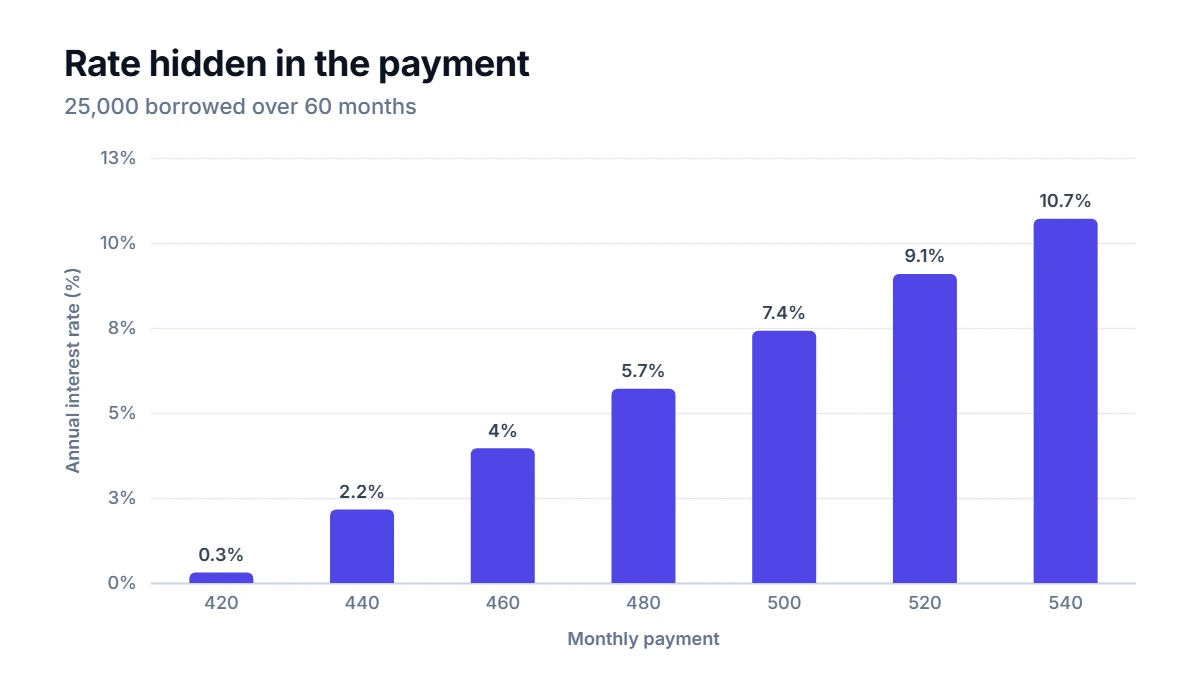
Every 20 more per month adds about 1.6 to 1.9 percentage points to the rate. When you negotiate, a payment that is 20 or 40 lower on the same term is a meaningful discount.
The "flat interest" trap
Some offers describe interest as a simple percentage of the amount: "borrow 1,200 for a year, pay 10% interest, so 110 a month." That 10% sounds like the rate, but it is not.
The 120 of interest is charged on the full 1,200 for the whole year, even though you repay part of it every month and owe less and less. Solving for the true rate from 1,200 borrowed, 110 a month and 12 payments gives an annual rate of about 17.97%, with an effective rate of about 19.53%. On a short loan repaid monthly, the real rate is often close to double the quoted flat rate.
When there is no positive rate
If the payments add up to exactly the amount borrowed, the rate is 0%: 1,200 repaid at 100 a month for 12 months costs nothing extra. If they add up to less than the amount, for example 95 a month, the loan is never repaid with interest, so no positive rate exists. That usually means a typo, or a balloon payment at the end that is not part of the monthly figure.
How to use the Interest Rate Calculator
The Interest Rate Calculator needs just three inputs:
- Loan amount: what you actually borrow, after any down payment or trade-in.
- Monthly payment: the fixed amount you will pay.
- Term: in years, months or both. For 4 years and 6 months, enter 4 and 6, or 54 months.
Press Calculate to see the annual rate, the effective annual rate, the total of payments and the total interest, with a year-by-year summary of interest, principal and remaining balance.
Good to know
- Fees change the picture. If a loan has an origination fee or a required add-on rolled into the amount, the true cost is higher. The APR a lender quotes is supposed to include many such fees, so it can be higher than the rate you find from the payment. Check current rules in your country for what APR must include.
- Use the amount you receive, not the sticker price. If a fee is added to the loan, the amount you borrow is higher than the money you get.
- Rounded payments shift the rate a little. A payment rounded up by a cent can change the third decimal of the rate.
- Compare like with like. Compare the rate and the total interest over the same term. A shorter loan often has a higher payment but a lower total cost.
FAQ
What is the difference between the annual rate and the effective annual rate?
The annual rate is the monthly rate times 12, which is how loan rates are usually quoted. The effective rate also counts the interest on interest from monthly compounding, so it is always a little higher when the rate is above zero.
Can I use this to check a "0% financing" offer?
Yes. Enter the price, the payment and the term. If the payments add up to exactly the price, it really is 0%. If the 0% offer requires giving up a cash discount, compare it with a loan for the lower cash price instead, which may reveal a hidden rate.
Does paying extra each month change my rate?
No. The rate is set by your contract. Extra payments reduce the balance faster, so you pay less total interest and finish sooner, but the rate itself stays the same.
Why does my lender's number differ slightly?
Lenders may count interest by the exact number of days in each month, include fees, or round each payment differently. Small differences in the second or third decimal are normal.


