How to Measure Your Body Fat Percentage at Home
Your weight does not tell you how much of it is fat. Learn how the tape measure method estimates body fat, how to measure consistently, and why one centimeter at the waist matters.

Body fat percentage tells you how much of your weight is fat and how much is everything else: muscle, bone, organs and water. Two people with the same height and weight can look and feel very different because one carries more muscle and the other more fat. That is why many people track body fat alongside, or instead of, the number on the scale.
Why body fat says more than weight or BMI
BMI only uses height and weight. It is quick and useful for large groups, but it cannot tell a muscular person from a person who carries extra fat at the same weight. Body fat percentage looks at composition instead. It also responds to changes that weight hides: if you start strength training, you can lose fat and gain muscle at the same time, so your weight barely moves while your body fat falls.
Waist size matters too. Fat stored around the middle is linked to more health risks than fat stored elsewhere, and the tape measure method used here leans heavily on your waist measurement for exactly that reason.
The main ways to measure body fat
There is no perfect home method. Each one trades cost and convenience against accuracy:
- Tape measure (circumference) methods such as the U.S. Navy formula use your height and a few body measurements. They are free, repeatable and good for tracking trends.
- Skinfold calipers pinch the fat layer at several sites. Accuracy depends a lot on the skill of the person measuring.
- Bioelectrical impedance scales and handheld devices send a weak current through the body. Results shift with hydration, meals and exercise, so readings can jump from day to day.
- DEXA scans, underwater weighing and air displacement are lab methods. They are more precise but cost money and are not something you do every week.
For most people the best method is the one you can repeat the same way every time. A consistent tape measurement taken every few weeks shows the direction you are heading, which matters more than any single reading.
How the tape measure method works
The U.S. Navy method was built by measuring many people with a lab method and then finding the formula that best predicted their results from simple measurements. Men need height, neck and waist. Women also need hip, because women typically store more fat around the hips and thighs.
The key quantity for men is waist minus neck. A larger waist raises the estimate, while a thicker neck, which tends to go with more muscle, lowers it. For women the formula uses waist plus hip minus neck. Height adjusts the result because a given waist means less on a taller frame.
Worked example for a man
A man is 180 cm tall, his neck measures 39 cm, his waist 90 cm, and he weighs 84 kg. The Body Fat Calculator gives:
- Body fat: 19.1%, in the Average category
- Fat mass: about 16.0 kg
- Lean mass: about 68.0 kg
Lean mass is simply weight minus fat mass. It is a useful number to watch during a diet: ideally your weight goes down while lean mass stays roughly the same.
Worked example for a woman
A woman is 165 cm tall with a 33 cm neck, a 74 cm waist and 98 cm hips, and she weighs 64 kg. Her estimate is 27.9% body fat, also in the Average range, which works out to about 17.9 kg of fat mass and 46.1 kg of lean mass.
Notice that she has more fat mass than the man in the first example despite weighing 20 kg less, yet both are in the Average category. Healthy ranges for women are higher than for men because women need more essential fat for normal hormonal and reproductive health.
How much a centimeter of waist changes the result
Your waist has the biggest influence on the result. Keeping the man's height (180 cm) and neck (39 cm) the same and changing only the waist gives these estimates:
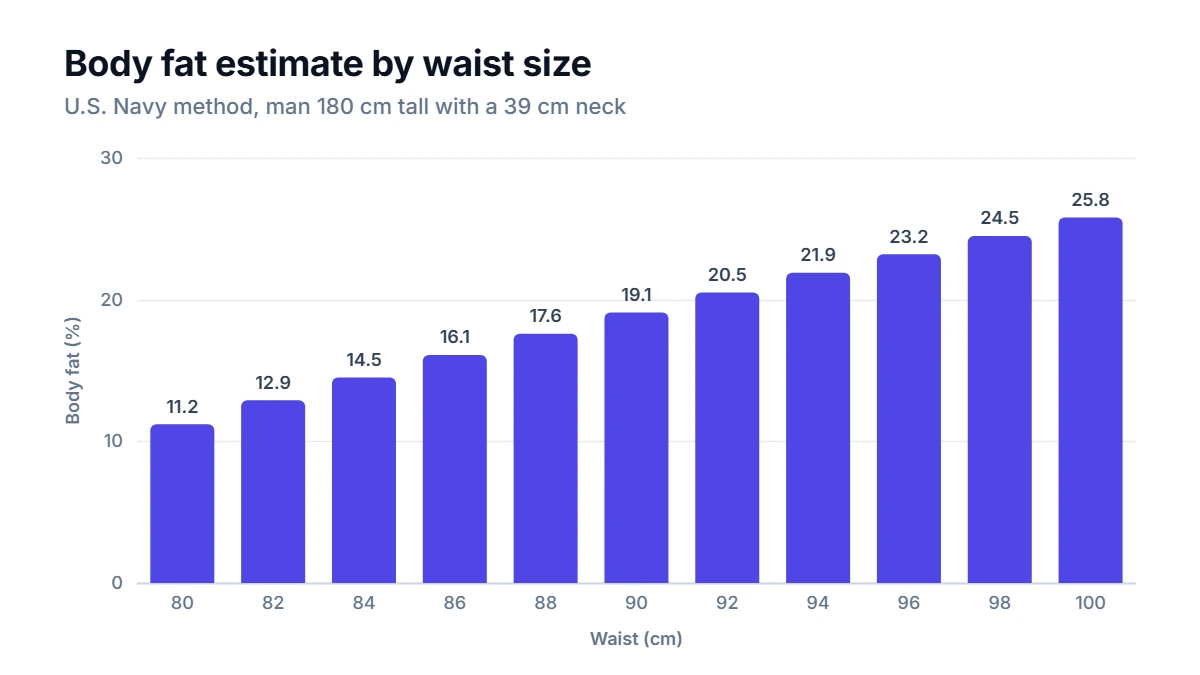
Each extra centimeter of waist adds roughly 0.7 percentage points. That has two practical consequences:
- Small measuring errors matter. Pulling the tape 2 cm too tight or too loose moves the result by about 1.5 points, enough to jump a category.
- Small real changes show up. If the man trims his waist from 90 cm to 88 cm at the same weight, his estimate drops from 19.1% to 17.6%, moving him into the Fitness category, and his fat mass falls from about 16.0 kg to about 14.8 kg.
Tips for consistent measurements
- Measure at the same time of day, ideally in the morning before eating.
- Stand relaxed, breathe out normally and do not pull your stomach in.
- Keep the tape level all the way around and snug against the skin without compressing it.
- Take each measurement two or three times and use the average.
- Track the trend over several weeks rather than reacting to one result.
Good to know
- All formula-based methods are estimates. Results for very muscular people, older adults and people with unusual body shapes can be off by several points.
- Different methods give different numbers. Compare a tape result with an earlier tape result, not with a smart scale reading.
- Body fat is one piece of the picture. Fitness, blood pressure, blood tests and how you feel matter too.
These results are estimates and are not medical advice. If you are concerned about your weight or health, talk to a doctor or another qualified health professional.
FAQ
Why does my smart scale give a different number?
Smart scales use bioelectrical impedance, a completely different technique, and their readings change with how much water you have had, recent exercise and even the temperature of your feet. Neither number is wrong as such; they are separate estimates. Pick one method and stick with it for tracking.
How often should I measure my body fat?
Every two to four weeks is enough. Real changes in body fat are slow, and measuring daily mostly shows measuring noise and normal fluctuations in bloating and water.
Can my body fat go up while my weight goes down?
Yes. If you lose weight quickly through a very low calorie diet without enough protein or strength training, part of the loss can be muscle. Your weight falls, but the share of fat in what is left can rise.
Is body fat percentage better than BMI?
They answer different questions. BMI is a quick screening number that ignores composition. Body fat percentage describes composition but is harder to measure accurately. Using both, plus your waist size, gives a more balanced view than either alone.
