How to Pay Off Credit Card Debt Faster
Why a card balance shrinks so slowly, how much each extra dollar of monthly payment saves, and how to pick a payment that clears the card by a date you choose.

Credit card debt is expensive because the interest rate is high and because interest is charged every month on whatever you still owe. Pay a little, and most of the payment goes to interest while the balance barely moves. Pay a bit more, and the picture changes surprisingly fast. This guide shows how the monthly math works, how big the difference between payment sizes really is and how to set a payoff date you can actually hit.
How card interest is charged
Your card has an annual percentage rate (APR). For a simple monthly model, the monthly rate is the APR divided by 12. Each month:
- Interest = balance × (APR ÷ 12).
- Your payment covers that interest first.
- Whatever is left of the payment reduces the balance.
Because next month's interest is charged on the new, slightly smaller balance, the interest part shrinks a little each month and the principal part grows. Card issuers usually work with a daily rate and the average daily balance, so a real statement can differ by a few cents, but the monthly model is close enough for planning.
A worked example
Say you owe 3,000 on a card with a 22% APR. The monthly rate is 22 ÷ 12 ≈ 1.833%.
- Month 1: interest is 3,000 × 0.01833 = 55.00. With a payment of 100, only 45.00 goes to the balance, which falls to 2,955.00.
- Month 2: interest is 2,955.00 × 0.01833 ≈ 54.18, so 45.82 goes to the balance, leaving 2,909.18.
Keep paying 100 a month and the card is clear after 44 months, with a smaller final payment of 95.37. You pay 4,395.37 in total, of which 1,395.37 is interest: almost half of the original balance.
Now compare different fixed payments on the same 3,000 balance:
- 60 a month: 137 months (over 11 years), 5,206.91 interest
- 75 a month: 73 months, 2,456.85 interest
- 100 a month: 44 months, 1,395.37 interest
- 150 a month: 26 months, 771.44 interest
- 200 a month: 18 months, 540.62 interest
- 300 a month: 12 months, 344.65 interest
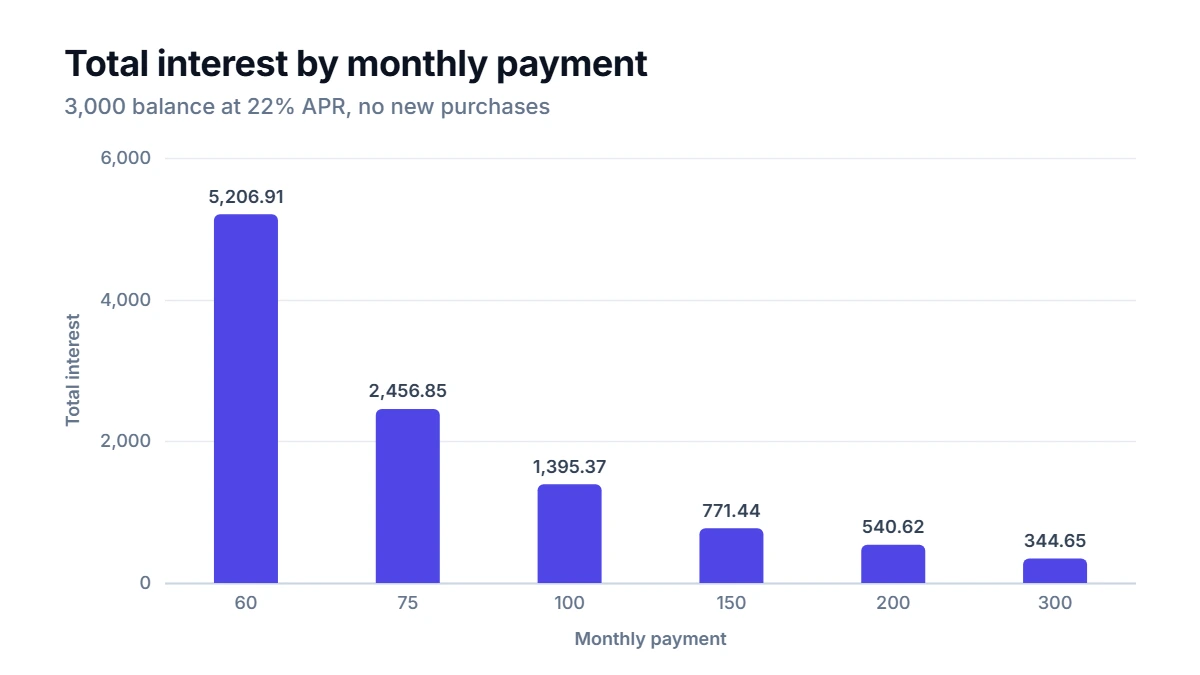
The steepest drop is at the low end. Going from 60 to 75 a month, just 15 more, cuts more than five years and about 2,750 of interest. That is because 60 is barely above the first month's interest of 55, so almost nothing reaches the balance. The closer your payment is to the interest charge, the longer the debt lasts.
Working backwards from a deadline
Sometimes you have a date in mind: clear the card before a move, a wedding or the end of the year. Then the question flips to "what payment do I need?" The answer comes from the same formula that sets loan payments:
M = B × r ÷ (1 − (1 + r)^−n)
B is the balance, r the monthly rate and n the number of months. For the 3,000 balance at 22%:
- Paid off in 12 months: 280.79 a month, 369.39 interest
- Paid off in 24 months: 155.64 a month, 735.17 interest
- Paid off in 36 months: 114.58 a month, 1,124.49 interest
Picking a deadline turns a vague goal into a fixed number you can put in your budget.
How to use the Credit Card Payoff Calculator
Enter your card balance and APR, then choose a mode. With a fixed monthly payment, the Credit Card Payoff Calculator shows how many months it takes, the final payment, the total paid and the total interest. With a target number of months, it finds the monthly payment that clears the card on time. A table shows the balance month by month for shorter payoffs and year by year for longer ones. If your payment is too small to cover the first month's interest, the calculator says so and shows the minimum that starts to reduce the balance.
Strategies that speed things up
- Pay a fixed amount, not the minimum. Minimum payments are usually a small percentage of the balance, so they shrink as the balance shrinks and stretch the payoff out for years. Choose a fixed amount and keep paying it even as the minimum falls.
- Stop adding to the balance. Every new purchase pushes the finish line back. Many people switch to a debit card or cash while they pay a card off.
- Target the highest rate first. If you have several cards, putting extra money toward the one with the highest APR saves the most interest. Paying the smallest balance first instead gives quicker wins, which some people find more motivating.
- Look at a lower rate. A balance transfer or a personal loan at a lower rate can cut the interest, but check fees, the length of any promotional rate and what the rate becomes afterward.
- Use windfalls. A tax refund, bonus or gift paid straight onto the card reduces the balance that interest is charged on from that month on.
The results are estimates based on a simple monthly model, not financial advice. Your card agreement sets the exact rules, so check your statement for fees and how interest is applied.
FAQ
Should I pay off my card or save first?
Many people keep a small emergency fund so a surprise bill does not go straight back on the card, then send every extra dollar to the card. Card APRs are usually much higher than what savings earn, so paying down the balance is often the better use of spare money.
Does paying twice a month help?
A little. With daily interest, paying half your amount every two weeks lowers the average daily balance, so slightly less interest builds up. The bigger effect still comes from the total amount you pay each month.
Why does my statement show a different interest figure?
Most issuers use a daily periodic rate on the average daily balance and the exact number of days in each billing cycle. A month with 31 days charges a bit more than one with 28. The monthly model used here smooths that out.
Will paying off a card hurt my credit?
Paying down a balance usually helps, because it lowers the share of your available credit that you are using. Closing the account afterward is a separate decision, so check how it would affect your available credit before you do it.
