How to Use a Scientific Calculator
Trig, logarithms, powers and factorials solve real problems, from the height of a tree to doubling time. Learn the functions you will actually use and the mistakes to avoid.

A scientific calculator does far more than add and multiply. With trigonometry, logarithms, powers and factorials you can measure the height of a tree from the ground, work out how long money takes to double or count lottery combinations. The keys are not hard to learn; what trips people up is the way an expression is read. This guide walks through the functions you will actually use, with real examples you can type in.
Think in expressions, not button presses
A basic calculator works one step at a time. A scientific calculator reads the whole line you type and applies the order of operations: parentheses first, then powers, then multiplication and division, then addition and subtraction. That means you can type a full formula exactly as it is written on paper, as long as you add parentheses where the meaning would otherwise be unclear.
Two quick checks show why this matters:
−2^2gives −4, because the power is applied before the minus sign. Type(−2)^2to get 4.1/2πgives 1.57079632679, which is (1/2) × π. If you meant one divided by 2π, type1/(2π)to get 0.159154943092.
When in doubt, add parentheses. They never hurt and they make the expression easier to read later.
Trigonometry: angles and distances
Sine, cosine and tangent connect the angles of a right triangle to the lengths of its sides. They answer practical questions you cannot easily measure directly.
Example: the height of a tree
You stand 20 m from a tree and measure the angle from the ground to the top as 35°. The tangent of an angle is the opposite side divided by the adjacent side, so:
height = 20 × tan(35°)
Type 20tan(35) in degree mode and you get 14.0041507642, so the tree is about 14 m tall (plus your eye height if you measured from standing).
Example: the angle of a ramp
A ramp rises 1 unit for every 12 units of length. The inverse tangent turns that ratio back into an angle: atan(1/12) = 4.76364169073°. Inverse functions (asin, acos, atan) always work this way: you give them a ratio and they return an angle.
Degrees or radians?
This is the most common source of wrong answers. In degree mode sin(30) is 0.5. In radian mode the same keys give −0.988031624093, because 30 radians is almost five full turns. Use degrees for everyday geometry, surveying and building work; use radians for calculus, physics formulas and most programming. In radian mode, 30° is written as π/6, and sin(π/6) gives 0.5 again.
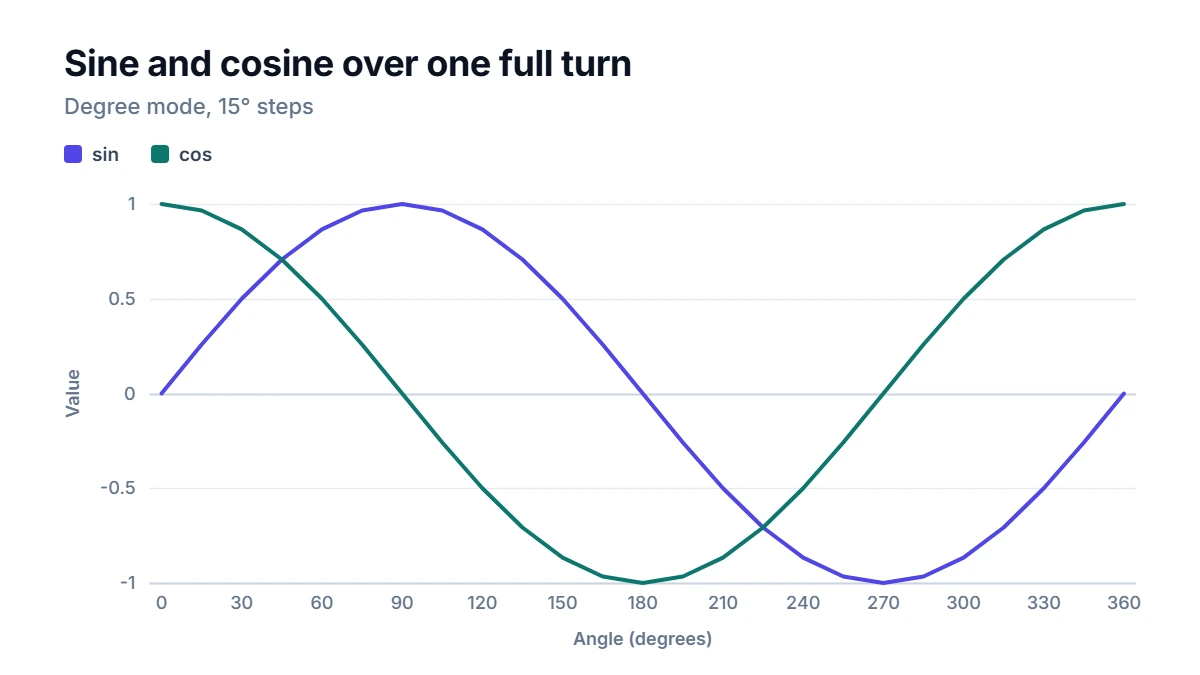
The chart below shows how sine and cosine move through one full turn. Both stay between −1 and 1, and cosine is simply sine shifted by 90°.
Powers and logarithms: growth and scale
Powers repeat multiplication; logarithms undo it. Together they handle anything that grows or shrinks by a percentage.
Example: compound growth
1,000 saved at 5% a year, compounded monthly for 10 years: 1000(1+0.05/12)^120 = 1647.00949769. The exponent 120 is the number of months.
Example: doubling time
How many years does it take for something growing 7% a year to double? Solve 1.07^t = 2 by taking logarithms of both sides: t = ln(2) / ln(1.07). Typing ln(2)/ln(1.07) gives 10.2447683511, so about 10 years and 3 months. Any base works here as long as you use the same one on top and bottom, so log instead of ln gives the same answer.
Example: logarithmic scales
Earthquake magnitudes, decibels and pH are all logarithmic. Two earthquakes that differ by 2 on the magnitude scale differ in recorded wave amplitude by 10^(7−5) = 100 times. And log(0.001) = −3, because 0.001 is 10 to the power −3.
Factorials and counting
The factorial n! multiplies all whole numbers from 1 up to n, so 5! = 120. Factorials count arrangements, and combinations divide them out. The number of ways to choose 6 numbers from 49 is 49! / (6! × 43!).
Type it with an explicit multiplication sign: 49!/(6!×43!) = 13983816. Writing 6!43! without the × produces an error, because two numbers side by side are treated as a typing mistake rather than a product. That is deliberate: it stops "2 3" from silently becoming 6.
Very large and very small numbers
Scientific notation keeps huge or tiny values readable. Use a capital E for "times ten to the power": 6.02E23×2 gives 1.204E24. Dividing the speed of light, about 3E8 m/s, by a frequency of 5E14 Hz gives 3E8/5E14 = 6E-7, a wavelength of 600 nanometers. A lowercase e on the other hand is Euler's number, 2.718..., so keep the two apart.
Using the Scientific Calculator
The Scientific Calculator lets you click keys or type straight into the expression box, then press = or Enter. A DEG/RAD switch sets the angle mode, and the last ten results stay in a history list while the page is open so you can reuse them. Results are rounded to 12 significant digits, which hides the tiny rounding noise all computers produce, and impossible operations such as dividing by zero or taking the square root of a negative number show a clear message instead of a strange value.
Common mistakes
- Wrong angle mode. If a trig answer looks odd, check DEG or RAD first.
- Missing parentheses in fractions.
(a+b)/(c+d)is not the same asa+b/c+d. - Percent confusion.
200×15%is 30, but200+15%gives 200.15, because 15% on its own is just 0.15. Write200×(1+15%)to add 15%. - Rounding too early. Keep full values through a calculation and round only the final answer.
- Trusting a single result. Estimate roughly first. If you expect about 14 and see 1,400, something went wrong.
FAQ
Why does my answer differ from my textbook in the last digit?
Textbooks often round intermediate steps or print fewer digits. The calculator carries full precision until the end and then rounds to 12 significant digits, so tiny differences in the last place are normal.
How do I calculate a cube root?
Raise the number to the power one third: 27^(1/3) = 3. This works for positive numbers. For a negative number, take the cube root of its positive value and add the minus sign yourself.
What is the difference between asin and 1/sin?
asin is the inverse function: it takes a ratio and returns an angle, so asin(0.5) = 30°. 1/sin(x) is the reciprocal, called cosecant, which returns a ratio, not an angle.
Can I use the result of one calculation in the next?
Yes. After a result appears, pressing an operator key continues from it. You can also pick any of your last ten results from the history list.