Ideal Body Weight Formulas Explained: Devine, Robinson, Miller and Hamwi
Why ideal weight calculators give four different answers, where each formula came from, and how to read the results next to the healthy BMI range for your height.

Type your height into an ideal weight calculator and you get not one answer but four, each a few pounds apart. That is not a bug. The Devine, Robinson, Miller and Hamwi formulas were created by different people, at different times, for different purposes. This guide explains where each one comes from, works through a full example, and shows how to read the results next to the healthy BMI range so you end up with a sensible target rather than a single magic number.
Where ideal weight formulas come from
The best known of them, the Devine formula, was published in 1974 to help doctors estimate doses of certain medications, not to tell anyone what they should weigh. Its simple shape, a base weight for 5 feet plus a fixed amount per extra inch, was easy to use at the bedside and spread quickly.
Hamwi's version is older still, from 1964, and was meant as a rough guide for dietitians. In 1983 two research groups, Robinson and Miller, revisited the idea using newer population data and published adjusted versions. All four share the same structure:
- Ideal weight = base weight + (amount per inch × inches over 5 feet)
Only the two numbers change. For women:
- Robinson: 49 kg + 1.7 kg per inch
- Miller: 53.1 kg + 1.36 kg per inch
- Devine: 45.5 kg + 2.3 kg per inch
- Hamwi: 45.5 kg + 2.2 kg per inch
For men:
- Robinson: 52 kg + 1.9 kg per inch
- Miller: 56.2 kg + 1.41 kg per inch
- Devine: 50 kg + 2.3 kg per inch
- Hamwi: 48 kg + 2.7 kg per inch
Every formula works in kilograms, even though it counts height in inches, a mix that reflects its medical origins.
A worked example
Take a woman who is 5 ft 5 in tall (165.1 cm). She is 5 inches over 5 feet.
- Robinson: 49 + 1.7 × 5 = 57.5 kg (about 126.8 lb)
- Miller: 53.1 + 1.36 × 5 = 59.9 kg (about 132.1 lb)
- Devine: 45.5 + 2.3 × 5 = 57.0 kg (about 125.7 lb)
- Hamwi: 45.5 + 2.2 × 5 = 56.5 kg (about 124.6 lb)
The four results span 56.5 to 59.9 kg, a range of about 7.5 lb.
Now the healthy BMI range for the same height. BMI is weight divided by height in meters squared, so weight = BMI × height². Her height is 1.651 m, and 1.651² is about 2.726.
- At BMI 18.5: 18.5 × 2.726 ≈ 50.4 kg (111.2 lb)
- At BMI 24.9: 24.9 × 2.726 ≈ 67.9 kg (149.6 lb)
All four formula results sit in the lower half of a much wider healthy range of roughly 50 to 68 kg. That is the key to reading them: the formulas point to a narrow band, while the BMI range shows how much room there is for a healthy body at that height.
Why the formulas disagree
The formulas differ mainly in their slope, the weight added per inch. Miller adds the least per inch but starts highest; Devine and Hamwi start lower but climb faster. So at short heights Miller gives the largest number, and at tall heights Devine gives the largest.
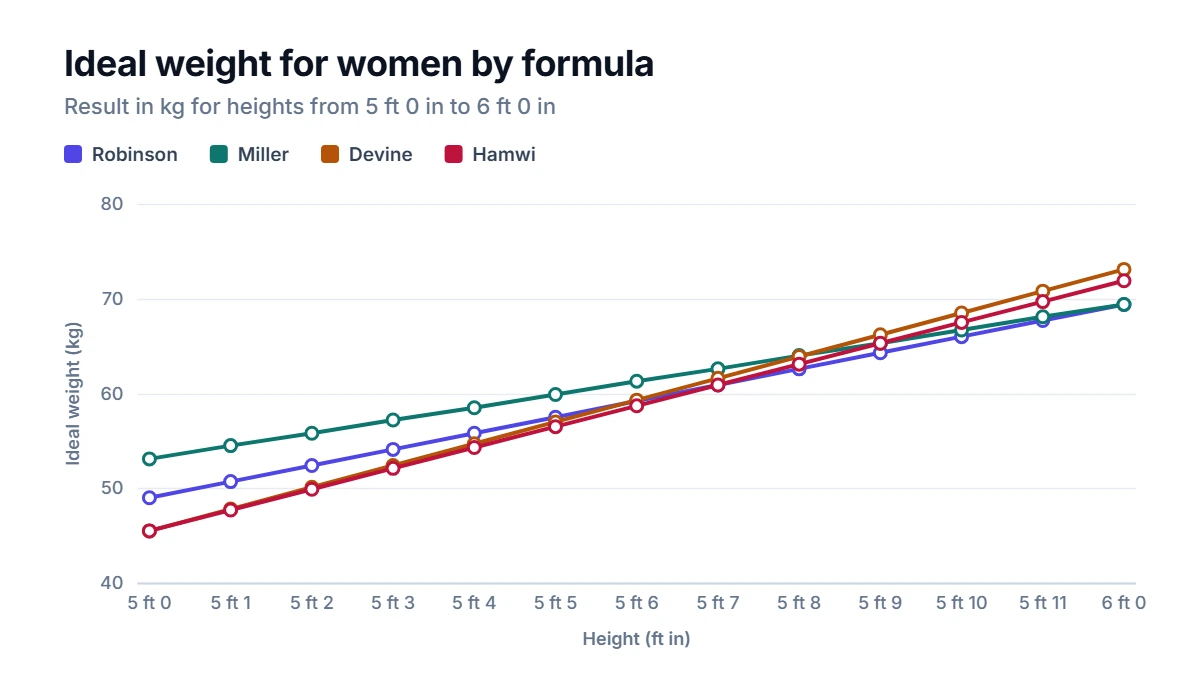
At 5 feet, the women's results run from 45.5 kg (Devine and Hamwi) to 53.1 kg (Miller), a gap of 7.6 kg. At 6 feet they run from 69.4 kg (Robinson and Miller) to 73.1 kg (Devine). For the woman in the example, the Robinson and Devine lines cross close to her height, which is why her four answers are fairly close together.
None of the formulas looks at age, frame size, muscle or body fat. A muscular athlete and a sedentary office worker of the same height get identical numbers. That is the main reason to treat the results as a rough reference, not a goal.
Why there are no results below 5 feet
All four formulas start at 5 feet and add weight for each inch above it. Running them backwards for shorter heights would mean subtracting weight for each missing inch, and the numbers quickly become unrealistic. For a woman of 4 ft 11 in (150 cm), for example, the Ideal Weight Calculator shows only the healthy BMI range, about 41.6 to 56.0 kg.
How to use the Ideal Weight Calculator
Choose US or metric units, select your sex and enter your height, then press Calculate. The summary line shows the lowest and highest of the four formula results, and the table lists each formula separately followed by the healthy BMI range in the same units.
A practical way to read the output:
- Look at the BMI range first. It is the broadest and best supported guide for most adults.
- Use the four formula results as a sense of where the middle of that range falls for your height.
- Consider your own build. If you carry a lot of muscle, a weight near the top of the BMI range, or even slightly above it, may be perfectly healthy.
Common mistakes
- Chasing a single number. Picking one formula and aiming for its exact result ignores the fact that four respected formulas disagree by several pounds.
- Using the formulas for children or teens. They were built for adults. Growth charts are used for young people instead.
- Ignoring body composition. Weight says nothing about how much of it is muscle. A body fat estimate or waist measurement adds useful context.
- Rounding height loosely. Each inch adds 1.4 to 2.7 kg depending on the formula, so measure height carefully, without shoes.
The results are estimates and are not medical advice. A doctor or registered dietitian can help you choose a weight goal that suits your health, age and body type.
FAQ
Why is the Devine formula still used in hospitals?
Because it is simple and well established for estimating doses of some medications and settings such as ventilator volumes. In that setting a consistent, quick estimate is more useful than a personalized target.
Do the formulas change with age?
No. None of them include age. Healthy weight ranges for older adults are sometimes discussed differently, so ask a health professional if that applies to you.
Is my ideal weight the same as my goal weight?
Not necessarily. A goal weight should also reflect your health, history, build and what you can maintain comfortably. The formulas only describe an average reference point for your height and sex.
Why do men and women get different results?
On average, men of the same height have more muscle and bone mass. The formulas reflect that by using a higher base weight and, in most cases, a larger amount per inch for men.


