Rounding Methods Explained: Half Up, Banker's Rounding and More
Rounding 2.5 seems obvious until you learn there are seven common ways to do it. See how each method works, why banks and statisticians prefer round half to even, and why computers sometimes round "wrong".

Most of us learned one rule at school: look at the next digit, and if it is 5 or more, round up. That rule works for everyday use, but it is not the only one, and in some jobs it is not even the right one. Banks, spreadsheets, programming languages, tax offices and scientific journals each have their own conventions. Knowing the differences helps you understand why two systems can report slightly different totals from the same data.
Two kinds of rounding
Rounding methods fall into two groups.
- Round to nearest. You pick whichever candidate is closer. 2.7 becomes 3 and 2.3 becomes 2. The only question is what to do with an exact tie, such as 2.5, which is equally close to 2 and 3.
- Directed rounding. You always move in one direction, no matter how close the number is to either candidate. 2.1 rounded up is 3; 2.9 rounded down is 2.
The tie-breaking rules
When the dropped part is exactly half, a round-to-nearest method needs a tie rule.
- Half up sends ties toward positive infinity: 2.5 becomes 3 and −2.5 becomes −2.
- Half down sends ties toward negative infinity: 2.5 becomes 2 and −2.5 becomes −3.
- Half even, also called banker's rounding, sends ties to the neighbor whose last digit is even: 2.5 becomes 2, 3.5 becomes 4, and −2.5 becomes −2.
Note that "half up" in the strict sense moves toward positive infinity. The school version, where −2.5 becomes −3, rounds ties away from zero. Most people never notice the difference because they rarely round negative numbers, but it matters in accounting, where refunds and losses are negative.
The rule only applies to exact ties. 2.345 rounded to two decimal places is a tie (the dropped part is exactly 5), so half up gives 2.35 and half even gives 2.34. But 4.8651 is not a tie, because the dropped part 51 is more than half, so every round-to-nearest method gives 4.87.
The directed methods
- Ceiling (up): always toward positive infinity. 0.07493 to two decimals becomes 0.08.
- Floor (down): always toward negative infinity. −2.7 becomes −3.
- Toward zero (truncate): just drop the extra digits. −2.7 becomes −2 and 2.7 becomes 2.
- Away from zero: always make the number bigger in size. 2.1 becomes 3 and −2.1 becomes −3.
Directed rounding is common when there is a practical limit. You round the number of buses needed up, because 3.2 buses means 4 buses. You round a person's age down, because you are not 30 until your birthday. Some tax and billing rules truncate fractions of a cent.
Why banker's rounding exists
Half up has a hidden bias: every tie goes the same way. Round one tie and nobody cares. Round thousands of them and the total drifts upward.
Here is a simple test. Take the ten values 0.5, 1.5, 2.5 and so on up to 9.5. Their exact sum is 50. Round each one to a whole number first, then add:
- Half up gives 1, 2, 3 … 10, which sums to 55.
- Half down gives 0, 1, 2 … 9, which sums to 45.
- Half even gives 0, 2, 2, 4, 4, 6, 6, 8, 8, 10, which sums to 50, exactly right.
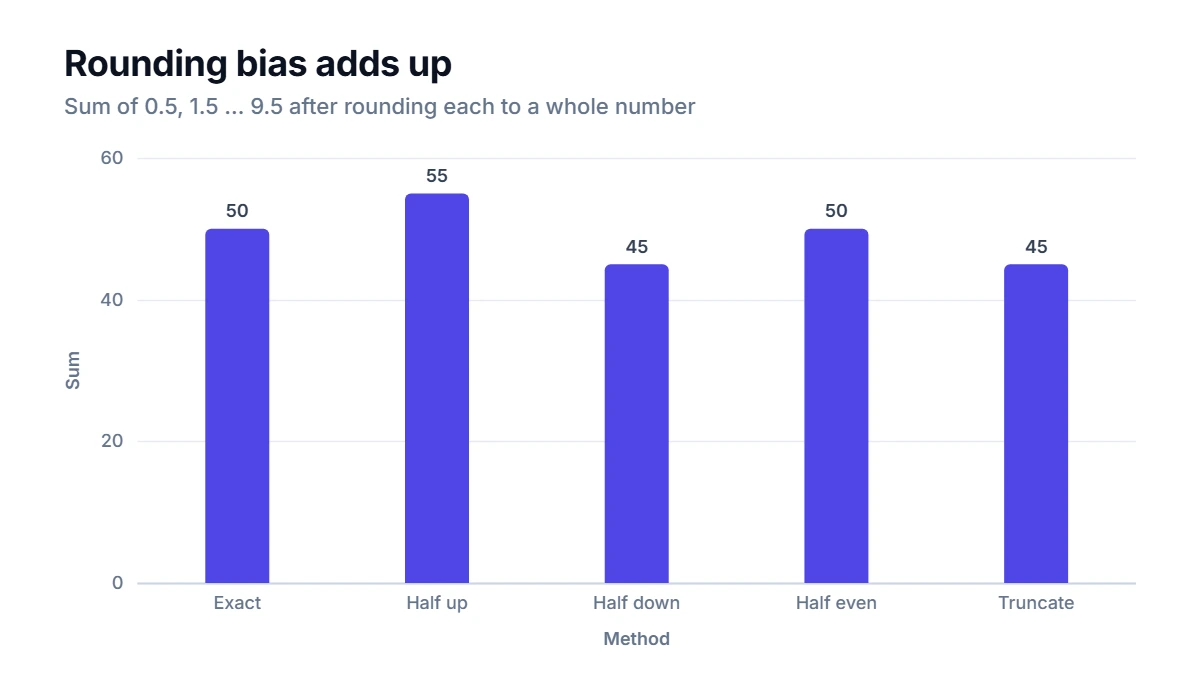
Half even sends half the ties up and half down, so the errors cancel. That is why it is the default in many financial and statistical systems and in the IEEE standard for computer arithmetic. Truncation, by contrast, always loses a little, and its total of 45 shows it.
Why computers sometimes round "wrong"
Try rounding 1.005 to two decimal places in many programming languages or spreadsheets and you may get 1.00 instead of 1.01. The computer is not ignoring the rules. It stores numbers in binary, and 1.005 has no exact binary form, just as one third has no exact decimal form. The stored value is a hair below 1.005, so it is not a tie at all, and it rounds down. The same happens with 2.675, which often becomes 2.67.
For money, the fix is to work in exact decimal types or in whole cents. When you only need to check a value by hand, a tool that works digit by digit on what you typed avoids the problem entirely.
Decimal places versus significant figures
Rounding to decimal places fixes how many digits follow the point, whatever the size of the number. Rounding to significant figures fixes how many meaningful digits you keep from the first nonzero digit. The speed of light in miles per second, about 186,282.397, rounded to three significant figures is 186,000, or 1.86 × 10^5. Rounded to two significant figures, 0.07493 becomes 0.075. Science usually uses significant figures because they describe the precision of a measurement; money uses decimal places because currency has a fixed smallest unit.
How to use the Rounding Calculator
Type or paste your number, choose decimal places or significant figures, set how many, pick one of the seven modes and press Round. The Rounding Calculator shows the rounded value, how much rounding changed the number, and for significant figures the scientific-notation form. It treats your input as an exact decimal, so a tie like 1.005 really is a tie. Use a negative number of decimal places to round to tens, hundreds or thousands; −3 turns 186,282.397 into 186,000.
Good habits
- Round once, at the end. Rounding at each step of a long calculation lets small errors pile up. Keep full precision until the final answer.
- Document the method. In a report, invoice or dataset, say which rounding rule you used. Two honest systems can differ by a cent.
- Match the rule to the job. Use ceiling for "how many do I need", floor or truncation for "how many full units do I have", half even for large sums of money or data, and half up for everyday answers.
FAQ
Which rounding method do spreadsheets use?
It depends on the function. A standard round function in most spreadsheets rounds ties away from zero, while separate functions round always up, always down or toward zero. Check the help page for the function you use, and remember the binary-storage issue described above.
Does rounding 4.45 to one decimal place and then to a whole number give 4 or 5?
Rounding twice can change the answer. 4.45 to one decimal with half up is 4.5, and 4.5 to a whole number is 5. Rounding 4.45 straight to a whole number gives 4, because 0.45 is less than half. This "double rounding" is another reason to round only once.
Why are prices like 9.99 not rounded?
Shops choose prices on purpose and do not calculate them. Rounding matters when a price is computed, for example after a percentage discount or tax, and the result has more decimals than the currency allows.
Is banker's rounding used by actual banks?
Many financial systems use it for interest and statistical calculations, because it avoids systematic drift. Retail receipts and tax rules often follow their own legal rounding rules, so check the current rules for your country.