What Do I Need on My Final? How to Work It Out
One weighted-average formula tells you the score you need on your final exam. See it worked through step by step, and learn why the weight of the final changes your chances so much.

Finals week has a way of turning every student into a statistician. Can a strong exam pull your B- up to a B? Is an A still possible, or should you put your energy into another course? The answer comes from a single weighted-average formula, and once you see how it works you can plan your studying with real numbers instead of guesswork. This guide explains the formula, works through an example, and shows how the weight of the final changes everything.
How a final exam fits into your grade
Most courses calculate the final grade as a weighted average. Each part of the course, such as homework, quizzes, midterms and the final, counts for a share of the total. The syllabus usually lists these shares as percentages that add up to 100.
From the point of view of finals week, all that matters is two pieces:
- Everything you have done so far, summarized by your current grade, which counts for (100% − final weight).
- The final exam, which counts for its own weight.
So if the final is worth 30%, your current grade counts for the other 70%.
The formula
Write the final's weight as a decimal, w. Then:
- Overall grade = current × (1 − w) + final × w
To find the final score you need, rearrange it:
- Needed on the final = (desired − current × (1 − w)) ÷ w
In words: work out how many points your current grade already locks in, see how many more you need to reach your goal, then divide by the weight of the final.
A worked example
Your current grade is 82%, you want to finish with at least 85%, and the final is worth 30%.
- Points already secured: 82 × 0.70 = 57.4
- Points still needed: 85 − 57.4 = 27.6
- Score needed on the final: 27.6 ÷ 0.30 = 92%
A 92% is demanding but possible. It is also worth knowing what happens if the exam goes better or worse than planned. With the same 82% current grade and a 30% final:
- A 50% on the final gives 72.4% overall (C-)
- 60% gives 75.4% (C)
- 70% gives 78.4% (C+)
- 80% gives 81.4% (B-)
- 90% gives 84.4% (B)
- 100% gives 87.4% (B+)
Each 10 points on the final moves the overall grade by 3 points, which is exactly 10 × 0.30. That simple ratio is the quickest way to judge how much a final can help or hurt.
Trying other targets
The same numbers answer several questions at once:
- To keep at least 80%, you need 75.33% on the final.
- To reach 83%, you need 85.33%.
- To reach 87%, you need 98.67%. Possible, but only with a near-perfect exam.
- To reach 90%, you would need 108.67%, which is out of reach without extra credit. The best you can finish with is 87.4%.
Why the weight of the final matters so much
A heavier final gives you more room to change your grade, in both directions. The chart shows the score needed on the final for two targets, still starting from an 82% current grade, as the final's weight goes from 10% to 50%.
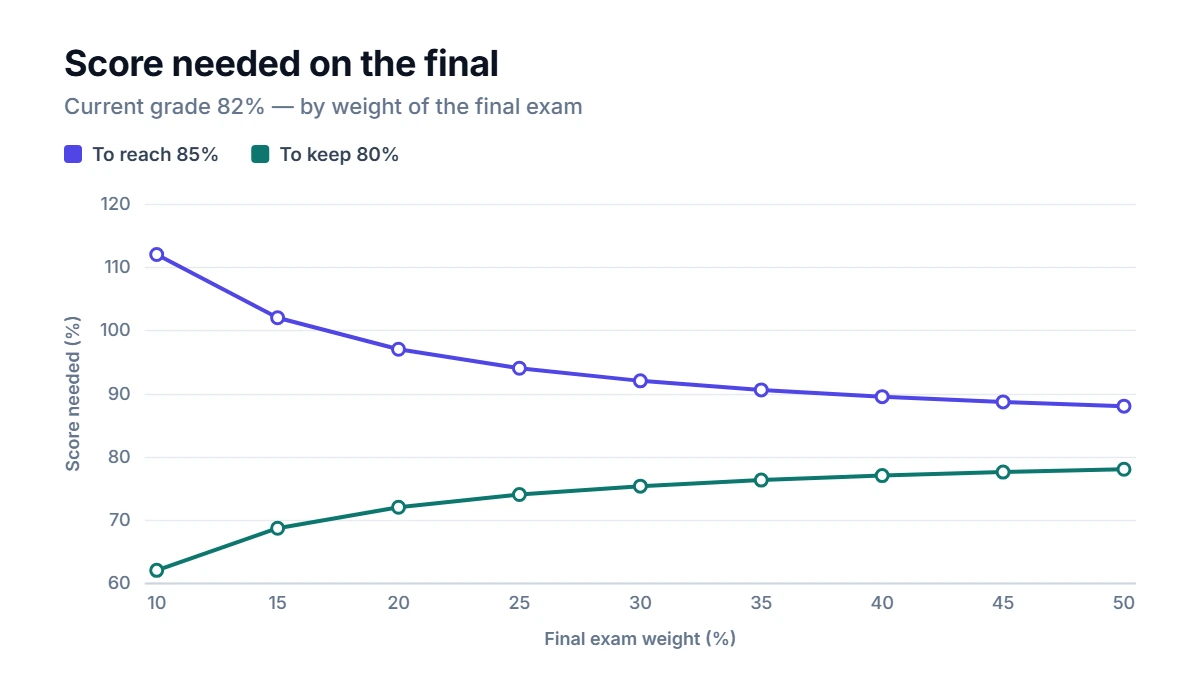
- Aiming higher (85%): with a 10% final you would need 112%, which is impossible. At 20% you need 97%, at 30% you need 92%, and at 50% you need only 88%. A heavy final is your friend when you are trying to climb.
- Holding on (80%): with a 10% final you only need 62%. At 30% you need 75.33%, and at 50% you need 78%. When you are already above your target, a heavy final is a risk, because a bad day costs more.
The pattern is general: the needed score always moves toward your desired grade as the final gets heavier.
When the goal is already secured
Sometimes the math says you need less than zero. Suppose your current grade is 95%, you want at least 80%, and the final counts for 15%. Your coursework already locks in 95 × 0.85 = 80.75 points, so even a 0% on the final leaves you at 80.75%. The goal is secured. You should still check the syllabus, because some courses require you to sit the final or reach a minimum score on it to pass.
How to use the Final Grade Calculator
Enter your current grade, the overall grade you want and the final's weight, all as percentages, then press Calculate. The result shows the score you need, or tells you that the goal is out of reach or already secured. It also shows the overall grade you would get with 0% and with 100% on the final, and a table of outcomes for final scores from 50% to 100%, each with a letter grade on a common US scale. Your school's letter cut-offs may differ.
Common mistakes
- Using an unweighted average as your current grade. If quizzes count for 10% and tests for 40%, a plain average of your scores will be off. Use the grade from your school's portal, or work it out first with the Weighted Grade Calculator.
- Entering the weight as a decimal. The calculator expects 30 for a 30% final, not 0.3.
- Forgetting other remaining work. If a project or last quiz is still ungraded, your current grade is not final. Either wait for it or treat the remaining work as part of the "final" weight.
- Ignoring rounding policies. Some instructors round 89.5% up to 90%, and some do not. Plan for the exact cut-off unless your syllabus says otherwise.
FAQ
How do I find my current grade if my school only shows points?
Divide the points you have earned by the points possible so far and multiply by 100. If you have 410 out of 500 points, your current grade is 82%. This works when the course is graded by total points rather than weighted categories.
Does the final exam weight include the final project?
Only if your syllabus groups them together. If the final exam and final project are separate items, treat the project as either part of your current grade (once it is graded) or part of the remaining weight.
Can I use this for a midterm instead of a final?
Yes, as long as the midterm is the only remaining graded item you are planning around. Enter the midterm's weight and your grade from everything else so far.
What is the highest overall grade I can still get?
Use 100% as the final score in the overall formula. With an 82% current grade and a 30% final, that is 82 × 0.70 + 100 × 0.30 = 87.4%.

