What Is BMI? How Body Mass Index Is Calculated and Read
BMI turns your weight and height into one number that doctors use as a quick first check. Here is how it is worked out, what the ranges mean and where the number falls short.

Body mass index, or BMI, is a single number that compares your weight with your height. It was designed in the 19th century to describe populations, not individuals, yet today it is the first number many doctors, insurers and fitness apps look at. It is quick, free and needs nothing more than a scale and a tape measure, which explains its popularity. Knowing how it is built also tells you exactly what it can and cannot say about you.
Why height squared?
Taller people are naturally heavier, so weight alone tells you little. BMI divides weight by height squared because, across large groups of adults, weight rises roughly with the square of height. Dividing by height once would still favor short people; dividing by height cubed would favor tall people. Squaring is a practical middle ground, and it is the reason the formula looks the way it does:
BMI = weight (kg) ÷ height (m)²
In US units the same result comes from BMI = 703 × weight (lb) ÷ height (in)². The 703 is simply a conversion factor that turns pounds and inches into kilograms and meters.
Calculating BMI step by step
Take an adult who is 5 ft 10 in tall and weighs 180 lb.
- Convert height to inches: 5 × 12 + 10 = 70 inches, which is 177.8 cm or 1.778 m.
- Convert weight to kilograms: 180 × 0.45359237 ≈ 81.65 kg.
- Square the height: 1.778 × 1.778 ≈ 3.161.
- Divide: 81.65 ÷ 3.161 ≈ 25.8.
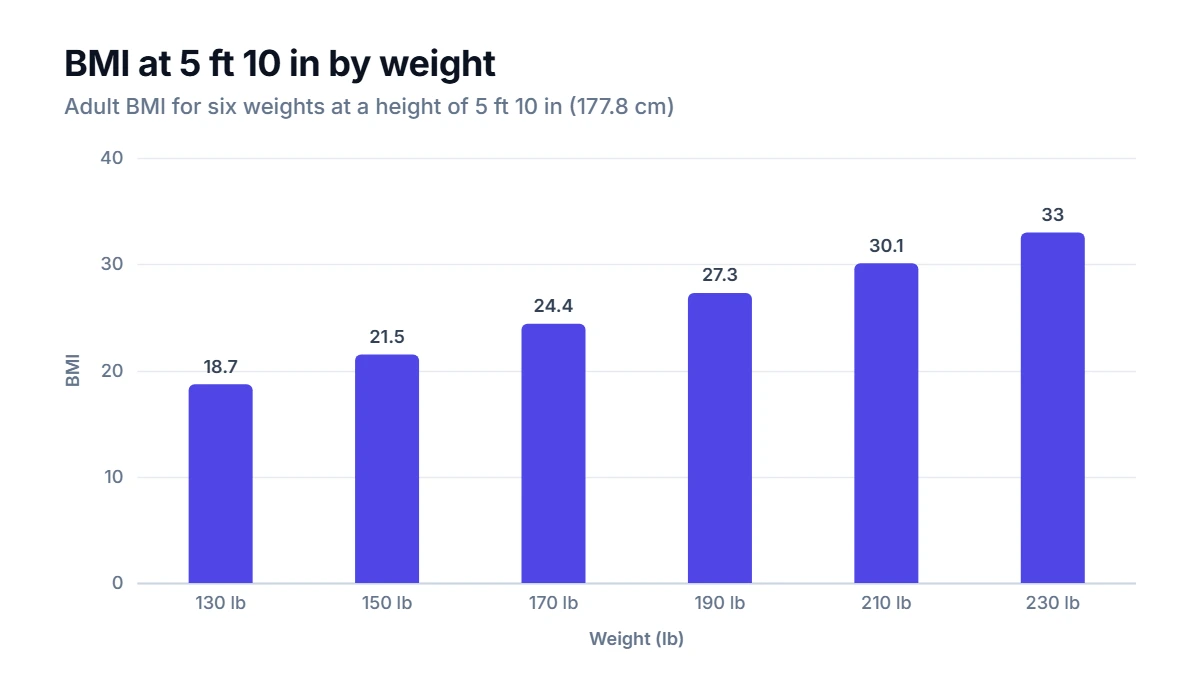
A BMI of 25.8 falls just inside the overweight range. The same person at 150 lb would have a BMI of 21.5, which is in the normal range.
A metric example: someone who is 165 cm tall and weighs 62 kg has a BMI of 62 ÷ (1.65 × 1.65) ≈ 22.8.
Reading the result
For adults aged 18 and over, the World Health Organization groups BMI like this:
- Below 18.5: underweight
- 18.5 to 24.9: normal weight
- 25.0 to 29.9: overweight
- 30.0 to 34.9: obesity class I
- 35.0 to 39.9: obesity class II
- 40 and above: obesity class III
The chart below shows how BMI changes with weight for one fixed height of 5 ft 10 in. Every 20 lb moves the number by close to three points, so a person can cross a category line with a fairly small change in weight.
Turning the formula around: a healthy weight range
You can also run the formula backwards to find which weights give a BMI from 18.5 to 24.9 at your height: weight = BMI × height². For 1.778 m that works out to about 58.5 kg to 78.7 kg, or roughly 129 lb to 174 lb. This band is wide on purpose. It is a range in which, on average, health risks tied to weight are lowest, not a target that everybody should aim for.
How to use the BMI Calculator
The BMI Calculator does the conversions for you. Choose US or Metric units, enter your weight and height, and press Calculate. You get your BMI to one decimal place, the matching WHO category and the healthy weight range for your height, shown in the units you picked. If you want to see how a planned change would affect the number, simply enter a different weight and calculate again.
What BMI does not tell you
BMI is a screening number. It flags people who may benefit from a closer look, but it cannot measure body fat directly. Keep these limits in mind:
- Muscle counts as weight. A strength athlete can have a BMI of 28 with little body fat. On the other hand, an older adult who has lost muscle can have a normal BMI and still carry a lot of fat.
- Fat location matters. Fat stored around the waist is linked to higher health risk than fat on the hips and thighs, and BMI cannot see the difference. A waist measurement or the waist-to-hip ratio adds that information.
- Groups differ. At the same BMI, risk can be higher for some ethnic groups, which is why some health bodies use lower cut-offs for people of Asian descent. Check the guidance that applies where you live.
- Not for everyone. The adult ranges do not apply to children and teens, who are compared with others of the same age and sex on growth charts, and they are not used during pregnancy.
Good-to-know tips for a reliable number
- Weigh yourself at the same time of day, ideally in the morning, because weight can swing by a few pounds over a day.
- Measure height without shoes, standing straight against a wall. An error of one inch moves BMI by about three-quarters of a point at average heights.
- Look at the trend over months rather than a single reading. A steady change says more than one number.
The results are estimates and not medical advice. If your BMI is outside the normal range, or you are unsure what it means for you, a doctor can combine it with other checks such as blood pressure, blood tests and body measurements.
FAQ
Is a BMI of 25 bad?
Not by itself. 25 is the point where the overweight range begins, but risk rises gradually rather than jumping at one value. Someone at 25 who is active and has a healthy waist size may be in good health. Treat it as a cue to look at other measures, not as a verdict.
Why does my BMI differ between apps?
Usually because of rounding or unit conversion. Some apps round height to the nearest inch or weight to the nearest pound before calculating, and some use 703 while others use the exact metric conversion. The differences are normally a tenth or two, not enough to change what the number means.
Does BMI change with age?
The formula stays the same for all adults, but body composition changes. Many people lose muscle and gain fat as they get older, so the same BMI can mean more body fat at 70 than at 30. Some doctors are less concerned about a slightly higher BMI in older adults for this reason.
What is a better measure than BMI?
No single number is perfect. Body fat percentage, waist circumference and the waist-to-hip ratio each add something BMI lacks. Used together with BMI, they give a much clearer picture of weight-related health risk.

