What Is BMR? Basal Metabolic Rate Explained
BMR is the energy your body burns at complete rest, and it sits underneath almost every calorie target. See how the three main equations work, with a full worked example and what to do with the number.

Your basal metabolic rate, or BMR, is the number of calories your body would burn in a day if you did nothing at all: no walking, no exercise, no digesting a big meal. It sounds like an abstract figure, but it is the foundation of almost every calorie target you will see, from weight loss plans to sports nutrition. This guide explains what BMR includes, how the three common equations work, and how to turn the number into something you can actually use.
What BMR actually measures
Even at complete rest your body is busy. The heart pumps, the lungs move air, the brain runs, the kidneys filter blood and cells are constantly repaired and replaced. All of that takes energy, and BMR is the estimate of how much.
For most people BMR is the biggest single part of daily energy use, typically well over half of it. The rest comes from physical activity of every kind, including fidgeting and standing, and from the energy used to digest food. That is why BMR matters: a small error in it carries through into every calorie target built on top of it.
In a lab, BMR is measured after a night's sleep and a fast, lying still in a comfortable room, by analyzing the oxygen you breathe in and the carbon dioxide you breathe out. Few people have that done, so in practice BMR is estimated from equations based on body size, age and sex.
The three equations
All three equations below use metric units: weight in kilograms, height in centimeters and age in years.
Mifflin-St Jeor
Published in 1990, this is the equation most dietitians reach for today when body composition is unknown.
- Men: 10 × weight + 6.25 × height − 5 × age + 5
- Women: 10 × weight + 6.25 × height − 5 × age − 161
Revised Harris-Benedict
The original Harris-Benedict equations date from 1919 and were revised in 1984. They tend to give slightly higher results than Mifflin-St Jeor for the same person.
- Men: 88.362 + 13.397 × weight + 4.799 × height − 5.677 × age
- Women: 447.593 + 9.247 × weight + 3.098 × height − 4.330 × age
Katch-McArdle
This one ignores age and sex and uses lean body mass instead: BMR = 370 + 21.6 × lean mass, where lean mass is your weight minus the weight of your body fat. Because muscle uses more energy than fat, it can suit very lean or muscular people better, but only if the body fat figure is reasonably accurate.
A worked example
Take a 35-year-old woman who weighs 68 kg (about 150 lb) and is 165 cm tall (about 5 ft 5 in). She thinks her body fat is around 30%.
Mifflin-St Jeor:
- 10 × 68 = 680
- 6.25 × 165 = 1,031.25
- 5 × 35 = 175
- 680 + 1,031.25 − 175 − 161 = 1,375 kcal per day (1,375.25 before rounding)
Revised Harris-Benedict: 447.593 + 628.796 + 511.17 − 151.55 = 1,436 kcal per day.
Katch-McArdle: her lean mass is 68 × 0.70 = 47.6 kg, so 370 + 21.6 × 47.6 = 1,398 kcal per day.
The three answers span about 60 kcal, roughly 4%. That spread is normal and a useful reminder that every equation is an estimate, not a measurement.
From BMR to daily calories
BMR alone is not how much you should eat. To estimate total daily energy expenditure (TDEE), multiply BMR by an activity factor. The usual factors are 1.2 for sedentary, 1.375 for light exercise, 1.55 for moderate, 1.725 for very active and 1.9 for extra active.
Using her Mifflin-St Jeor result:
- Sedentary: 1,650 kcal
- Light: 1,891 kcal
- Moderate: 2,132 kcal
- Very active: 2,372 kcal
- Extra active: 2,613 kcal
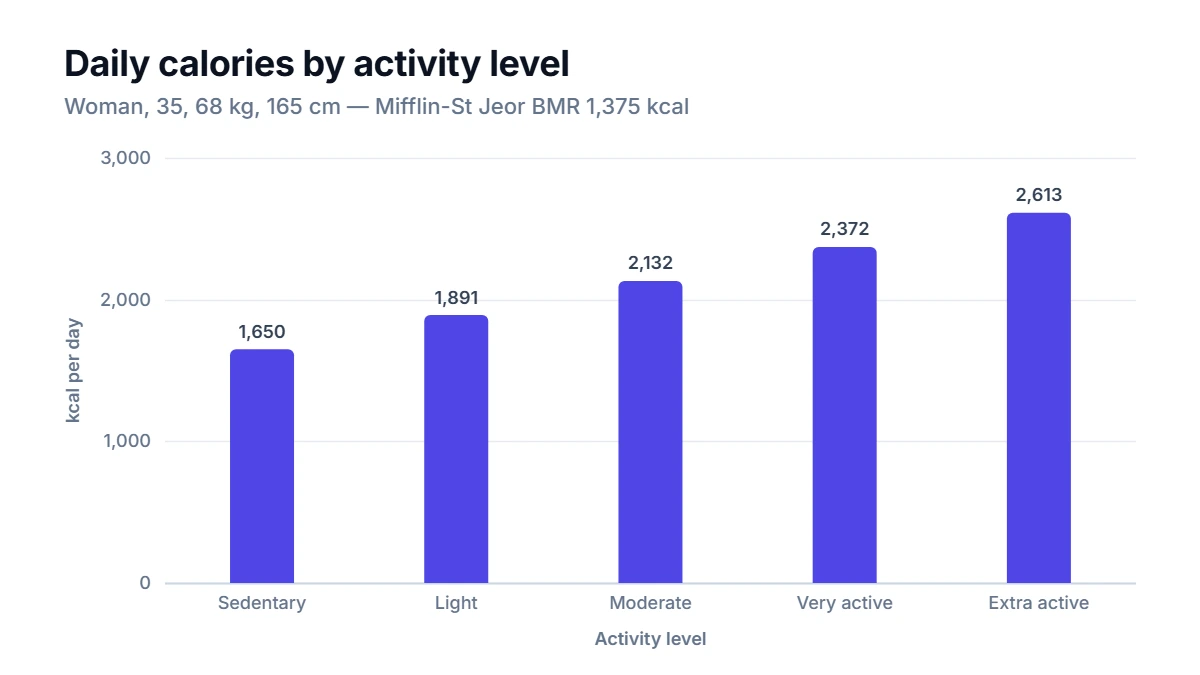
The jump from one activity level to the next is about 240 kcal here, bigger than the difference between the three BMR equations. In other words, picking an honest activity level matters more than picking the "best" formula. Most people overestimate how active they are, so if you are unsure between two levels, start with the lower one.
How BMR changes with age
All the age-based equations subtract a fixed amount per year. With Mifflin-St Jeor, the same woman's estimate drops by 5 kcal for every year, so from 1,450 kcal at 20 to 1,150 kcal at 80 if her weight and height stayed the same. Revised Harris-Benedict falls a little less steeply, by about 4.3 kcal per year.
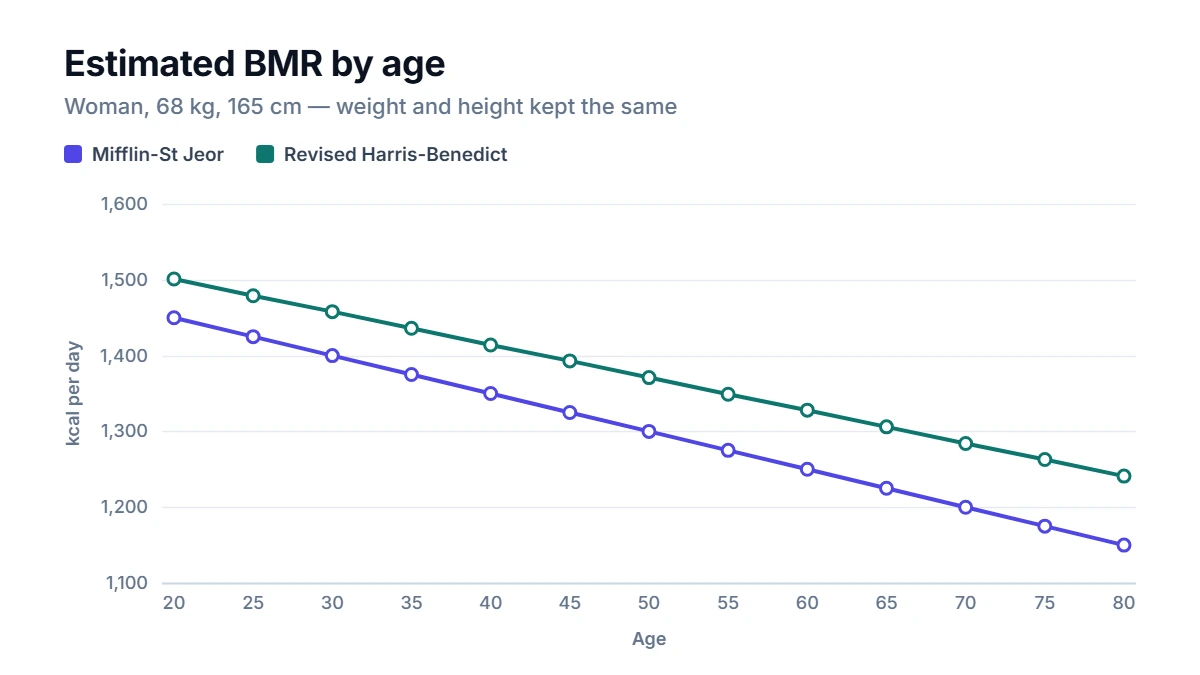
In real life much of the decline is linked to losing muscle, which is one reason strength training is often recommended as people get older. Weight loss lowers BMR too: if she lost 5 kg, her Mifflin-St Jeor estimate would fall by 50 kcal to 1,325.
How to use the BMR Calculator
Choose US or metric units, enter age, sex, weight and height, and pick a formula. Mifflin-St Jeor is the default. If you know your body fat percentage, switch to Katch-McArdle and a body fat field appears. Press Calculate to see your BMR and a table of daily calories at the five activity levels.
Try all three formulas. If they agree closely, you can be fairly confident in the range. If Katch-McArdle is far off the others, your body fat estimate may be worth double-checking.
Common mistakes
- Eating at your BMR to lose weight. BMR is what you burn lying still all day. Eating only that much usually means a large deficit once activity is added, which is hard to sustain. A moderate deficit below your TDEE is the usual approach, ideally with professional advice.
- Treating the result as exact. Real BMR can differ from any prediction by 10% or more for some people. Use the estimate as a starting point, then adjust based on how your weight actually changes over a few weeks.
- Mixing units. The equations need kilograms and centimeters. Entering pounds into a metric formula by hand gives nonsense.
- Using an outdated weight. Recalculate after a noticeable change in weight.
These figures are estimates and are not medical advice. If you are pregnant, breastfeeding, managing a health condition or planning a big change in diet, talk to a doctor or registered dietitian.
FAQ
Is BMR the same as resting metabolic rate?
They are close but not identical. Resting metabolic rate (RMR) is measured under less strict conditions, so it usually comes out slightly higher. In everyday use the two terms are often treated as the same thing.
Why do men usually have a higher BMR?
On average men are larger and carry more muscle and less fat at the same weight. Equations that use sex are capturing that average difference. Katch-McArdle skips sex entirely and uses lean mass directly.
Does a faster metabolism mean I can eat more?
A higher BMR does mean you burn more at rest, but differences between people of the same size, age and sex are usually smaller than people expect. Activity level tends to explain more of the gap between two people's calorie needs.
How often should I recalculate my BMR?
Whenever your weight changes by a few kilograms or pounds, or every year or so as your age goes up. The change from a single birthday is small, but it adds up over a decade.

