What Is a Debt-to-Income Ratio and How Can You Lower It?
Lenders use your debt-to-income ratio to judge how much more you can borrow. Learn how front-end and back-end DTI are calculated, what the usual limits mean and which moves lower your ratio fastest.

When you apply for a mortgage or a large loan, one of the first numbers a lender looks at is your debt-to-income ratio, or DTI. It answers a simple question: of every dollar you earn before tax, how much is already promised to debt payments? This guide shows how DTI is calculated, what the usual limits mean and which moves lower it the fastest.
The calculation
DTI compares monthly debt payments with gross monthly income, the amount before tax and deductions.
- Back-end DTI = all monthly debt payments ÷ gross monthly income × 100. This is the number most people mean by DTI.
- Front-end DTI = housing payment ÷ gross monthly income × 100. It looks at rent or the mortgage alone, including property tax, home insurance and HOA fees if you pay them.
Debt payments means required, recurring payments: the mortgage or rent, car loans, student loans, personal loans, the minimum due on each credit card and obligations such as child support. Groceries, utilities, phone bills and subscriptions do not count, even though they are real costs.
What the percentages mean
Lenders set their own limits, and these change with the loan type and over time, so check current rules with the lender. As a general guide:
- 36% or less: widely seen as comfortable.
- 37% to 43%: often still approved, especially for mortgages.
- 44% to 49%: many lenders become cautious.
- 50% or more: most lenders see a high risk.
For front-end DTI, a common guideline is 28% or less of income going to housing.
A worked example
Sam earns 84,000 a year before tax, which is 7,000 a month. Sam's monthly payments are:
- Rent: 1,900
- Car loan: 450
- Student loan: 300
- Credit card minimums: 175
- Personal loan: 225
The total is 3,050.
- Front-end DTI: 1,900 ÷ 7,000 = 27.14%.
- Back-end DTI: 3,050 ÷ 7,000 = 43.57%, just over the 43% mark.
To reach 43%, Sam's payments would need to fall to 3,010, a cut of 40 a month. To reach 36%, they would need to fall to 2,520, a cut of 530.
Which moves lower DTI the most
Because DTI is a ratio, there are only two levers: smaller payments or a higher income. Here is how far each option moves Sam's back-end ratio:
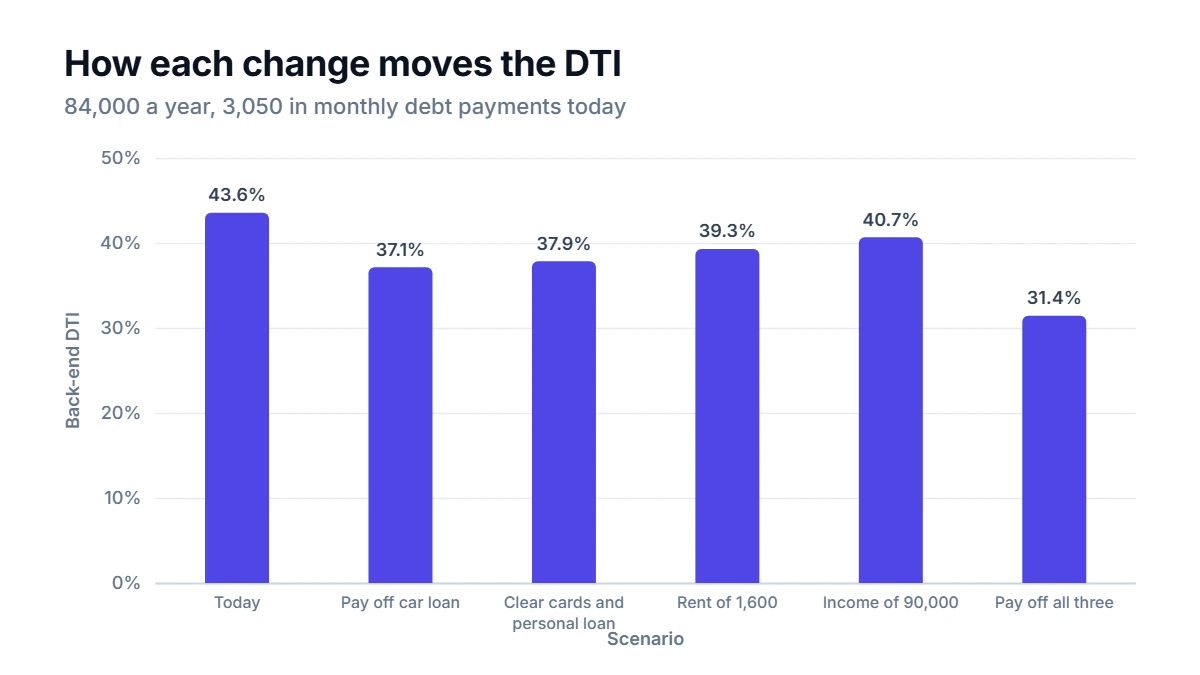
- Pay off the car loan: 2,600 ÷ 7,000 = 37.14%.
- Clear the credit cards and the personal loan: 2,650 ÷ 7,000 = 37.86%.
- Move to a home with rent of 1,600: 2,750 ÷ 7,000 = 39.29%.
- Earn 90,000 a year instead of 84,000: 3,050 ÷ 7,500 = 40.67%.
- Pay off the car, the cards and the personal loan: 2,200 ÷ 7,000 = 31.43%.
Two lessons stand out. First, the debt with the biggest monthly payment moves DTI the most, not the one with the biggest balance. A loan with only a few payments left can be worth clearing before an application, because it removes a whole payment for a modest sum. Second, a raise helps less than you might hope: 6,000 more a year lowers Sam's ratio by about 3 points, while paying off a single 450 car loan lowers it by more than 6.
Paying down versus paying off
Credit cards behave differently from installment loans. The minimum payment on a card usually shrinks as the balance shrinks, so paying down a card lowers DTI a little straight away. Paying down an installment loan, such as a car loan, does not change its monthly payment at all; only paying it off completely removes it from the ratio. If your goal is a lower DTI for an application, focus on loans you can finish and on cards with high minimums.
How to use the Debt-to-Income Ratio Calculator
Choose monthly or annual income and enter your gross pay, including everyone who will be on the application. Then fill in your rent or mortgage payment and your other monthly debt payments, adding extra rows for anything that does not fit the standard boxes. The Debt-to-Income Ratio Calculator shows your front-end and back-end ratios with a rating, a breakdown of each debt's share of your income and how much your payments would have to change to reach 36% or 43%. Try a few what-if versions, such as leaving out one loan, to see which change helps most.
Common mistakes
- Using take-home pay. Lenders use gross income. Net pay makes your ratio look worse than a lender would calculate.
- Entering balances instead of payments. DTI compares monthly payments with monthly income. A 6,000 card balance with a 175 minimum counts as 175.
- Forgetting the new loan. A mortgage application looks at your DTI with the new housing payment included, not your current rent.
- Taking on credit just before applying. A new car loan or store card shortly before a mortgage application can push the ratio over a lender's limit.
DTI is only one part of a lending decision, alongside your credit history, savings and job stability. Treat the numbers here as estimates for planning, not financial advice.
FAQ
Does DTI affect my credit score?
Not directly. Credit scores are built from your credit report, which does not record your income. Credit utilization, the share of your card limits you are using, does affect scores, and paying down cards helps both.
Do lenders count income from a side job?
Often, if it is regular and you can document it, for example with tax returns covering a couple of years. Rules differ between lenders and loan types, so ask what they need.
Can I get a loan with a DTI above 50%?
Some lenders and programs allow it with strong compensating factors, such as large savings or an excellent credit history, but the options become fewer and usually more expensive. Lowering the ratio first gives you more choice.
Is a lower DTI always better?
For borrowing, yes. For your budget, DTI is a useful warning light but not the whole picture, because it ignores living costs such as childcare and transport that do not count as debt.

