What Is Dollar-Cost Averaging? How It Works, With Examples
Investing the same amount every month means you automatically buy more when prices are low. Learn how dollar-cost averaging works, why your average cost ends up below the average price, and when a lump sum would have done better.

Dollar-cost averaging, often shortened to DCA, means investing a fixed amount at regular intervals, for example 200 every month, no matter what the price is doing. Many people already do it without calling it anything: a monthly transfer into a retirement account or an index fund is dollar-cost averaging. The idea is simple, but the effect on your average purchase price is less obvious, and the comparison with investing everything at once surprises a lot of people.
How it works
Each period, your fixed amount buys as many units as it can at that period's price:
- Units bought = amount ÷ price
- Average cost per unit = total invested ÷ total units
- Current value = total units × current price
- Gain or loss = current value − total invested
When the price is low, the same 200 buys more units. When it is high, it buys fewer. Over time, the cheap purchases carry more weight, which pulls your average cost down.
Why your average cost is below the average price
Mathematically, the average cost under DCA is the harmonic mean of the prices you paid, and a harmonic mean is never higher than the simple average. A tiny example shows why: invest 100 at a price of 10 and 100 at a price of 5. You get 10 + 20 = 30 units for 200, an average cost of 6.67, while the average of the two prices is 7.50. The low price bought twice as many units, so it counts twice as much.
This does not mean DCA guarantees a profit. It only means you pay less per unit than the average price over the period. Whether you gain depends on where the price ends up.
A worked example: a choppy year
Say you invest 200 a month for 12 months in a fund whose price dips and then recovers: 50, 46, 41, 38, 35, 37, 40, 44, 47, 45, 49 and 52.
- In month 1 you buy 4 units at 50. In month 5, at the low of 35, the same 200 buys about 5.71 units.
- After 12 months you have invested 2,400 and own about 55.78 units.
- Your average cost is about 43.02 per unit, below the simple average price of 43.67.
- At the final price of 52 your units are worth 2,900.65, a gain of 500.65 or 20.86%.
Investing the whole 2,400 in month 1 at 50 would have bought exactly 48 units, worth 2,496 at the end, a gain of only 96. In this year, spreading the purchases out clearly helped, because the money arrived while prices were low.
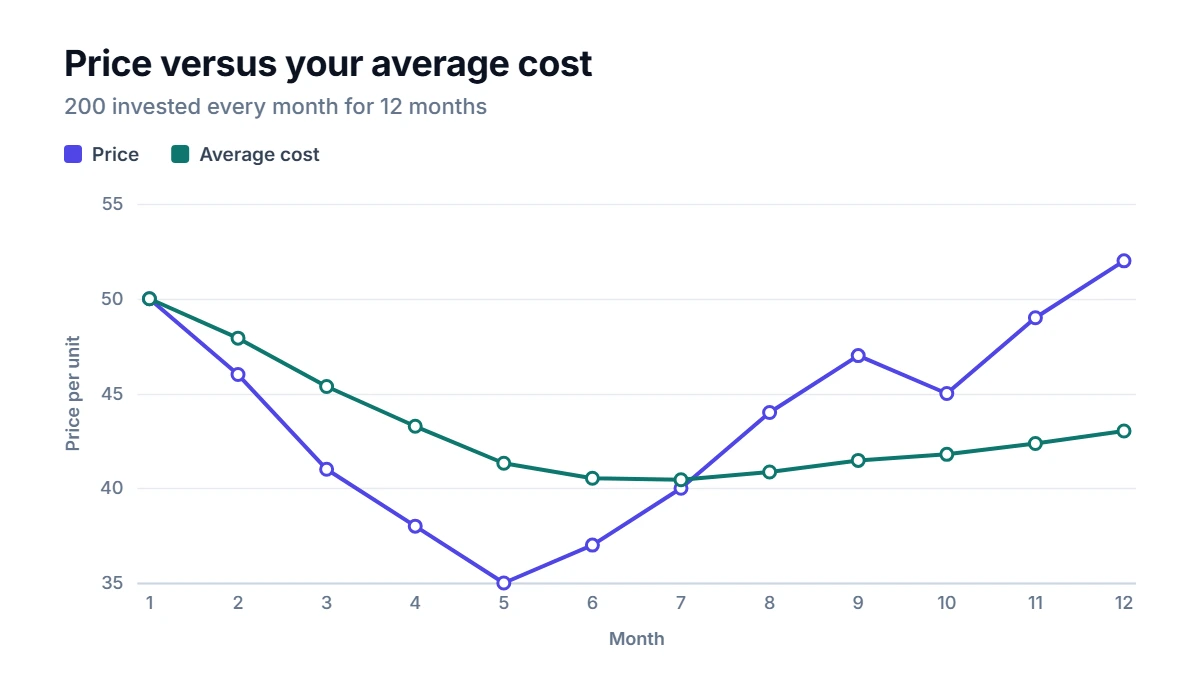
Notice how the average cost line moves much less than the price. It falls quickly while prices drop, then rises slowly as purchases at higher prices are added.
DCA versus a lump sum
The choppy year flatters DCA. Here is what happens in two smoother markets, with the same 2,400 to invest:
- Steady rise of 12% a year: the price grows from 50 to about 55.47 over the year. DCA ends with 2,529.30; the lump sum invested in month 1 ends with 2,662.73. The lump sum wins because all of the money was invested for the whole climb.
- Steady fall of 20% a year: the price slides from 50 to about 40.75. DCA ends with 2,171.14; the lump sum ends with 1,956.04. DCA loses less because later purchases were cheaper.
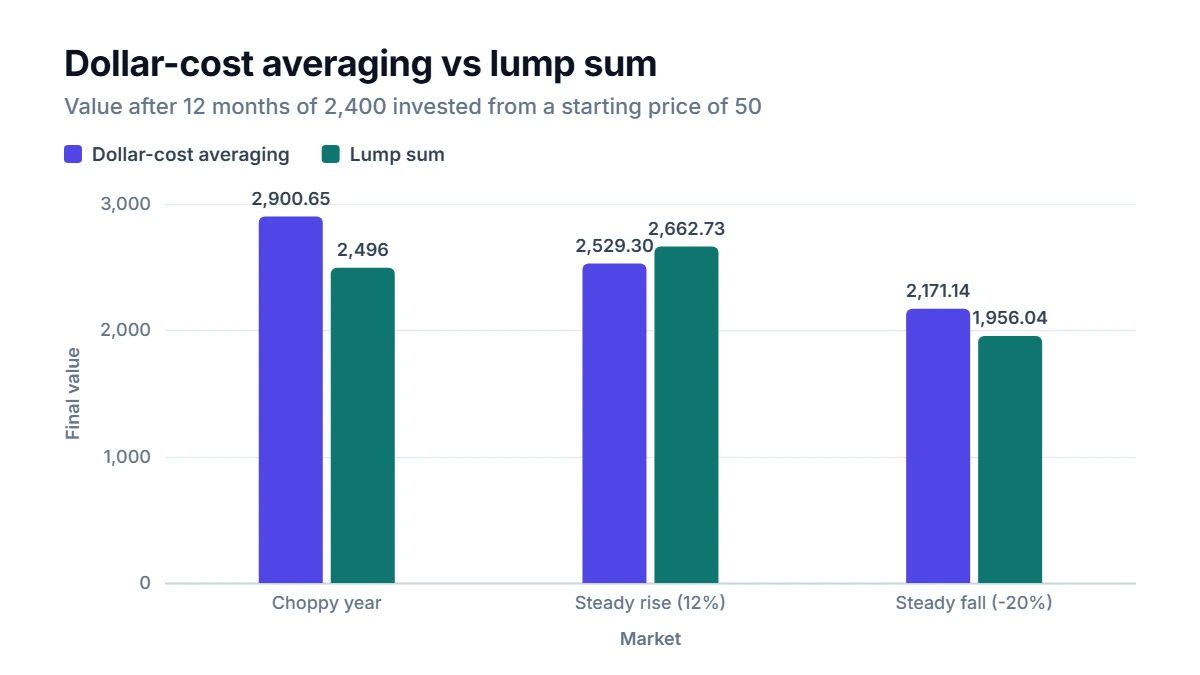
Since markets have historically risen more often than they have fallen, a lump sum has often come out ahead over long periods. DCA's main strengths are different: it limits the regret of investing everything just before a drop, it matches how most people actually get money, from a paycheck, and it removes the temptation to time the market. Neither approach is right for everyone, and past patterns do not guarantee future results.
How to use the calculator
Enter the amount you invest each period and choose weekly or monthly. If you have real prices, paste them in, oldest first, one per line or separated by commas; a column copied from a spreadsheet works. If you want to explore a scenario instead, switch to expected return and enter a starting price, an annual return and the number of purchases. Add today's price if you want to value your units now rather than at the last purchase. The Dollar-Cost Averaging Calculator then shows your total units, average cost, current value and gain, with a row-by-row schedule.
A useful exercise is to run the same prices twice: once as entered and once with only the first price and the full amount. That gives you the lump-sum comparison for your own data.
Things that change the real result
- Fees. A fixed fee per purchase hurts small, frequent investments the most. Check what your platform charges.
- Dividends. Reinvested dividends add units, which the simple calculation ignores.
- Taxes. Each purchase may have its own cost basis for tax purposes. Rules differ by country, so check current rules.
- Consistency. DCA only works if you keep buying when prices fall. Pausing during a drop removes the cheap purchases that do the averaging.
These figures are estimates for learning and planning, not financial advice.
FAQ
Does dollar-cost averaging reduce risk?
It reduces timing risk, the risk of putting all your money in just before a fall. It does not reduce the risk of the investment itself. If the asset loses value for good, buying it gradually still loses money, just more slowly.
How often should I invest with DCA?
Monthly is common because it matches most paychecks. Weekly purchases smooth the average a little more but can cost more if each purchase carries a fee. The difference in average cost between weekly and monthly is usually small.
Is DCA a good idea for very volatile assets?
The bigger the price swings, the larger the gap between your average cost and the average price, so DCA has a stronger averaging effect. But volatile assets can also fall sharply and stay down, so the averaging effect is no protection against a poor investment.
What is the difference between DCA and simply investing every month?
In practice there is none. If you invest a set amount from every paycheck, you are already dollar-cost averaging. The term matters more when someone has a lump sum available and chooses to spread it out on purpose.

