What Is Lean Body Mass and How Do You Estimate It?
Your weight does not say what it is made of. Learn what lean body mass is, how the Boer, James and Hume formulas estimate it, where they go wrong and how to use lean mass to track real progress.

Two people can both weigh 68 kg and have very different bodies. One might carry 15 kg of fat, the other 25 kg. The scale cannot tell them apart, but lean body mass can. This guide explains what lean mass is, how the height-and-weight formulas estimate it, why they fail for some people and how to use the number to track a diet or training plan.
What counts as lean mass
Lean body mass (LBM) is your total weight minus your fat. It includes muscle, bones, organs, skin, blood and the water in your tissues. Body fat percentage and lean mass are two sides of the same split:
- Lean mass = weight × (1 − body fat % ÷ 100)
- Fat mass = weight − lean mass
Lean mass is the working part of your body. It accounts for most of the energy you burn at rest, which is why some calorie formulas, such as Katch-McArdle, start from lean mass instead of total weight. It is also used to set protein targets and, in medicine, for some drug doses.
Two ways to get the number
From a body fat measurement. If a smart scale, skinfold caliper, tape-measure method or DEXA scan gives you a body fat percentage, lean mass follows directly from the formula above. The result is only as good as the measurement, but it is based on your own body.
From height and weight alone. Researchers fitted formulas to groups of adults whose body composition was measured in a lab. The best known are the Boer, James and Hume formulas. Each uses sex, height in cm and weight in kg. For women, for example, the Boer formula is 0.252 × weight + 0.473 × height − 48.3. These formulas need no equipment, but they only know how tall and how heavy you are, not what you are made of.
A worked example
A woman is 165 cm tall and weighs 68 kg. A body fat scan puts her at 32% fat.
- From the scan: 68 × 0.68 = 46.2 kg of lean mass and 21.8 kg of fat.
- Boer: 0.252 × 68 + 0.473 × 165 − 48.3 = 46.9 kg (68.9% of her weight).
- James: 47.6 kg (70.0%).
- Hume: 45.8 kg (67.4%).
For her, the formulas land within about a kilogram of the scan. That is typical for people of fairly average build, and it is why the formulas are useful for a quick estimate.
Where the formulas go wrong
Muscular people
A man who is 180 cm tall, weighs 95 kg and lifts weights seriously might measure 12% body fat. His real lean mass is then 95 × 0.88 = 83.6 kg. The Boer formula, seeing only his height and weight, estimates 67.5 kg, which would mean 29% body fat. It is 16 kg off, because it assumes his extra weight is mostly fat, as it would be for an average person of the same size.
High body weight
The James formula contains a squared term that eventually turns its estimate downward as weight rises at a fixed height. For our 165 cm woman, James gives 52.6 kg of lean mass at 100 kg but only 47.2 kg at 130 kg, which makes no physical sense. Boer and Hume keep rising.
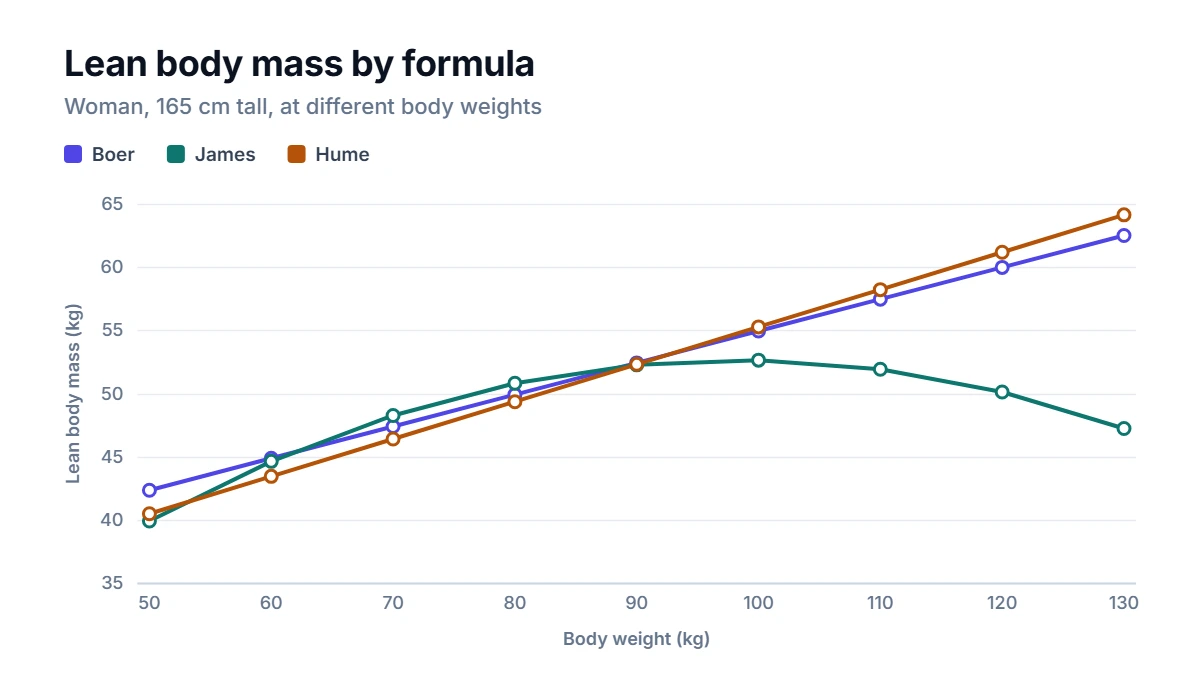
Between 50 and 100 kg at this height the three formulas stay within about 2.5 kg of each other. Above 100 kg they drift apart quickly, and the James result is best ignored.
Children
Adult formulas do not fit the body proportions of children. Separate formulas, such as the Peters formula, exist for them, and any result for a child is best discussed with a pediatrician.
Using lean mass to track progress
The scale tells you how much you lost; lean mass tells you what you lost. Suppose the same woman diets and trains for three months and goes from 68 kg at 32% fat to 63 kg at 28% fat:
- Before: 46.2 kg lean, 21.8 kg fat.
- After: 45.4 kg lean, 17.6 kg fat.
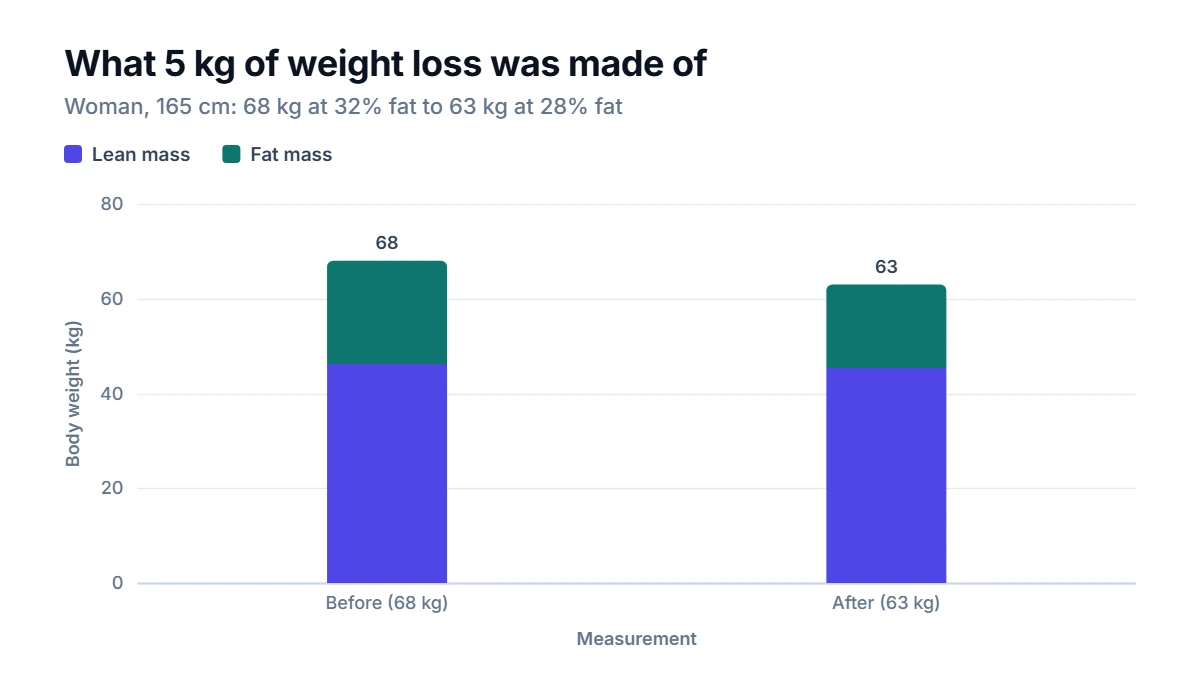
Of the 5 kg she lost, about 4.1 kg was fat and 0.9 kg was lean mass. Some lean loss is normal during weight loss, because lean mass includes water and stored carbohydrate. Strength training and enough protein help keep it small.
A height-and-weight formula cannot show any of this. Given 63 kg instead of 68 kg, the Boer formula simply lowers its estimate by 1.26 kg (0.252 × 5), whatever actually happened in her body. Only a measurement reveals the real change.
How to use the Lean Body Mass Calculator
Choose US or metric units, select your sex and enter your height and weight. If you know your body fat percentage from a scale, caliper or scan, add it too. The Lean Body Mass Calculator shows the estimate from each formula as a weight and as a share of your body weight, together with the matching body fat. When you enter a measured body fat percentage, that becomes the headline result and the formulas act as a sanity check. Enter an age under 14 and it switches to a formula designed for children.
Good to know
- Measure under the same conditions each time: same scale, same time of day, before eating. Hydration alone can shift a smart scale's reading by a few percent.
- Watch the trend over several weeks rather than any single reading.
- Lean mass is not muscle mass. Muscle is only part of it, so a 1 kg drop in lean mass is not 1 kg of lost muscle.
- All of these numbers are estimates, not medical advice. If lean mass is needed for a medical purpose, such as dosing, follow your doctor or pharmacist.
FAQ
Can I increase my lean body mass?
Yes, mainly by building muscle through regular resistance training with enough protein and calories. Bone and body water also count toward lean mass, but muscle is the part you can change most.
Why does my smart scale disagree with the calculator?
Most smart scales estimate body fat by sending a tiny electrical current through your body, and the reading depends on hydration, skin temperature and how your feet touch the pads. The formulas use only height and weight. Both are estimates, and they can differ by several kilograms.
Is lean body mass the same as fat-free mass?
The two terms are often used interchangeably. Strictly, fat-free mass excludes all fat, while lean body mass includes the small amount of essential fat in organs, nerves and bone marrow. For everyday use the difference is small.
What lean mass percentage should I aim for?
There is no single target, because healthy ranges depend on sex, age and activity. Use your own trend instead: holding lean mass steady while fat mass falls is a good sign during weight loss.


