What Is TDEE? Total Daily Energy Expenditure Explained
TDEE is the number of calories you burn in a day. Here is what it is made of, how it is estimated, why your activity level matters so much and how to fine-tune the estimate.

TDEE, or total daily energy expenditure, is the number of calories you burn in an average day, everything included. It is the most useful single number for anyone who wants to lose, keep or gain weight on purpose, because every eating plan is really just a decision about how far above or below it to eat.
What goes into your daily calorie burn
Think of TDEE as a stack of four layers:
- Basal metabolic rate (BMR) is the energy your body uses just to stay alive: breathing, circulation, keeping warm, repairing cells. For most people it is 60–70% of the total.
- Non-exercise activity covers everything that is not a workout: walking around the office, cooking, carrying shopping, even fidgeting. It can differ by hundreds of calories between two people of the same size.
- Exercise is the planned part: runs, gym sessions, sports. It is often smaller than people expect.
- The thermic effect of food is the energy spent digesting and storing what you eat, roughly a tenth of your intake.
Only BMR can be estimated well from your body measurements. The other layers depend on how you live, which is why every TDEE calculator asks about activity.
How TDEE is estimated
Measuring calorie burn directly needs a lab. Instead, calculators use a two-step estimate.
Step 1: estimate BMR
The most widely used equation is Mifflin-St Jeor. It uses weight in kilograms, height in centimeters and age in years:
BMR = 10 × weight + 6.25 × height − 5 × age + 5for menBMR = 10 × weight + 6.25 × height − 5 × age − 161for women
If you know your body fat percentage, the Katch-McArdle equation is an alternative: BMR = 370 + 21.6 × lean body mass (kg). It ignores age and sex and looks only at the tissue that burns the most energy.
Step 2: multiply by an activity factor
BMR is multiplied by a factor that stands for the other three layers:
- 1.2 for sedentary (little or no exercise)
- 1.375 for light activity (exercise 1–3 days a week)
- 1.55 for moderate activity (3–5 days a week)
- 1.725 for very active (hard exercise 6–7 days a week)
- 1.9 for extra active (very hard training or a physical job)
A worked example
Take a 35-year-old woman who is 165 cm tall, weighs 65 kg and works out two or three times a week, so she picks light.
- 10 × 65 = 650
- 6.25 × 165 = 1,031.25
- 5 × 35 = 175
- BMR = 650 + 1,031.25 − 175 − 161 = 1,345.25, about 1,345 kcal
- TDEE = 1,345.25 × 1.375 ≈ 1,850 kcal a day
To lose about 0.5 kg a week she would aim for roughly 550 kcal less, or about 1,300 kcal. To gain 0.25 kg a week she would eat about 2,125 kcal.
If she measures her body fat at 28% and uses Katch-McArdle instead, her lean mass is 46.8 kg, her BMR comes out at about 1,381 kcal and her TDEE at about 1,899 kcal. The two formulas land within 50 kcal of each other, which is typical for people with average body composition.
Activity matters more than anything else
Here is the same woman at every activity level. Her body has not changed, only her week:
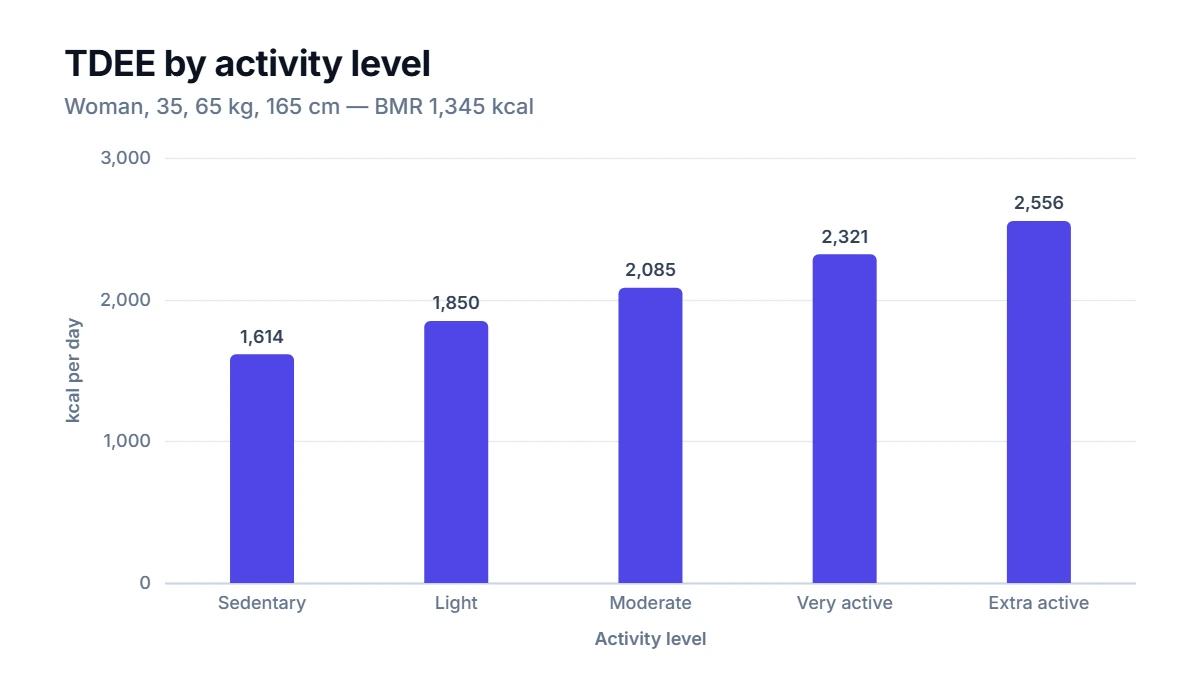
The gap from sedentary (1,614 kcal) to extra active (2,556 kcal) is more than 940 kcal a day. Picking a level one step too high is the most common reason a diet stalls: the plan assumes you burn 235 kcal more than you really do, which cancels about half of a typical 500 kcal deficit.
A practical rule: if you have a desk job, choose the level that matches your exercise and then think about how much you move the rest of the day. Someone who trains three times a week but sits for ten hours and drives everywhere often fits light better than moderate.
Using the TDEE Calculator
The TDEE Calculator does both steps for you. Choose US or metric units, enter your age, sex, weight and height, pick an activity level and, if you like, switch to Katch-McArdle and add your body fat. You get your BMR, your TDEE, three daily targets and a table with your TDEE at every activity level, so you can see how sensitive the number is to your choice.
Turning the estimate into a real number
Any formula can be off by 10% or more for a given person. Treat the result as a starting point and let your own data correct it:
- Eat close to your estimated TDEE for two to three weeks.
- Weigh yourself several mornings a week under the same conditions and look at the weekly average, not single days.
- If the average stays flat, the estimate is about right. If it drifts up or down, adjust by 100–200 kcal and test again.
This turns a population average into your personal number, which is what you actually need.
Common mistakes
- Counting exercise twice. The activity factor already includes your workouts. Adding watch-reported exercise calories on top usually overstates your burn.
- Going below a safe floor. Very low targets are hard to sustain and can cost muscle. The calculator flags targets under 1,200 kcal for women or 1,500 kcal for men; eating that little is generally only advised under medical supervision.
- Never updating it. As you lose weight, your BMR and TDEE drop. Recalculate after every 4–5 kg (about 10 lb) of change.
These figures are estimates, not medical advice. If you are pregnant, breastfeeding, have a medical condition or take medication that affects weight, speak to a doctor or registered dietitian first.
FAQ
Why does my fitness tracker show a different number?
Trackers estimate calorie burn from heart rate and movement, and their accuracy varies widely between devices and activities. Neither number is exact. Pick one method, use it consistently and adjust based on how your weight actually changes.
Does TDEE change as I get older?
Yes, slowly. In the Mifflin-St Jeor equation each extra year lowers BMR by 5 kcal, so ten years make about 50 kcal difference before activity. Loss of muscle and a less active routine often matter more than age itself.
Can I raise my TDEE?
The easiest lever is everyday movement: walking more, standing more and taking the stairs. Building muscle through strength training also raises BMR a little over time.
Is it better to cut more calories to lose weight faster?
A larger deficit gives faster early results, but it is harder to keep up, increases hunger and makes muscle loss more likely. Many people do better with a moderate deficit they can maintain for months.


