When Does Refinancing Make Sense? Break-Even and Total Cost
A lower rate does not automatically mean a better deal. Learn how to judge a refinance by its break-even point and its total cost, with a worked example that compares five real-looking options.

Refinancing means replacing the loan you have with a new one, usually to get a lower interest rate, a different term or both. The offer letter tends to highlight one number: how much lower your monthly payment will be. That number matters, but it is only one of three questions you need to answer. The other two are how long it takes to earn back the cost of refinancing, and whether you pay more or less in total by the time the new loan is gone.
The three questions behind every refinance
- Does the payment go down? This is the monthly savings: your current payment minus the new one.
- When do I break even? Refinancing has closing costs such as appraisal, lender and title fees. The break-even point is the number of months of lower payments it takes to win that money back.
- Do I pay less overall? Add up every payment left on the current loan and compare it with every payment on the new loan plus the closing costs. The difference is the lifetime savings, and it can be negative.
A refinance can pass the first test and fail the third. That happens most often when a lower rate comes with a longer term.
How the numbers are worked out
Both payments come from the standard loan formula: the balance, the monthly rate (the annual rate divided by 12) and the number of months. For the current loan you use the balance you still owe and the months you have left, not the original amount and term.
- Monthly savings = current payment − new payment
- Break-even (months) = closing costs ÷ monthly savings, rounded up to a whole month
- Lifetime savings = all remaining current payments − (all new payments + closing costs paid upfront)
If you roll the closing costs into the new loan instead of paying them in cash, the new balance is larger and you pay interest on those costs for the whole term. The costs are then already inside the new payments, so they are not added again.
A worked example with five options
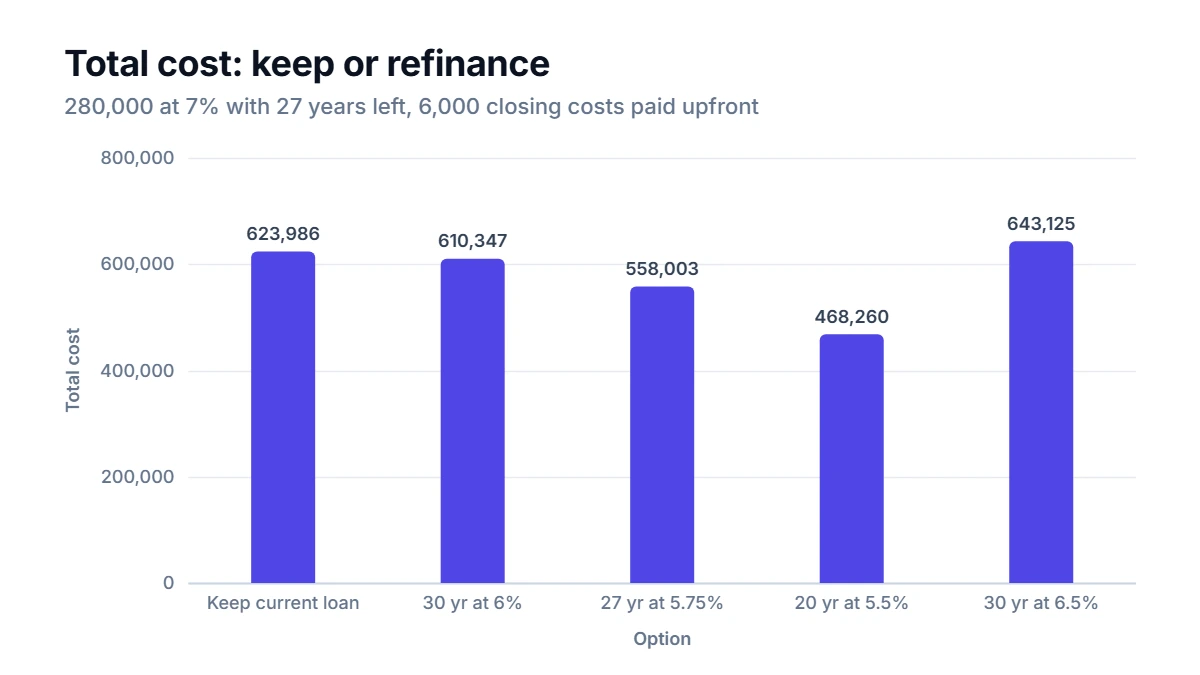
Say you owe 280,000 at 7% with 27 years (324 months) left. Your payment is 1,925.88 a month, and if you simply keep paying, the remaining payments add up to 623,985.71. A lender offers several new loans, each with 6,000 in closing costs paid upfront. Running them through the Refinance Calculator gives:
- 30 years at 6%: 1,678.74 a month, saving 247.14. Break-even in 25 months. Lifetime savings: 13,638.78.
- 27 years at 5.75%: 1,703.71 a month, saving 222.17. Break-even in 28 months. Lifetime savings: 65,982.58.
- 20 years at 5.5%: 1,926.08 a month, 20 cents more than now. There is no break-even because the payment does not fall, yet you save 155,725.44 over the life of the loan and are debt-free seven years sooner.
- 30 years at 6.5%: 1,769.79 a month, saving 156.09. Break-even in 39 months. Lifetime savings: −19,138.86, so this one costs more in total.
The 30-year loan at 6% has the biggest monthly savings, but the 27-year loan at a slightly lower rate keeps almost the same payment relief and saves nearly five times as much overall. The reason is simple: the 30-year loan adds three extra years of payments to a loan that had 27 left.
Reading the break-even point
The break-even point answers a practical question: how long do you need to keep the new loan for the refinance to pay for itself? For the 30-year loan at 6%, you spend 6,000 at closing and gain 247.14 a month. After 24 months you are still 68.64 behind; in month 25 you move ahead. From then on, each month adds to your gain, reaching about 8,828 after five years.
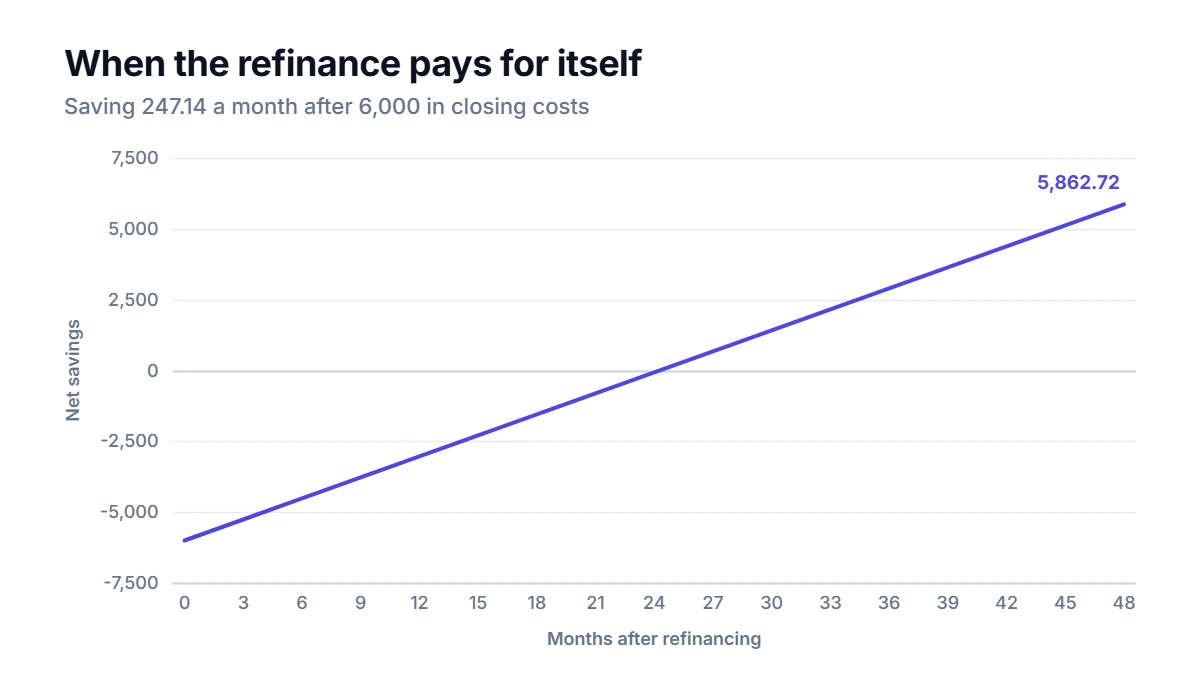
If there is a real chance you will sell the home or pay off the loan before the break-even month, the refinance will likely lose money even though the payment fell. A move in two years makes a 39-month break-even a poor bet.
Paying costs upfront or rolling them in
Take the same 30-year loan at 6%, but roll the 6,000 into the balance so you borrow 286,000. The payment becomes 1,714.71, the monthly savings shrink to 211.17 and the break-even stretches to 29 months. The lifetime savings drop from 13,638.78 to 6,688.49, because you pay 6% interest on the fees for 30 years. Rolling costs in keeps cash in your pocket today, but it is the more expensive way to pay them.
How to use the calculator for your own loan
Find the balance and the number of payments left on your latest statement. Enter them with your current rate under the current loan. Then enter the new rate, the new term in years and the closing costs from the lender's estimate, and choose upfront or rolled in. Try a few terms side by side: the same rate over 30, 25 and 20 years often tells a very different story. The comparison table shows the interest left on each loan, which is where the real difference hides.
Things that are easy to overlook
- The term reset. Starting a fresh 30-year loan when you have 22 years left adds eight years of payments. Matching the new term to the years you have left is the fairest comparison.
- Cash-out refinancing. If you borrow more than you owe, part of the new payment is for the extra cash, so the comparison is no longer like for like.
- Escrow and insurance. Taxes and insurance are usually collected with the payment but are not part of the loan math. Compare principal and interest only.
- Rules and fees vary. Closing costs, tax treatment and prepayment rules differ by lender and country. Check current rules and the official loan estimate.
All figures here are estimates that assume fixed rates and no extra payments. They are not financial advice.
FAQ
How much lower should the rate be before refinancing is worth it?
There is no fixed rule. A small rate drop can pay off if closing costs are low and you plan to stay for years, while a big drop can still lose money if you move soon or stretch the term a lot. Work out the break-even and the lifetime figure for your own numbers instead of relying on a rule of thumb.
Can I refinance to a shorter term without raising my payment?
Sometimes. In the example, a 20-year loan at 5.5% costs almost exactly the same per month as the current 27 years at 7%, because the lower rate offsets the shorter term. It is worth checking whenever rates have fallen by a meaningful amount.
Should I make extra payments instead of refinancing?
Extra payments cut interest without any closing costs, but they do not lower your rate. If the rate gap is large, refinancing usually saves more. If it is small, extra payments on your current loan may be the simpler choice. A payoff calculator shows how much extra payments save.
Does refinancing restart the interest-heavy part of the loan?
Yes. Early payments on any new loan are mostly interest, because the balance is at its highest. That is one more reason a refinance with a much longer term can cost more overall even at a lower rate.
