Dice Probability Explained: Odds for 2d6, 3d6 and d20 Rolls
Why is 7 the most common roll with two dice, and how much does rolling with advantage really help? Learn to work out dice odds by counting, with tables for 2d6, 3d6 and the d20.

Board games, tabletop role-playing games and classroom probability lessons all lean on dice, and the odds behind them are surprisingly easy to work out once you see the trick. You do not need advanced math, just careful counting. This guide shows how to find the chance of any total, why sums of several dice behave so differently from a single die, and what "advantage" on a d20 is really worth.
One die: every face is equal
A fair die with S sides gives each face a chance of 1 in S. On a six-sided die (a d6), each number has a 1/6 chance, about 16.67%. On a d20, each number has a 1/20 chance, exactly 5%. The chance of rolling a range is the number of faces in the range divided by S: rolling 15 or higher on a d20 covers 6 faces (15 to 20), so it happens 6/20 = 30% of the time.
The average of one die is the middle of its range: (1 + S) ÷ 2. That is 3.5 for a d6 and 10.5 for a d20.
Two dice: count the combinations
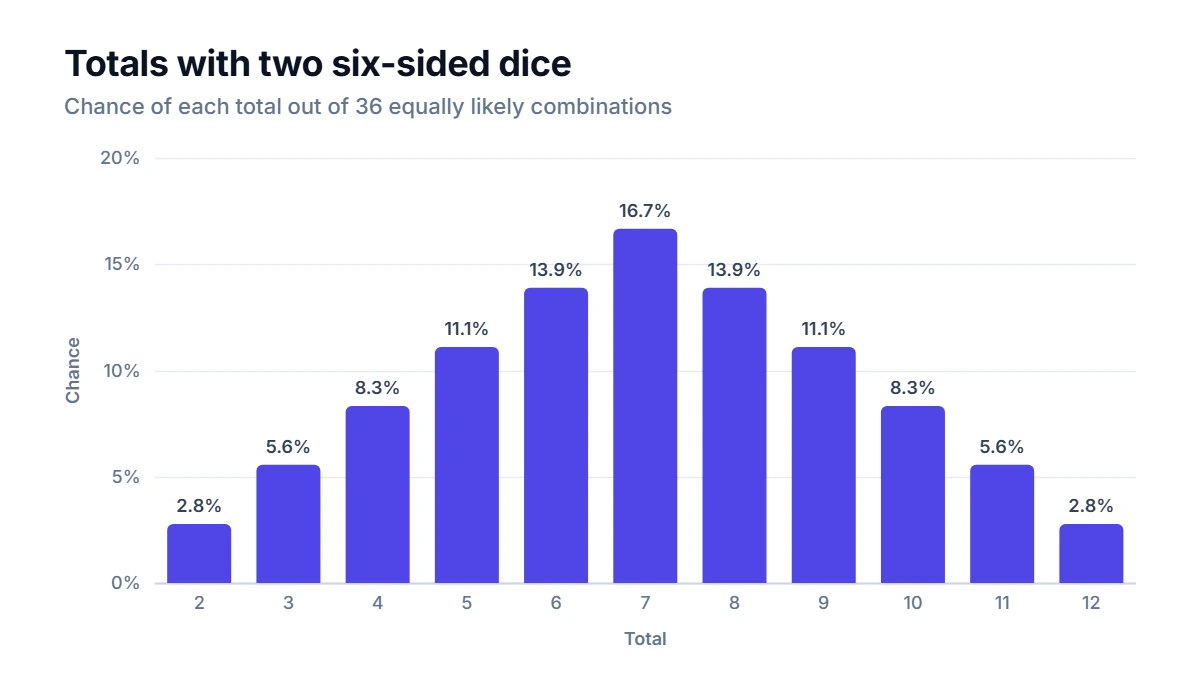
With two dice, the total is not equally likely at all. The method is to list every way the dice can land. Two d6 have 6 × 6 = 36 equally likely outcomes, and you count how many give each total.
- A total of 2 needs 1 + 1: one way out of 36, or 2.78%.
- A total of 7 can be 1 + 6, 2 + 5, 3 + 4, 4 + 3, 5 + 2 or 6 + 1: six ways, or 16.67%.
- A total of 12 needs 6 + 6: one way, 2.78% again.
The full pattern rises by one combination per step from 2 to 7 and falls by one from 7 to 12, giving the familiar triangle shape. A 7 is six times as likely as a 2 or a 12, which is why so many board games put special rules on 7.
Three dice: the bell curve appears
Add a third d6 and there are 6 × 6 × 6 = 216 outcomes. The totals range from 3 to 18, but the edges become very rare: a 3 or an 18 needs all three dice to match, so each has just 1 chance in 216, about 0.46%. In the middle, 10 and 11 can each be made 27 ways, so each shows up 12.5% of the time.
- 3 or 18: 0.46% each
- 6 or 15: 4.63% each
- 9 or 12: 11.57% each
- 10 or 11: 12.50% each
The more dice you add, the more the totals bunch up around the average and the more the shape looks like a bell. That is why games roll 3d6 for character traits that should usually be average, and a single d20 when any result from great to terrible should be equally likely.
"At least one" problems: use the opposite
Many questions ask for the chance of getting something at least once, such as at least one 6 in three rolls. Counting every way that can happen is tedious. It is much quicker to find the chance that it never happens and subtract from 1.
- The chance of not rolling a 6 on one die is 5/6.
- The chance of no 6 in three rolls is (5/6)³ ≈ 0.5787.
- So the chance of at least one 6 is 1 − 0.5787 ≈ 42.13%.
With four rolls it climbs to 1 − (5/6)⁴ ≈ 51.77%, just better than a coin flip. This classic example puzzled gamblers centuries ago, and it shows that you need more tries than intuition suggests before something likely happens.
Advantage and disadvantage on a d20
Some games let you roll two d20 and keep the higher one (advantage) or the lower one (disadvantage). Using the "opposite" trick:
- Advantage: you fail only if both dice fail. If one die succeeds with probability p, advantage succeeds with 1 − (1 − p)².
- Disadvantage: you succeed only if both dice succeed, so the chance is p².
Needing 10 or higher (p = 55%), advantage raises your odds to 79.75% and disadvantage lowers them to 30.25%. Needing 15 or higher (p = 30%), advantage gives 51% and disadvantage just 9%. Needing a natural 20 (p = 5%), advantage nearly doubles the chance to 9.75%, while disadvantage cuts it to 0.25%, or 1 in 400.
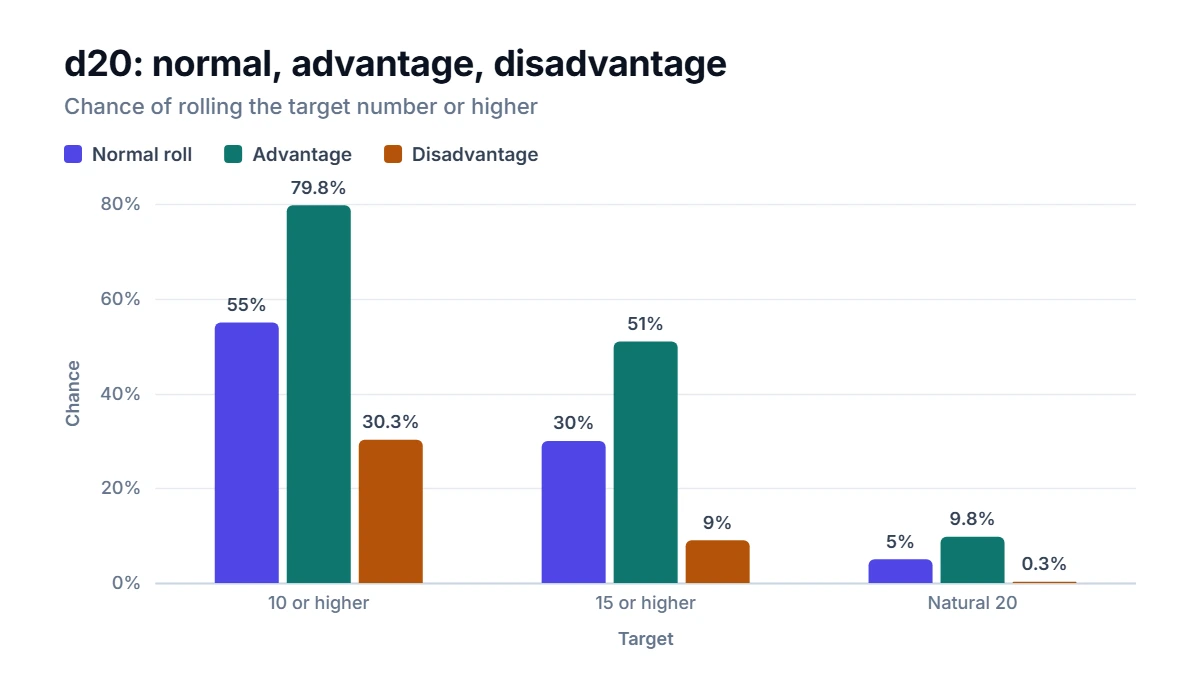
On average, the higher of two d20 is 13.83 and the lower is 7.18, compared with 10.5 for a single roll. Advantage helps most when you need a middling roll, and least at the extremes.
Checking the math with the roller
The Dice Roller makes each roll with your browser's secure random generator, so every face has the same chance. A quick experiment shows the counting in action: 200,000 rolls of 2d6 produced a 7 in 16.68% of rolls and a 2 in 2.78%, almost exactly the 16.67% and 2.78% the counting predicts. To try it yourself, set the number of dice to 2, choose d6 and roll a few dozen times. You will see sevens pile up long before you see a 2 or a 12, though small samples always wobble.
The roller also handles a modifier, as in 1d20 + 5. A modifier shifts every total by the same amount without changing the shape of the odds, so the chance of "1d20 + 5 reaches 15" equals the chance of "1d20 reaches 10".
Common mistakes
- The gambler's fallacy. A die has no memory. After five rolls without a 6, the next roll still has a 1/6 chance.
- Adding chances that overlap. Two rolls at 1/6 each do not give a 2/6 chance of at least one 6. The correct figure is 11/36, about 30.56%, because rolling two 6s is counted only once.
- Treating totals as equally likely. With two or more dice, the middle totals are much more common than the edges.
FAQ
What is the probability of rolling doubles with two dice?
There are six doubles (1-1 up to 6-6) among the 36 combinations, so the chance is 6/36, or 1 in 6. It is the same as the chance of any single number on one die.
Is a d20 roll the same as picking a random percentage?
Not quite. A d20 moves in 5% steps, so it can express chances such as 30% or 55% but not 33%. A d100, or two d10 read as tens and units, gives every whole percentage from 1 to 100.
What is the average total of 3d6?
The average of one d6 is 3.5, and averages add, so 3d6 averages 10.5. Since the total must be a whole number, 10 and 11 are the most common results, each with a 12.5% chance.
How many times should I roll to test whether a die is fair?
Many more than most people expect. With a few dozen rolls, uneven results are normal. You need hundreds or thousands of rolls before small differences become meaningful, and even then a statistical test such as chi-square is the proper way to judge.
