How Long Is a Month or a Year? Time Units Explained
A minute is always 60 seconds, but a month can be 28 to 31 days and a year 365 or 366. Learn where our time units come from, why converters use averages and when that matters.

Converting meters to centimeters is easy because every step is a power of ten. Time is messier. There are 60 seconds in a minute, 24 hours in a day, 7 days in a week, and then months and years that do not even have a fixed length. Knowing why helps you pick the right number when you turn "3 months" into weeks or "a billion seconds" into years, and it explains why different tools sometimes give slightly different answers.
Two kinds of time units
It helps to split time units into two groups.
Fixed units always have the same length. A second is defined by atomic physics, and everything up to a week is built from it:
- 1 minute = 60 seconds
- 1 hour = 60 minutes = 3,600 seconds
- 1 day = 24 hours = 86,400 seconds
- 1 week = 7 days = 604,800 seconds
Below the second, the units are decimal: a millisecond is a thousandth of a second, a microsecond a millionth and a nanosecond a billionth.
Calendar units follow the Earth and Moon rather than a clock, so their length depends on which one you mean. February 2026 has 28 days, March has 31, and 2028 will have 366 days instead of 365.
Where 60 and 24 come from
The 24-hour day goes back to ancient Egypt, which split day and night into 12 parts each. Dividing hours into 60 minutes and minutes into 60 seconds comes from Babylonian astronomy, which counted in base 60. Sixty is handy because it divides evenly by 2, 3, 4, 5, 6, 10, 12, 15, 20 and 30, so a quarter or a third of an hour is always a whole number of minutes. Attempts to introduce decimal time, most famously in France in the 1790s, never caught on.
Why a year is 365.2425 days
The Earth takes about 365.2422 days to go round the Sun from one spring to the next. A calendar of exactly 365 days would drift by almost a quarter of a day every year, and the seasons would slowly slide through the months.
- The Julian calendar added a leap day every four years, giving an average year of 365.25 days. That was slightly too long, and by the 1500s the calendar had drifted about ten days.
- The Gregorian calendar, used today in most of the world, skips the leap day in century years unless they divide by 400. So 2000 was a leap year, but 2100 will not be. That leaves 97 leap years in every 400, and an average year of 365 + 97/400 = 365.2425 days.
That average equals 31,556,952 seconds. A common year of 365 days has 31,536,000 seconds, and a leap year has 31,622,400.
Why a month is 30.436875 days
Months started as moon cycles, about 29.5 days, but calendar months have since been stretched to fill the year. Their lengths now range from 28 to 31 days, with no neat pattern. For conversions, the only fair single value is the average: one twelfth of the average year, 365.2425 ÷ 12 = 30.436875 days, or 730.485 hours.
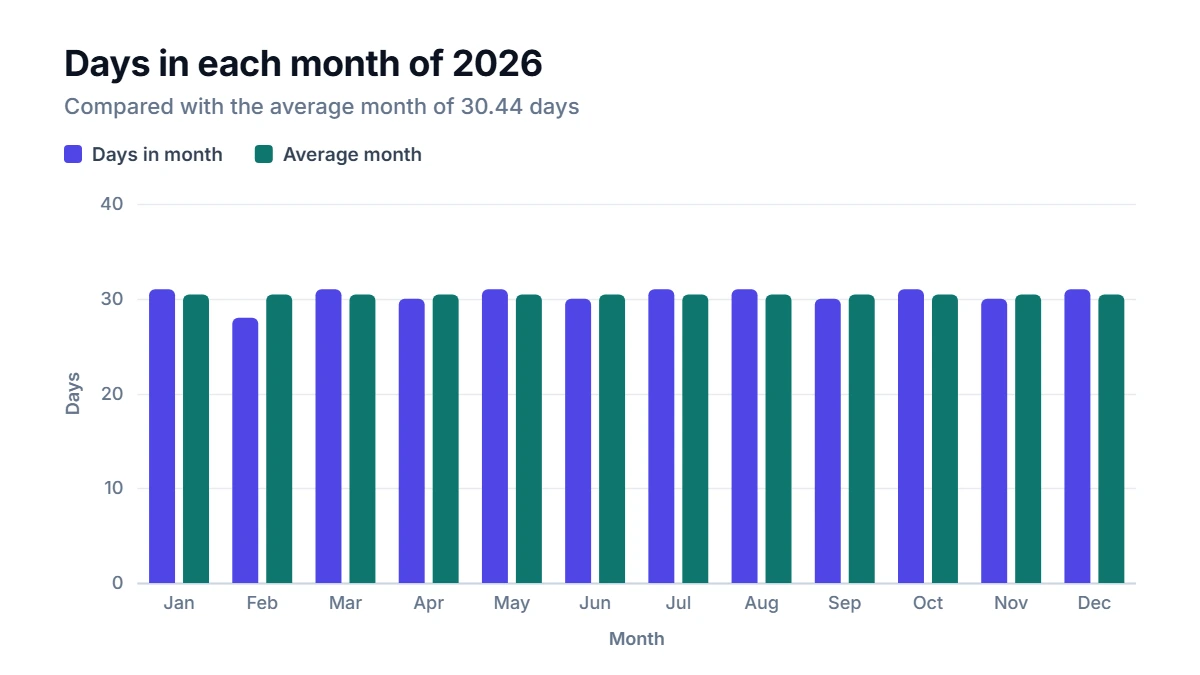
No real month is exactly 30.44 days long, but over many months the average is spot on. That is why converters use it, and why "monthly" figures in rent, salaries or subscriptions are sometimes converted to yearly ones by multiplying by 12 rather than counting days.
Worked examples
All of these come from the Time Unit Converter, which uses the average Gregorian month and year:
- A billion seconds is 1,000,000,000 ÷ 31,556,952 ≈ 31.69 years. You reach your billionth second about eight months after your 31st birthday.
- 80 years is about 29,219.4 days, or roughly 701,266 hours.
- 3 months is about 13.04 weeks. That is why a quarter is often described as "13 weeks", which is in fact slightly less, about 2.99 months.
- One year is 52.1775 weeks, not exactly 52. Weekly pay schedules therefore have 53 paydays in some years.
- A full-time work year of 40 hours × 52 weeks = 2,080 hours is only about 23.7% of the 8,765.82 hours in an average year.
When averages are not the right answer
An average month works for estimates and long-run comparisons, but not for questions about specific dates. "How many days from January 15 to April 15?" depends on the months in between, and on whether February has 29 days that year. For that, count the actual calendar days with a date calculator.
The same goes for exact ages and deadlines. A rental agreement with a 30-day notice period and one with a one-month notice period can end on different days. Contracts and laws often define these terms precisely, so check the wording or the current rules where you live.
How to use the converter
Type an amount, pick the unit you have and the unit you want, and press Convert. A table then shows the same length of time in every unit from nanoseconds to millennia, which is handy for getting a feel for big or small numbers. The swap button flips the direction when you want to go back.
Good to know
- A day is treated as exactly 86,400 seconds. Daylight saving changes make some local days 23 or 25 hours long, but those are clock adjustments, not a different day length.
- Leap seconds have occasionally been added to keep clocks in step with the Earth's rotation, but they are tiny and are being phased out internationally.
- Computers often store time as the number of seconds since January 1, 1970, which avoids months and years entirely until a date has to be displayed.
FAQ
How many weeks are in a month?
On average, 30.436875 ÷ 7 ≈ 4.35 weeks. A 28-day February is exactly 4 weeks, and a 31-day month is 4 weeks and 3 days.
How many hours are in a year?
A common year of 365 days has 8,760 hours, a leap year has 8,784, and the long-run average is 8,765.82 hours.
Is a decade 3,650 days?
Not quite. Ten common years would be 3,650 days, but a decade usually contains two or three leap days, so it is 3,652 or 3,653 days. Using the average year gives 3,652.425.
Why do different converters give different answers for months?
Some use a flat 30 days, some 30.4167 (365 ÷ 12) and some 30.436875 (the Gregorian average). For a few months the gap is tiny, but it adds up over years. When accuracy matters, check which definition a tool uses.


