How Morse Code Works: Letters, Timing and Speed
Morse code turns every letter into a short pattern of beeps, and its design is smarter than it looks. Learn why E is a single dot, how timing defines speed, how to decode a message by hand and how people actually learn to read it by ear.

Morse code is one of the oldest digital codes still in use. It has only two signal lengths, yet it can carry any message over a wire, a radio link, a flashlight or a tap on a pipe. It needs almost no equipment, and a weak Morse signal can often be understood when a voice on the same channel would be lost in the noise. That simplicity is why radio amateurs still use it, long after it stopped being a commercial necessity.
Where the code came from
Samuel Morse and Alfred Vail developed their telegraph system in the United States in the late 1830s and early 1840s. An electric circuit can only be on or off, so messages had to be built out of short and long pulses. The first version, now called American Morse, used several odd spacings that were awkward on long lines. A simplified European variant replaced it across most of the world and became what is now International Morse code, the version the Morse Code Translator uses.
Ships relied on it for decades. The distress signal SOS was adopted internationally in the early twentieth century because its pattern is easy to recognize. Despite the popular story, the letters do not stand for "save our souls" or anything else. They were chosen for the sound. Maritime services moved to satellite and digital distress systems in the late 1990s, but Morse lives on in amateur radio, in aviation navigation beacons that identify themselves in code, and as an input method for people who can only operate one or two switches.
Why E is one dot and Q is four symbols
The alphabet was designed around how often letters are used. E and T are the most common letters in English, so they get the shortest codes: a single dot and a single dash. Rare letters such as Q, J and Z get long ones. This is the same idea behind modern data compression: spend the fewest signals on what you send most.
The effect is easy to measure. A dot lasts one time unit, a dash three, and each gap inside a character one. Counting that way, E takes 1 unit, T takes 3, S takes 5, O takes 11 and Q takes 13. Digits are the longest of all because each one has exactly five symbols, so 0 reaches 19 units.
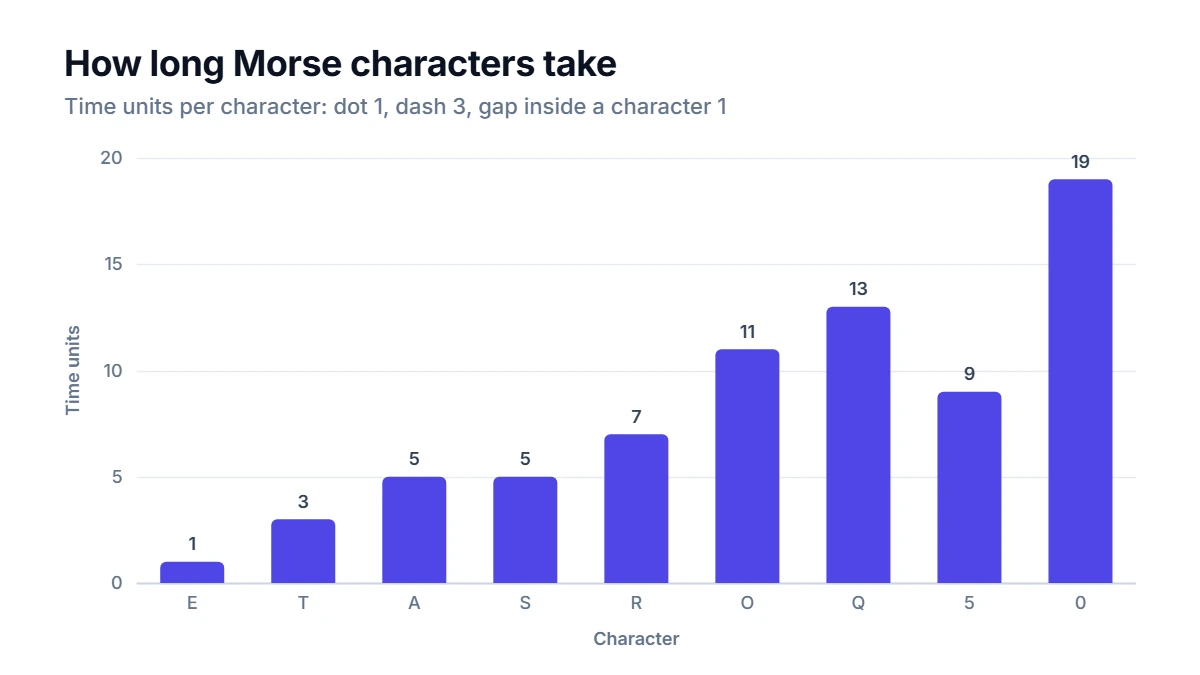
The system is not perfectly efficient. O, one of the most common letters, takes more than twice as long as S. But it is good enough, and its patterns are easy to tell apart by ear.
Worked example: decoding by hand
Written Morse depends entirely on the spaces. Take this line:
-- --- .-. ... .
Split it at each space and look up one group at a time:
--is M---is O.-.is R...is S.is E
The message is MORSE. Now see why the spaces matter. The group .- is the letter A, but . - is E followed by T. Likewise .... is H, while . . . . is four separate Es. Remove the spaces entirely and a line of dots and dashes can be read in many different ways, so always keep them when you copy Morse as text.
Worked example: how long a message takes
Speed comes from the length of one time unit, so the length of a message is a matter of adding up units. For HELLO WORLD:
- HELLO: the letters take 7 + 1 + 9 + 9 + 11 = 37 units, plus four letter gaps of 3 units each, for 49
- WORLD: the letters take 9 + 11 + 7 + 9 + 7 = 43 units, plus four letter gaps, for 55
- The word gap between them adds 7
That is 49 + 55 + 7 = 111 units. At 20 words per minute one unit is 60 milliseconds, so the message lasts 6.66 seconds. At a beginner's 5 words per minute one unit stretches to 240 milliseconds, and the same message takes 26.64 seconds.
Words per minute is a convention rather than a count of real words, because actual text varies. Operators usually time the word PARIS, which comes to 50 units with its word gap. Some training software uses CODEX, which takes 60 units and gives a lower figure for the same unit length, so check which standard a speed claim is based on.
How to use the translator
Paste your text or code into the Morse Code Translator and it works out the direction on its own. A good way to practice is to encode a sentence you know, press Play sound at a low speed and listen without looking. Then write down what you heard, paste it back in and compare. Anything the tool cannot translate is listed under the result, so you will spot a typo at once.
How people actually learn it
Most people start by memorizing a chart of dots and dashes, and most instructors advise against it. Skilled operators do not count symbols in their heads. They recognize each letter as a complete sound, so the letter L is a rhythm, not the list dot, dash, dot, dot. Saying "dit" and "dah" aloud builds that habit far better than reading the symbols.
Two popular methods build on that idea:
- The Koch method starts at full speed with only two letters. You add a new letter each time you reach about 90 percent accuracy.
- The Farnsworth method sends letters at a fast speed but stretches the gaps between them, which leaves you time to think while the rhythm of each letter stays intact.
Short, regular sessions work better than long ones. Fifteen minutes a day will usually do more than two hours on a weekend.
Common mistakes
- Leaving out word breaks. Without a slash or a wide gap, a sentence decodes as one long word.
- Expecting lowercase or every symbol back. Morse has no letter case, and many symbols, including the exclamation mark, have no code in the international set.
- Using look-alike characters. Long dashes and bullets copied from a document may not be true dots and dashes. The translator converts common look-alikes, but other tools may not.
- Treating it as secret. Morse is an encoding that anyone can read, not encryption.
FAQ
What do radio operators mean by "73" and "CQ"?
They are shorthand from the telegraph days. 73 means "best regards" and is sent as --... ...--. CQ is a general call that invites any station to answer, sent as -.-. --.-. Short codes like these save time at the key.
Can Morse code be sent with light?
Yes. Any signal with two states works, including a flashlight, a ship's signal lamp or a tapped sound. The timing rules stay the same, though hand-sent light is usually much slower than radio.
How long does it take to learn Morse code?
Many learners can recognize all the letters and digits within a few weeks of daily practice. Comfortable conversation at around 20 words per minute usually takes several months. Your pace depends far more on regular practice than on talent.
Is Morse code the same in every language?
The international set covers the Latin alphabet, digits and some punctuation. Other writing systems have their own variants, such as Cyrillic, Greek, Arabic and Japanese Wabun code, which reuse many of the same patterns with different meanings. A message from one table cannot be read safely with another.
Related guides

How to Write Numbers in Words
From forty-two to one million two hundred fifty thousand: learn the groups-of-three method for spelling out any number, the US and British "and", the exact format for checks, and when to use words instead of digits.

How to Analyze Word Frequency in Your Writing
A word frequency count shows overused words, the real topic of a text and differences between drafts in seconds. Learn how counts and shares work, why filler words dominate, and how to act on the results.

What Is Lorem Ipsum and When Should You Use It?
Lorem ipsum is scrambled Latin from a text by Cicero. Learn where it came from, why it works so well as placeholder text, how much of it each part of a layout needs, and when real words are the better choice.

Text Case Styles Explained: Title Case, Sentence Case, camelCase and More
Title Case or Sentence case for headings? camelCase or snake_case for code? Learn what each case style is for, how acronyms complicate things and what automatic conversion cannot fix for you.