How to Analyze Word Frequency in Your Writing
A word frequency count shows overused words, the real topic of a text and differences between drafts in seconds. Learn how counts and shares work, why filler words dominate, and how to act on the results.

Every writer has words they lean on without noticing: "really," "just," "actually," or the same key term in every other sentence. A word frequency count shows those habits in seconds. It is also a quick way to check what a piece of text is really about, to compare two drafts, or to make sure an article uses its main terms naturally instead of stuffing them in. Here is how frequency analysis works, how to read the numbers, and what to do with them.
What a word frequency count measures
The idea is simple: split the text into words, treat capital and lowercase letters as the same, and count how many times each word appears. Each count can also be shown as a share of all words, which makes texts of different lengths comparable.
Two adjustments make the result far more useful:
- Filler words (stop words). Words like "the," "and," "of," "a" and "to" dominate every English text. Filtering them out lets the words that carry meaning rise to the top.
- Two-word phrases. Counting adjacent word pairs, such as "customer service" or "interest rate," catches ideas that a single-word count would split in half.
A natural pattern in every text
Count the words in any long text and a striking pattern appears. A handful of words are extremely common, and most words appear only once or twice. In large collections of English, the most frequent word occurs roughly twice as often as the second most frequent, about three times as often as the third, and so on. This rough rule is known as Zipf's law.
The practical lesson: an unfiltered list will always be topped by filler words, whatever your topic. That says nothing about your writing. What matters is which meaningful words follow and how often they repeat.
Worked example: a product description
Take a 103-word product description for a garden planning app. It begins: "Our new garden planner helps you plan a garden in minutes." The rest describes picking plants, checking sunlight and spacing, saving the plan and printing a shopping list.
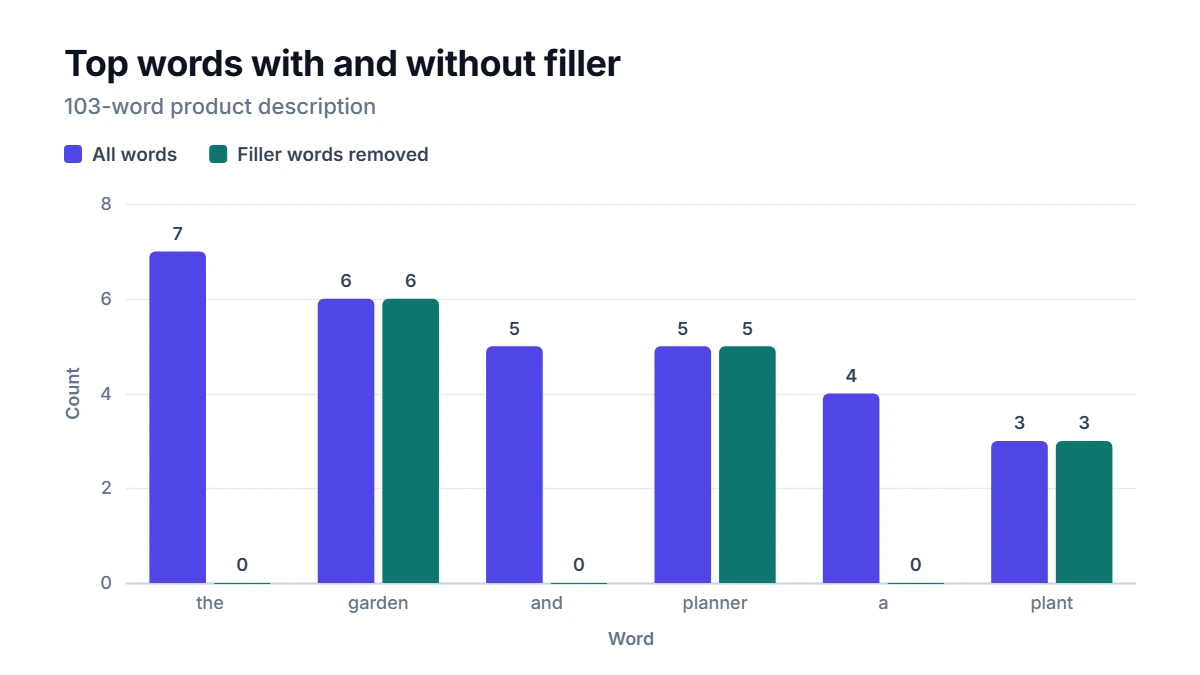
With every word counted, the text has 103 words and 67 different ones. The top of the list is:
- the: 7 (6.80%)
- garden: 6 (5.83%)
- and: 5 (4.85%)
- planner: 5 (4.85%)
- a: 4 (3.88%)
Three of the top five are filler words, exactly as Zipf's pattern predicts.
With filler words ignored, 57 words are counted and 43 are different. Now the list reads like a summary of the text:
- garden: 6 (10.53%)
- planner: 5 (8.77%)
- plant: 3 (5.26%)
- needs, plan and plants: 2 each (3.51%)
Reading the result
- The main topic is obvious. "Garden" and "planner" together make up almost a fifth of the meaningful words. A reader would not miss what the product is.
- "Garden" may be overused. Six uses in about 100 words is high. Some could become "it," "your plot" or be dropped entirely.
- Word forms are counted separately. "Plant" (3) and "plants" (2) are different entries, and so are "plan" and "planning." Together the "plant" family appears 5 times. Keep that in mind before deciding a word is rare.
- Variety. 67 different words out of 103 means about 65% of the words are distinct. Short texts naturally score high; long texts score lower because common words keep repeating.
How to use the counter
Paste your text into the Word Frequency Counter and the tables update as you type. Tick "Ignore common English filler words" to hide words such as "the," "and" and "is." Set a minimum word length to skip short words, and choose how many rows to show, from the top 10 to the top 500. One table lists single words with their count and share; the other lists two-word phrases. Copy as CSV puts both tables on your clipboard for a spreadsheet. Counting happens in your browser, so drafts and private documents stay on your device.
Practical uses
Editing your own writing
Run a draft through the counter with filler words hidden and look at the top 20. Any word that you did not intend to emphasize but appears near the top is a candidate for trimming or a synonym. Then turn the filter off and look for crutch words like "very," "really," "just" and "also." Many of these can be deleted outright.
Checking an article's focus
If an article is about retirement savings, "retirement" and "savings" should be near the top. If the top terms are about something else, the piece may have drifted. This is also a healthier way to think about search terms than counting keyword density: write naturally, then check that the main topic actually shows up.
Comparing two texts
Count two versions of a document, or your text and a competitor's, and compare the top terms. Words that appear in one list but not the other show differences in focus or vocabulary.
Studying language
Teachers and students use frequency lists to find the vocabulary a book relies on, and language learners use them to decide which words to study first.
Common mistakes
- Judging by raw counts across different lengths. Five uses in 100 words is a lot; five in 5,000 is barely noticeable. Compare shares, not counts.
- Forgetting the filter is English only. For other languages, switch it off or raise the minimum length so short function words drop out.
- Treating repetition as always bad. Technical terms, names and key concepts should repeat. Clarity matters more than variety.
- Ignoring phrases. "Credit" and "card" may look unremarkable separately, while "credit card" turns out to be the most repeated idea in the text.
FAQ
What counts as a "word"?
A run of letters or digits, with contractions such as "don't" kept together. Standalone numbers like 2026 are not counted as words in the frequency table, and punctuation is ignored except that it ends a two-word phrase.
How long should a text be for frequency analysis?
Any length works, but patterns become clearer with a few hundred words or more. In very short texts, almost every word appears only once, so the list mostly confirms which few words repeat.
Why might a phrase I use often not appear in the phrase table?
A phrase is two counted words sitting next to each other. If one of them is a filler word, a number or shorter than the minimum length, or if punctuation separates them, the pair is not counted. Turn the filter off to see phrases that include filler words.
Is there an ideal share for my main keyword?
No fixed number is reliable. A topic word naturally takes a noticeable share because you are writing about it. If a sentence sounds forced when read aloud, the word is probably overused, whatever its percentage.
Related tools

Related guides

How to Count Words and Estimate Reading Time
Why do word counters disagree, and how long will your text take to read or say aloud? Learn what counts as a word, how reading time is worked out and how to plan a talk.

How Morse Code Works: Letters, Timing and Speed
Morse code turns every letter into a short pattern of beeps, and its design is smarter than it looks. Learn why E is a single dot, how timing defines speed, how to decode a message by hand and how people actually learn to read it by ear.

How to Write Numbers in Words
From forty-two to one million two hundred fifty thousand: learn the groups-of-three method for spelling out any number, the US and British "and", the exact format for checks, and when to use words instead of digits.

What Is Lorem Ipsum and When Should You Use It?
Lorem ipsum is scrambled Latin from a text by Cicero. Learn where it came from, why it works so well as placeholder text, how much of it each part of a layout needs, and when real words are the better choice.