How to Calculate a Discount and the Sale Price
Work out percent-off prices in your head, see why two discounts never simply add up, and find out what you really pay once sales tax is added.

A sign says 25% off, the checkout adds an extra 15% coupon and then tax goes on top. What do you actually pay? Discounts are simple percentages, but combining them is where most people guess wrong. This guide shows the basic method, a few mental shortcuts, how stacked discounts really work and where sales tax fits in.
The basic discount formula
There are two ways to get the same answer.
- Find the saving, then subtract. Saving = price × discount ÷ 100. Sale price = price − saving. For 25% off 80.00: 80 × 25 ÷ 100 = 20.00 saved, so you pay 60.00.
- Multiply by what is left. If 25% is taken off, 75% remains. Sale price = price × (1 − discount ÷ 100) = 80 × 0.75 = 60.00.
The second method is the one to remember, because it makes stacked discounts and tax easy.
Mental shortcuts
You rarely need a calculator for a single discount:
- 10% off: move the decimal point one place left and subtract. 10% of 46.00 is 4.60, so the price is 41.40.
- 20% off: double the 10% figure. 20% of 46.00 is 9.20.
- 25% off: divide by 4. A quarter of 80.00 is 20.00.
- 50% off: halve it.
- 15% off: 10% plus half of that again. On 60.00, that is 6.00 + 3.00 = 9.00.
- 30% off: three times 10%. On 90.00, that is 27.00 off, leaving 63.00.
Stacked discounts: why 25% + 15% is not 40%
When a second discount is applied, it is taken from the price that is already reduced, not from the original price. Take an 80.00 shirt with 25% off and an extra 15% coupon:
- After 25% off: 80.00 × 0.75 = 60.00.
- After the 15% coupon: 60.00 × 0.85 = 51.00.
- You save 80.00 − 51.00 = 29.00.
The combined discount is 29 ÷ 80 = 36.25%, not 40%. A single 40% discount would have left you at 48.00, so the stacked deal costs you 3.00 more than the headline numbers suggest.
The general rule: combined discount = 1 − (1 − d1) × (1 − d2). The gap between the simple sum and the real figure grows as the discounts get bigger.
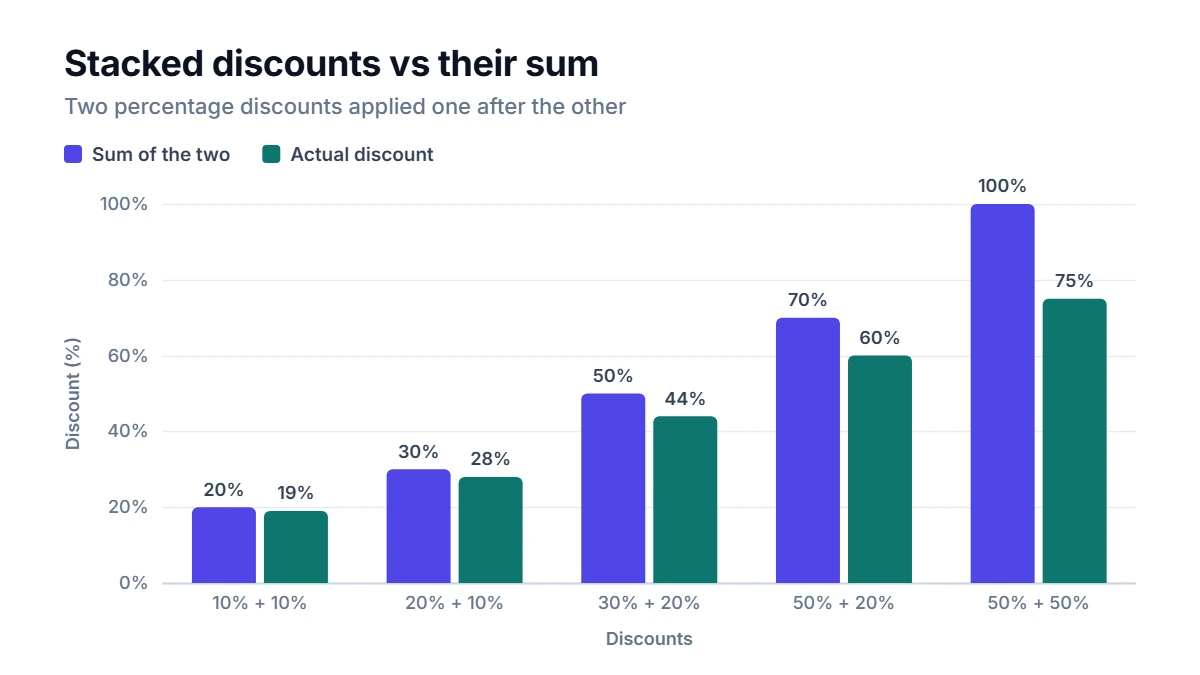
- 10% + 10% gives 19%, not 20%.
- 20% + 10% gives 28%, not 30%.
- 30% + 20% gives 44%, not 50%.
- 50% + 20% gives 60%, not 70%.
- 50% + 50% gives 75%, not 100%. The item is not free.
The order does not matter: 15% then 25% lands on exactly the same 51.00, because the multiplication works in any order.
A percentage off versus a fixed amount off
Not every deal is a percentage. A coupon might say "20.00 off orders over 100.00" instead. On a fixed coupon, the saving is the same whatever you buy, so the percentage it represents shrinks as the price grows: 20.00 off 100.00 is 20%, but 20.00 off 250.00 is only 8%. When a shop lets you choose between, say, 15% off and 20.00 off, work out the break-even price: 20.00 ÷ 0.15 ≈ 133.33. Below that price the fixed coupon saves more; above it the percentage wins.
Adding sales tax
In most places sales tax is charged on the price you actually pay, which is the discounted price. Continuing the shirt example with 8% tax:
- Tax = 51.00 × 0.08 = 4.08.
- Final price = 51.00 + 4.08 = 55.08.
A shortcut is to multiply everything at once: 80 × 0.75 × 0.85 × 1.08 = 55.08. Tax rules differ by state, city and country, and some items are exempt, so check the current rules where you shop.
How to use the Discount Calculator
Enter the original price and the discount percentage. If there is a second offer, such as a coupon on top of a sale, put it in the extra discount box. Add a sales tax rate if one applies. The Discount Calculator then shows the amount you save, the price before tax, the tax and the final price, and when you enter two discounts it also shows the real combined discount. That last figure is the quickest way to compare a stacked deal with a single, larger discount.
Common mistakes
- Adding percentages together. As shown above, two discounts always save less than their sum.
- Undoing a discount with the same percentage. If a price drops 20% from 100.00 to 80.00, adding 20% back gives 96.00, not 100.00. To get back to the original you would need to add 25%.
- Comparing percentages instead of prices. 30% off a 120.00 jacket (84.00) is still more expensive than 10% off an 85.00 one (76.50). Compare the final price, and for groceries compare the price per unit.
- Forgetting tax and shipping. A deal online can look better than one in a store until delivery fees are added.
- Trusting the "was" price. A discount is only a saving if the original price was real. Checking a few other sellers tells you more than the percentage on the tag.
FAQ
How do I work out the original price from a sale price?
Divide the sale price by what is left after the discount. If you paid 63.00 after 30% off, the original was 63.00 ÷ 0.70 = 90.00. Do not add 30% to 63.00; that gives 81.90, which is too low.
What percentage did I save if I know both prices?
Divide the saving by the original price and multiply by 100. Paying 51.00 for something that cost 80.00 means you saved 29.00, and 29 ÷ 80 × 100 = 36.25%.
Is "buy one, get one 50% off" the same as 25% off?
On two items of the same price, yes. Two items at 40.00 cost 40.00 + 20.00 = 60.00 instead of 80.00, which is 25% off the pair. If the cheaper item gets the discount and the prices differ, the overall saving is less than 25%.
Why does my receipt differ by a cent?
Shops round each line, and sometimes each discount, to the cent before adding tax. Rounding at different steps can shift the total by a cent or two.


