How to Calculate a Tip and Split the Bill
The exact math for any tip percentage, mental shortcuts that get you close in seconds, and what happens when a group splits the bill or rounds up each share.

The check arrives, the table goes quiet, and someone has to work out the tip. It is only a percentage, but doing it in your head after a meal, splitting it four ways and deciding whether to round up is where the awkward moments come from. This guide covers the exact math, a few mental shortcuts that get you close in seconds, and the small decisions that change the final number.
The basic formula
A tip is a percentage of the bill:
- Tip = bill × tip percentage ÷ 100
- Total = bill + tip
- Each share = total ÷ number of people
Money is counted in cents, so the tip is rounded to the nearest cent. That rounding is tiny, but it explains why a group's shares sometimes do not add up perfectly, as you will see below.
A worked example
Four people share a dinner bill of 64.80 and want to leave 20%.
- Tip: 64.80 × 20 ÷ 100 = 12.96
- Total: 64.80 + 12.96 = 77.76
- Each share: 77.76 ÷ 4 = 19.44
Here is how the same bill looks at the common tip levels:
- 10%: tip 6.48, total 71.28, each person 17.82
- 15%: tip 9.72, total 74.52, each person 18.63
- 18%: tip 11.66, total 76.46, each person 19.12
- 20%: tip 12.96, total 77.76, each person 19.44
- 25%: tip 16.20, total 81.00, each person 20.25
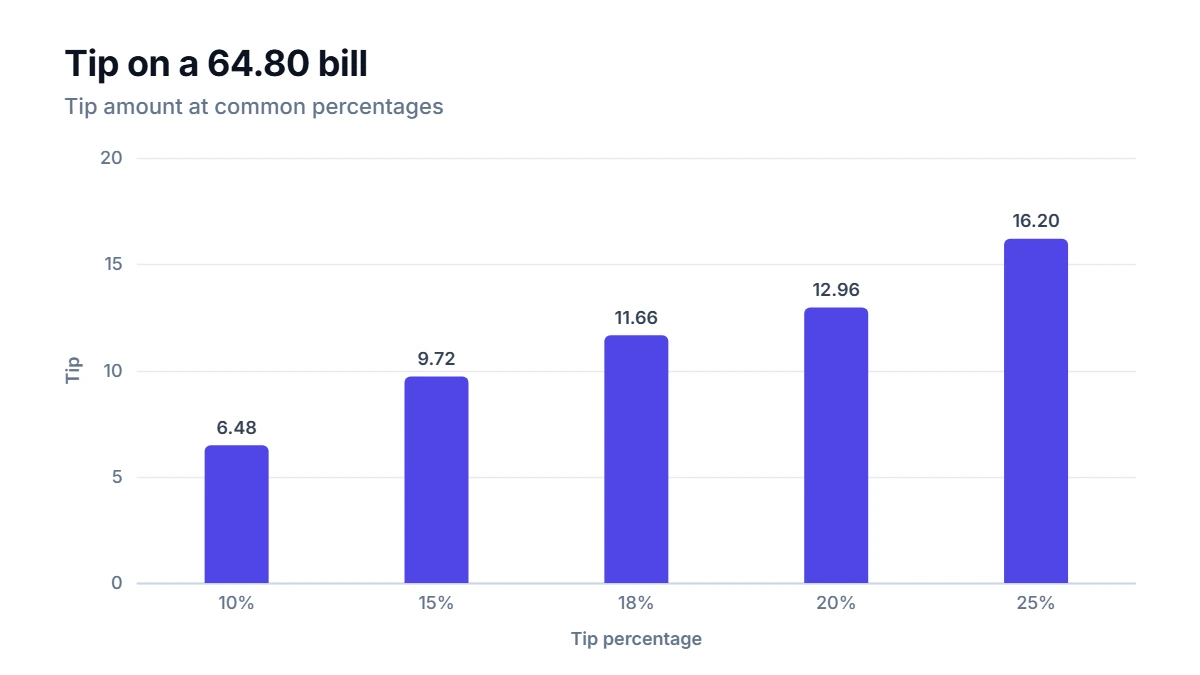
Notice that going from 15% to 20% on this bill costs the group only 3.24 in total, or 81 cents each. Seen per person, the difference between tip levels is often smaller than it feels.
Mental shortcuts
You do not always need a calculator. These tricks build every common percentage from 10%.
- 10%: move the decimal point one place to the left. 64.80 becomes 6.48.
- 20%: double the 10% figure. 6.48 × 2 = 12.96.
- 15%: take 10% and add half of it. 6.48 + 3.24 = 9.72.
- 18%: take 20% and subtract a tenth of it. 12.96 − 1.30 = 11.66.
- 25%: divide the bill by 4. 64.80 ÷ 4 = 16.20.
For a quick estimate, round the bill first. Treat 64.80 as 65, and 20% is 13. That is within a few cents of the exact answer and perfectly fine when you are leaving cash.
Splitting and rounding
Why shares can be a cent off
Try the 18% tip on the same bill. The total is 76.46, and 76.46 ÷ 4 is 19.115. Rounded to the cent, each share is 19.12, but four shares of 19.12 add up to 76.48, two cents more than the total. With other numbers the rounding goes the other way and the group is a cent or two short. It is normal, and the easiest fix is for one person to cover the difference.
Rounding up each share
Many groups prefer whole amounts, especially when paying in cash or sending each other money. Take the 20% example: each share of 19.44 is rounded up to 20.00, so the group pays 80.00 instead of 77.76. The extra 2.24 goes to the server, which makes the real tip 15.20, or about 23.46% of the bill.
Rounding up is generous on a small bill and expensive on a large one, so it is worth knowing what the effective percentage turns into.
Before tax or after tax?
There is no single rule. Some people tip on the subtotal before tax, others on the final amount. The difference is usually small, but it is easy to see with numbers. Say the food comes to 58.90 and tax brings the bill to 64.80. At 20%:
- On 58.90 before tax, the tip is 11.78.
- On 64.80 after tax, the tip is 12.96.
The gap is 1.18. Use whichever figure you prefer as the bill amount. If a service charge is already printed on the bill, read it carefully before adding a tip on top, so you do not tip twice.
How to use the Tip Calculator
Enter the bill amount, pick a tip with one of the quick buttons (10% to 25%) or type your own, and enter how many people are paying. Tick the round-up box if everyone wants a whole amount per person. Press Calculate to see the tip, the total and each person's share. When rounding is switched on, the breakdown shows the adjusted tip percentage so you know exactly how generous the group is being.
Because the calculator does not use a currency symbol, it works the same way in dollars, euros, pounds or any other currency.
Good to know
- Customs vary widely. Expected tip levels, and whether tipping is expected at all, differ between countries and between types of service. Check local customs when you travel.
- Coupons and discounts. Many people tip on the price before a discount, since the service was the same. Enter the original amount if that is your preference.
- Large groups. Some restaurants add an automatic gratuity for bigger parties. Look for it on the bill.
- Uneven orders. If people ordered very different amounts, an equal split may not feel fair. The Bill Split Calculator can share the bill and tip by what each person had.
The numbers here are simple arithmetic, not financial advice; what you leave is up to you.
FAQ
How do I work out a tip quickly without a phone?
Find 10% by moving the decimal point one place left, then build from it: double it for 20%, add half of it for 15%. Rounding the bill to a whole number first makes it even easier.
What percentage did I actually tip?
Divide the tip by the bill and multiply by 100. If you left 15.20 on a 64.80 bill, that is 15.20 ÷ 64.80 × 100, which is about 23.46%.
Should the tip include drinks and dessert?
Usually yes. The tip is normally based on everything the server brought to the table, so use the full bill amount rather than only the main courses.
Is it better to round the tip or the total?
Rounding the total, or each person's share, is often simpler because everyone pays a clean number. Rounding only the tip leaves the total with awkward cents, which is less convenient when splitting.

