How to Calculate Your Exact Age in Years, Months and Days
Subtracting birth years only gets you close. Learn the calendar counting method behind an exact age, how leap-day birthdays and month ends are handled, and how to read your age in total days and weeks.

Working out how old someone is sounds easy until you need the answer to the day. A school entry cutoff, an insurance form, a sports age group or a pension start date can all hinge on whether a birthday has already happened, and "about 38" is not good enough. This guide shows the counting method that gives an exact age, the two calendar quirks that trip people up, and how to read an age in total months, weeks and days.
Why subtracting years is not enough
Subtracting the birth year from the current year only tells you the age a person reaches at some point during this year. Whether they have reached it yet depends on the birthday. Someone born in March 1988 is 38 in November 2026, but someone born in December 1988 is still 37 on the same day.
Months add a second problem. They have 28, 29, 30 or 31 days, so "one month" is not a fixed number of days, and a year is 365 or 366 days. Any method that divides a day count by an average month or year length will be off now and then. An exact age has to be counted on the calendar.
The method, step by step
The reliable approach counts full calendar units forward from the date of birth, largest unit first.
- Count full years. Step forward from the birth date one year at a time, as long as you do not pass the target date. Each step lands on a birthday.
- Count full months. From the last birthday, step forward one month at a time, landing on the same day number each month, again without passing the target date.
- Count the remaining days. Whatever is left between the last monthly anniversary and the target date is the day count.
The day of birth is day zero. A baby is 0 days old on the day it is born and exactly 1 year old on its first birthday, not 1 year and 1 day.
A worked example
Take a date of birth of March 8, 1988, and find the age on November 4, 2026.
- From March 8, 1988 to March 8, 2026 is 38 full years. One more step would land on March 8, 2027, which is past the target.
- From March 8, 2026 the monthly anniversaries run April 8, May 8 and so on up to October 8. That is 7 full months. November 8 would be too far.
- From October 8 to November 4: October has 31 days, so there are 23 days to the end of October plus 4 days in November, which makes 27 days.
The exact age is 38 years, 7 months and 27 days.
The same age in other units
Totals are handy for milestone celebrations, baby and toddler charts that use weeks or months, or plain curiosity. For the same two dates:
- Total months: 38 × 12 + 7 = 463 months and 27 days.
- Total days: 14,120. This has to be counted rather than estimated: 38 years of 365 days is 13,870, the period includes nine February 29s, and March 8 to November 4, 2026 adds another 241 days.
- Total weeks: 14,120 ÷ 7 = 2,017 weeks with 1 day left over.
- Next birthday: March 8, 2027, when the person turns 39, which is 124 days away.
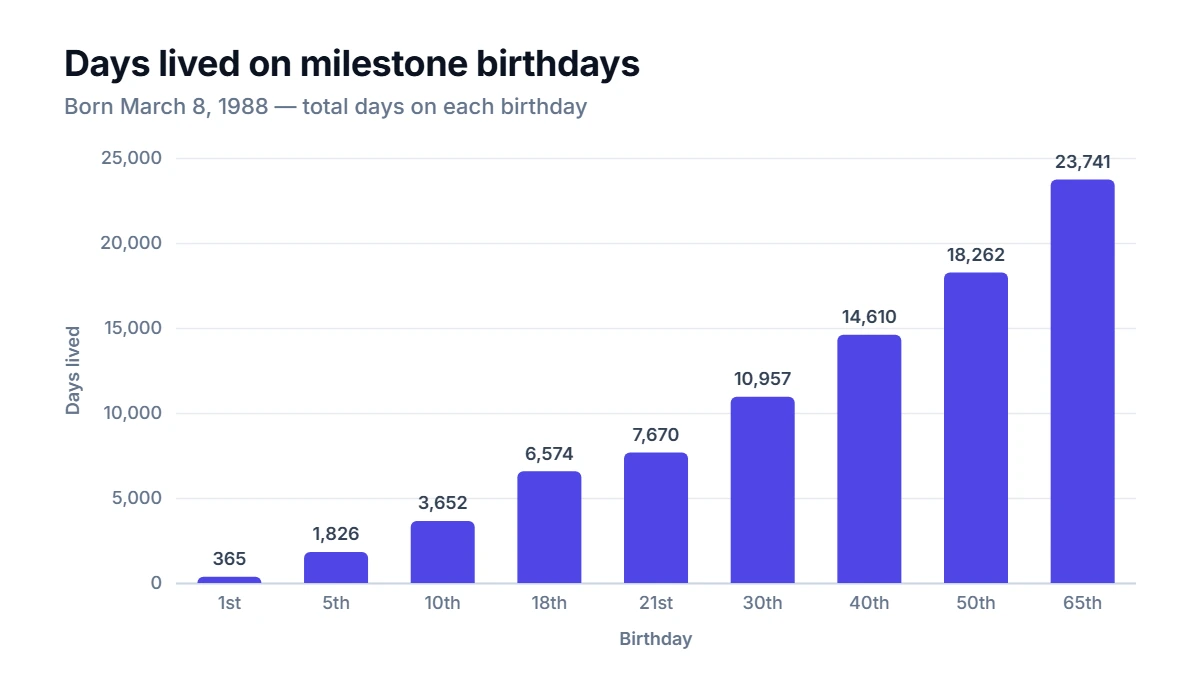
The number of days lived grows by 365 or 366 each year, so round-number milestones arrive at slightly different ages for different people. The chart shows the day count on several birthdays for the same date of birth.
Two calendar quirks worth knowing
Birthdays on February 29
Someone born on a leap day only gets their real birthday in leap years. For the other years, a rule is needed. The common convention, and the one the Age Calculator uses, is to treat February 28 as the birthday in non-leap years.
So a person born on February 29, 2004 is 22 years, 11 months and 29 days old on February 27, 2027, and turns 23 on February 28, 2027. In 2028, a leap year, the birthday is back on February 29. Official rules for leap-day birthdays are not the same everywhere, and some places use March 1 instead, so check the rule that applies if the date matters legally.
Month ends
The same issue shows up every month for anyone born on the 29th, 30th or 31st. When the birth day number does not exist in a month, the last day of that month counts as the anniversary. A baby born on January 31, 2026 is exactly 1 month old on February 28, 2026, and 1 month and 1 day old on March 1. Methods that ignore this rule can produce strange results, such as a first month that only completes in early March.
How to use the Age Calculator
Enter the date of birth in the first box. The second box, the "age at" date, starts with today's date from your device, so for a current age you only need to press Calculate. Change the second date to answer other questions:
- How old was I on my wedding day, or when I started my first job?
- How old will my child be on the school's cutoff date?
- How old will I be on the day my pension or a benefit can start?
The answer appears as years, months and days, followed by the totals in months, weeks and days, and a countdown to the next birthday with the age that will be reached on it. Because the calculation works in whole calendar days, the time of birth and your time zone do not change the result.
Common mistakes
- Dividing days by 365. 14,120 ÷ 365 is about 38.68, which suggests 38 years and roughly 8 months. The real answer is 38 years and 7 months. Leap days and uneven months throw the shortcut off. Dividing by 365.25 is closer but still not exact.
- Counting the birth day as day one. That makes every age one day too old.
- Assuming every month has 30 days. When you count the leftover days, use the real length of the month you cross.
- Mixing calendars. All dates are treated as modern Gregorian dates. For very old dates, records written in an older calendar may not line up with the result.
FAQ
At what age has someone lived 10,000 days?
At roughly 27 years and 4 months. For someone born on March 8, 1988, day 10,000 fell on July 25, 2015, when they were 27 years, 4 months and 17 days old. Enter your own birth date and watch the total days line to see when your milestone falls.
Why do two age tools sometimes disagree?
Almost always because of month-end and leap-day rules. Some tools treat every month as 30 days or move February 29 birthdays to March 1. The total number of days between two dates should always match; the split into years, months and days is where conventions differ.
How do I find the age gap between two people?
Compare the two birth dates directly instead of subtracting their current ages, which hides the months and days. The Age Difference Calculator does this in one step.
Do all cultures count age the same way?
No. Some traditional systems count a newborn as one year old and add a year at each new year rather than on the birthday, so a person can appear one or two years older. The Age Calculator uses the international method, where age starts at zero and goes up by one on each birthday.
