How to Calculate Area: Formulas for Common Shapes
From a rectangular room to a round pond or an L-shaped garden, every area comes down to a handful of formulas. Learn them, see why they work and follow a full worked example for an irregular plot.

Area is the amount of flat surface inside a shape. You need it for everyday jobs: how much paint, flooring, turf or fabric to buy, how big an apartment really is, or how much fertilizer a lawn takes. The good news is that nearly every real surface can be handled with a few formulas, and those formulas all grow out of one simple idea.
Start with the rectangle
Area is measured in squares. A rectangle that is 5 meters long and 4 meters wide can be covered by 5 rows of 4 one-meter squares, so its area is 5 × 4 = 20 square meters. That is the whole idea behind A = length × width, and the square, with A = s², is simply a rectangle with equal sides.
Because area counts squares, the unit is always squared. Sides in feet give square feet; sides in centimeters give square centimeters. Mixing units is the fastest way to get a wrong answer, so convert everything to one unit before you multiply.
Every other formula is a rectangle in disguise
- Parallelogram: slice off the slanted triangle on one end and move it to the other, and you get a rectangle. So
A = base × height, where the height is measured straight up from the base, not along the slanted side. - Triangle: two identical triangles fit together into a parallelogram, so a triangle is half of one:
A = ½ × base × height. - Trapezoid: two copies, one flipped, form a parallelogram whose base is the two parallel sides added together. Half of that gives
A = ½ × (a + b) × height. - Circle: cut a circle into many thin pizza slices and lay them alternately point up and point down. They form a shape close to a rectangle with a height of r and a length of half the circumference, πr. That is where
A = πr²comes from. - Ellipse: an oval is a circle stretched in one direction, so
A = πab, where a and b are half the longest and shortest widths.
When you know all three sides of a triangle but not its height, Heron's formula does the work: find half the perimeter s, then A = √(s(s − a)(s − b)(s − c)).
Worked example: an L-shaped garden with a pond
Picture a backyard plot that is 12 meters by 8 meters, except for a 5 by 4 meter corner taken up by a shed. In the middle of the lawn sits a round pond with a radius of 1.5 meters. How much lawn is there to seed?
- The whole rectangle: 12 × 8 = 96 square meters.
- Remove the shed corner: 5 × 4 = 20 square meters, so the plot is 96 − 20 = 76 square meters.
- Remove the pond: π × 1.5² ≈ 7.07 square meters.
- Lawn area: 76 − 7.07 ≈ 68.93 square meters.
This "add the big shape, subtract the holes" approach works for almost any room or plot. The other route is to split the shape into pieces and add them up. Both give the same answer; pick whichever needs fewer measurements.
Now suppose a triangular flower bed sits in one corner with sides of 7, 9 and 12 meters. Nobody measured its height, so use Heron's formula: s = (7 + 9 + 12) ÷ 2 = 14, and A = √(14 × 7 × 5 × 2) = √980 ≈ 31.30 square meters. A patio with parallel sides of 14 and 9 meters and 6 meters between them is a trapezoid: ½ × (14 + 9) × 6 = 69 square meters.
Area and perimeter are different things
Perimeter is the distance around a shape; area is the space inside. Two shapes with the same perimeter can enclose very different areas. Imagine 40 meters of fencing:
- A long, thin 18 by 2 meter pen encloses only 36 square meters.
- A 15 by 5 rectangle encloses 75.
- A 10 by 10 square encloses 100.
- A regular hexagon with 6.67-meter sides encloses about 115.47.
- A circle with a circumference of 40 encloses about 127.32.
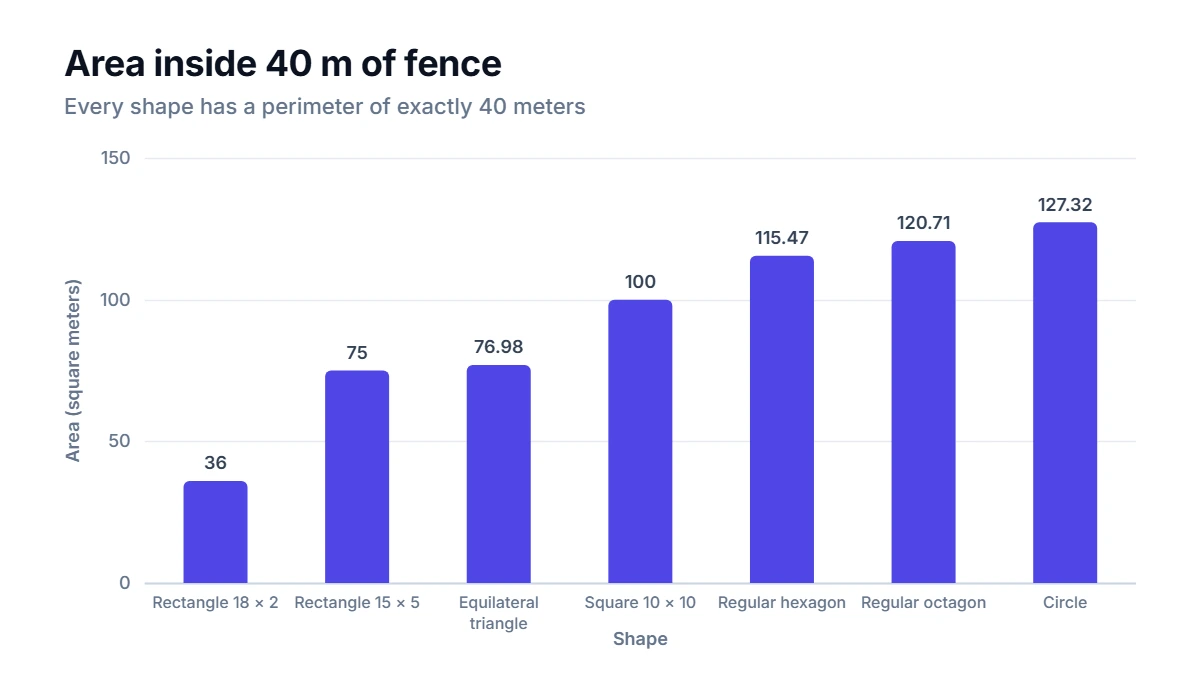
The rounder and more compact the shape, the more area you get for the same boundary. A circle is the best possible; a square beats any other rectangle. This is why the price per meter of fencing or edging tells you nothing about the price per square meter of the land inside.
How to use the calculator
Pick a shape in the Area Calculator, and only the fields that shape needs appear. Enter the measurements in one unit and press Calculate. The details panel shows the formula with your own numbers filled in, which makes it easy to check your work or copy the steps into homework or a quote. For an irregular room, run each piece separately and add or subtract the results as in the garden example.
Common mistakes
- Using the slanted side as the height. For triangles, parallelograms and trapezoids, the height is always at a right angle to the base. A slanted side is longer, so it inflates the area.
- Confusing radius and diameter. If you measure across a circle, halve the number before squaring it. Using the diameter makes the area four times too large.
- Converting area like length. One meter is 100 centimeters, but one square meter is 10,000 square centimeters. Convert the lengths first, or use the square of the length factor.
- Forgetting waste. For flooring, tiles or turf, buy extra for cuts and mistakes. The exact allowance depends on the material, so check the supplier's advice.
FAQ
How do I find the area of a room that is not a rectangle?
Sketch it on paper and split it into rectangles and triangles, or draw the surrounding rectangle and subtract the missing corners. Measure each piece, work out its area, then add or subtract. Write the numbers on the sketch so nothing gets counted twice.
What is the area of a circle with a diameter of 10?
The radius is 5, so the area is π × 5² ≈ 78.54 square units. A quick check: a circle covers a little more than three quarters of the square around it, and 0.785 × 100 = 78.5.
Why does the area grow so fast when I double the sides?
Area depends on two dimensions at once. Doubling both the length and the width multiplies the area by 2 × 2 = 4. A pizza with twice the diameter has four times the area, which is why large pizzas are often better value.
Can I measure area from a map or a floor plan?
Yes. Measure the drawing, then multiply each length by the scale before calculating. If you calculate the area on the drawing first, multiply it by the square of the scale. A 1:100 plan means one square centimeter on paper is 10,000 square centimeters, or one square meter, in real life.

