How to Calculate Percentages
Percent of a number, what percent one number is of another, and percentage change: three simple methods with worked examples, plus why two discounts never add up the way you expect.

A percentage is simply a fraction with 100 as the bottom number. "Per cent" means "per hundred", so 25% is 25 out of every 100, or 0.25 as a decimal. Once you see percentages that way, almost every percent question you meet in daily life, from a store discount to a test score to a pay raise, comes down to one of three small calculations.
The three percentage questions
Nearly every percentage problem is one of these:
- What is X% of Y? You know the percent and the whole, and you want the part. Example: a 15% tip on a 200 bill.
- X is what percent of Y? You know the part and the whole, and you want the percent. Example: you answered 45 of 180 questions.
- What is the percentage change from X to Y? You know an old and a new value, and you want the relative change. Example: rent went from 1,200 to 1,290.
The trick is to decide which question you are asking before you touch any numbers. Most mistakes come from using the right arithmetic on the wrong question.
The method, step by step
Finding a percent of a number
Turn the percent into a decimal by dividing by 100, then multiply. 15% of 200 is 0.15 × 200 = 30. 8% of 1,250 is 0.08 × 1,250 = 100.
Percentages above 100 work the same way. 120% of 50 is 1.2 × 50 = 60, which is more than the whole, and that is fine: it just means "the whole plus another 20%".
Finding what percent one number is of another
Divide the part by the whole and multiply by 100. 45 out of 180 is 45 ÷ 180 = 0.25, so 25%. 18 out of 24 is 0.75, so 75%.
The whole is the number that comes after "of". If you swap the two numbers you get a completely different answer, so say the sentence out loud: "45 is what percent of 180?"
Finding a percentage change
Subtract the old value from the new value, divide by the old value, and multiply by 100:
change = (new − old) ÷ old × 100
From 80 to 100 is (100 − 80) ÷ 80 × 100 = 25% increase. From 100 to 80 is (80 − 100) ÷ 100 × 100 = 20% decrease. The same 20-unit gap gives two different percentages because the starting point is different.
A fully worked example: a sale with two discounts
A jacket costs 100. The store takes 20% off, and at the register you get another 10% off the sale price. Is that 30% off?
- First discount: 20% of 100 is 20, so the price drops to 80.
- Second discount: 10% of 80 is 8, so the price drops to 72.
- Total change from 100 to 72: (72 − 100) ÷ 100 × 100 = 28% decrease.
So two discounts of 20% and 10% add up to 28%, not 30%. The second discount is taken from a smaller number. A quick way to see this is to multiply the "what is left" factors: 0.80 × 0.90 = 0.72, which means you pay 72% of the original price.
Going backwards: finding the original number
Sometimes you know the result and the percent, but not the starting value. A shirt costs 64 after 20% off. What was the original price?
After a 20% discount you pay 80% of the original, so 64 is 80% of the price. Divide instead of multiplying: 64 ÷ 0.80 = 80. A common mistake is to add 20% of 64 back on (64 + 12.80 = 76.80), which gives the wrong answer because the 20% was taken from the original price, not from 64.
The same logic works for a price that includes a markup or a tax: divide by (1 + the rate) to remove it, and check current rules if you are working with a real tax rate.
Why losses are harder to recover than they look
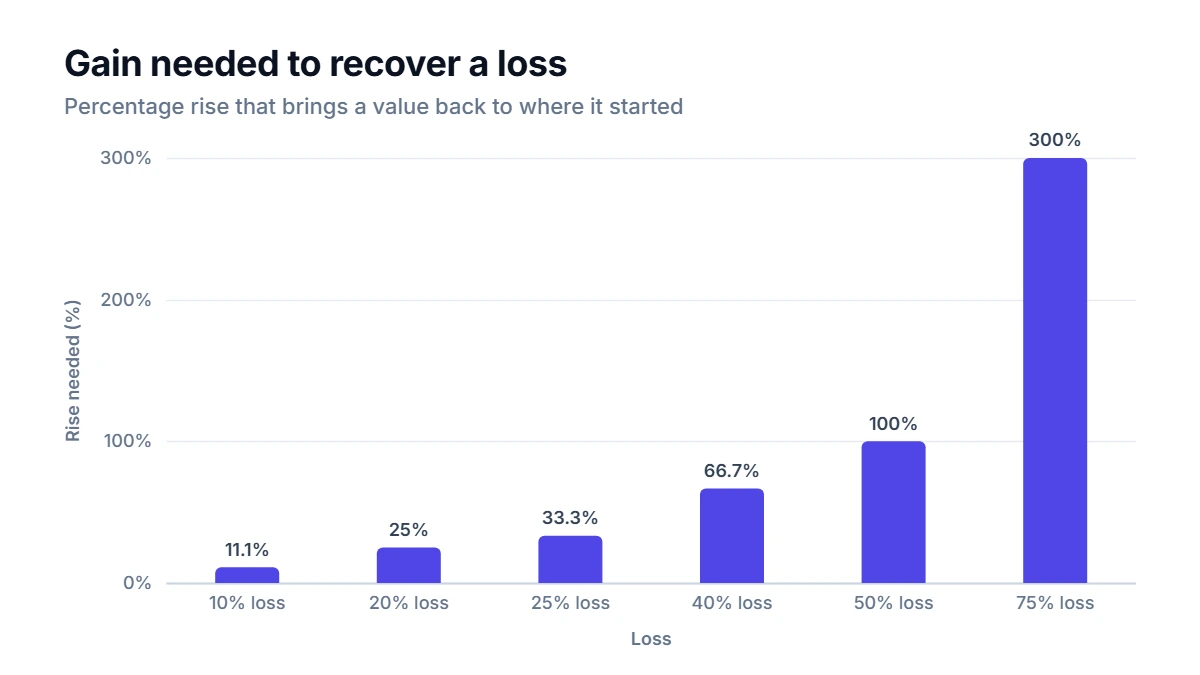
Percentage change is not symmetric. If a value falls by 50% and then rises by 50%, you do not get back to where you started: 100 drops to 50, and 50% of 50 is only 25, so you end at 75. To get from 50 back to 100 you need a 100% increase.
The bigger the drop, the bigger the rise needed to undo it. A 10% loss needs an 11.1% gain to recover, a 25% loss needs 33.3%, and a 75% loss needs a 300% gain.
This matters for anything that moves up and down over time, such as prices, savings balances or your weight on a scale. It is also why a "50% more" offer and a "50% off" offer are not opposites.
How to use the Percentage Calculator
The Percentage Calculator has a separate box for each of the three questions above, so you never have to rearrange a formula:
- Use What is X% of Y? for tips, discounts, commissions and shares of a total.
- Use X is what percent of Y? for test scores, completion rates and a budget category's share of spending.
- Use Percentage change from X to Y for price changes, growth and before-and-after comparisons.
For a chain of changes, like the double discount above, work one step at a time and feed each result into the next calculation. You can type numbers with or without thousands separators.
Common mistakes
- Using the wrong base. The percent in a change is always relative to the starting value. "Sales fell from 500 to 400" is a 20% decrease, but "sales would have to rise from 400 to 500" is a 25% increase.
- Adding percentages that apply in sequence. Successive changes multiply. Two 10% raises in a row are a 21% total raise (1.1 × 1.1 = 1.21), not 20%.
- Mixing up percent and percentage points. A rate that moves from 4% to 5% has risen by one percentage point, but by 25% in relative terms.
- Dividing by zero. A change from 0 cannot be expressed as a percentage, because there is nothing to compare against. Describe it in plain numbers instead.
- Rounding too early. If you round 33.333% to 33% in the middle of a calculation and then multiply it again, small errors grow. Keep the full number until the final step.
FAQ
How can I work out 10% or 5% in my head?
For 10%, move the decimal point one place to the left: 10% of 64 is 6.4. For 5%, halve that, which gives 3.2. You can build many other percents from these two: 15% is 10% plus 5%, and 20% is 10% doubled.
Is X% of Y the same as Y% of X?
Yes. Multiplication works in either order, so 8% of 50 equals 50% of 8, which is 4 in both cases. This can make some mental math much easier: 4% of 75 is the same as 75% of 4, which is 3.
How do I find the percentage difference between two numbers when neither is the "old" one?
If there is no natural starting point, for example comparing two stores' prices, many people divide the gap by the average of the two values. That is a different formula from percentage change, so say which one you used when you share the result.
Why does my answer have so many decimal places?
Some fractions never end as decimals. 1 out of 3 is 33.333...% forever. For everyday use, round the final answer to one or two decimal places; for money, round to the cent at the very end.
